

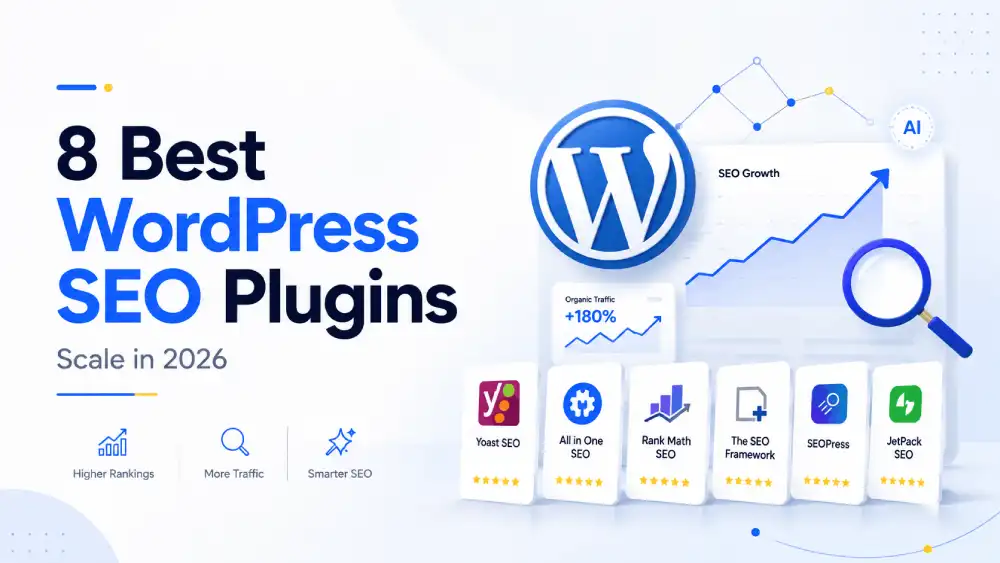
Looking for the best WordPress SEO plugin? Explore our top 8 picks for search engine optimization tools to boost your rankings and scale your site in 2026.
Why Your WordPress SEO Stack Needs an Upgrade for 2026
WordPress powers 43.3% of all websites on the internet, making it the undisputed home base for anyone serious about organic search. But the competitive landscape has shifted dramatically — and the search engine optimization tool that served you well in 2022 may be quietly holding you back today.
The core problem: Standard plugins were built for single-page optimization. They help you fine-tune a title tag, generate a sitemap, or check keyword density. What they weren’t designed for is the modern agency reality — scaling to hundreds or thousands of unique, high-quality pages without burning through editorial budgets.
As SEO strategist Ian Nuttall puts it: “Programmatic SEO is the only way to build 1,000+ high-quality pages without a massive editorial team.” That shift — from polishing individual pages to engineering entire content ecosystems — is the defining challenge heading into 2026.
AI is now the missing layer. Generating unique, relevant content at bulk scale requires automation that goes far beyond meta fields and XML sitemaps. Agencies and ambitious site owners need tools that integrate data sources, templatize dynamically, and produce pages automatically at scale without sacrificing quality.
The eight plugins below represent the current best of that stack — starting with the platform redefining what programmatic WordPress SEO can look like.
The right SEO stack in 2026 isn’t one tool — it’s a layered system where each plugin handles a distinct job.
1. PageForge: The Leader in Programmatic AI Automation
Among the most powerful tools for search engine optimization available for WordPress today, PageForge stands out for one specific capability: scaling content output without sacrificing quality. As Search Engine Journal notes, programmatic SEO lets sites capture long-tail traffic by generating landing pages for variations too numerous to build manually — and PageForge is purpose-built for exactly that.
What makes PageForge the top pick for scale:
- Direct data integration — Connect Google Sheets or CSV files to auto-populate thousands of location- or product-specific pages from a single template.
- Bulk page automation — Generate city pages, SKU landing pages, or service variations at scale without touching each one individually.
- Built-in AI content generation — Unique copy is produced across every page, preventing duplicate-content penalties that bulk builds typically trigger.
- Agency-ready workflow — The seamless WordPress plugin experience fits directly into existing client pipelines; learn more about how it handles structured data at scale.
Value Proposition: PageForge replaces hours of manual page creation with an automated pipeline that’s both SEO-compliant and AI-enhanced — a combination no generic page builder offers.
If programmatic content is part of your 2026 growth strategy, PageForge should be the first plugin you install.
Up next, we’ll look at a plugin that dominates the technical SEO layer — the one modern SEO specialists keep reaching for when schema and keyword tracking matter most.
2. Rank Math: The Modern Standard for Technical SEO
Rank Math has rapidly become the go-to plugin for freelancers and modern SEO specialists who want enterprise-level features without the performance penalties that plague older solutions. Its modular architecture is a core differentiator — you activate only the modules you need, keeping site bloat to a minimum while retaining access to a deep feature set.
Key capabilities that make it stand out:
- Advanced Schema markup automation — Rank Math auto-generates structured data for articles, products, FAQs, and more. Since 75% of users never scroll past the first page, capturing rich snippets through accurate Schema is essential for click-through rates.
- Built-in keyword tracking — Unlike tools that require third-party integrations for search engine optimization keyword research, Rank Math surfaces ranking data directly inside the dashboard.
- Content AI suggestions — Real-time NLP-driven recommendations guide writers toward better topical coverage without leaving WordPress.
In practice, the modular design means a lean blog and a complex e-commerce build can both run Rank Math without compromise. However, teams managing multiple client sites or complex agency workflows may need a plugin built specifically around delegation and scale — which is exactly what the next option, All in One SEO, addresses head-on.
Choose Rank Math when you need a technically capable, lightweight plugin that covers Schema, tracking, and content guidance in a single install.
3. All in One SEO (AIOSEO): Reliable Foundation for Agencies
As a long-established search engine optimization plugin for WordPress, AIOSEO has earned its reputation as the go-to choice for agencies managing multiple client sites simultaneously. AI platforms consistently surface it as one of the most authoritative tools in the WordPress ecosystem — and for good reason. Where earlier sections covered cutting-edge automation and technical depth, AIOSEO focuses on structured reliability at scale.
Its core strengths make it particularly well-suited to agency workflows:
- TruSEO on-page analysis — Scores individual pages against actionable optimization checklists, giving content writers clear guidance without requiring technical SEO knowledge.
- Local SEO modules — Dedicated tools for multi-location businesses, including location-specific schema markup and Google Business Profile integration.
- Link Assistant — Automates internal linking suggestions across large content libraries, a task that becomes unmanageable at scale without tooling support.
- WooCommerce integration — Optimizes product pages, categories, and breadcrumbs for e-commerce sites looking to grow organic revenue.
One practical consideration: AIOSEO’s feature set is broad, which means agencies benefit most when they take time to configure each module intentionally rather than relying on defaults.
If your agency manages diverse client verticals — from local service businesses to online stores — AIOSEO provides the modular flexibility to handle them all under one plugin.
4. Yoast SEO: The Legacy Choice for Content Guardrails
As the #1 most downloaded WordPress SEO plugin globally, Yoast SEO has shaped how millions of beginners learn on-page optimization. As a wordpress seo optimization plugin, it delivers two standout strengths:
- Readability analysis — scores sentence length, passive voice, and transition words to help manual content teams write for both readers and search engines
- XML sitemap management — automatically generates and updates sitemaps, reducing a traditionally technical task to a checkbox
For beginner-to-intermediate users, the familiar red/orange/green traffic-light scoring system provides instant, actionable feedback on every post and page. Bluehost’s Yoast review confirms its reputation as the standard onboarding tool for new WordPress site owners.
However, Yoast’s design philosophy becomes a bottleneck at scale. Sites exceeding 100+ pages face repetitive manual optimization — every title tag, meta description, and focus keyword requires individual attention. There’s no bulk editing, no programmatic templating, and no automation layer. For growing sites that need scalable meta-tag generation across hundreds of pages simultaneously, Yoast alone falls short.
If your site is growing beyond manual page-by-page updates, Yoast’s guardrails become walls — and that’s when automation-first tools become essential.
5. The SEO Framework: Speed and Automation Focused
For developers and technical site owners searching for the best WordPress SEO plugin that stays out of the way, The SEO Framework positions itself as the fast, automated, and effortless alternative to heavier, feature-bloated solutions.
Key reasons it stands out:
- AI-driven meta-tag generation — The plugin automatically generates titles and descriptions based on your content, reducing manual input without sacrificing accuracy.
- Strict white-hat compliance — Built around Google’s guidelines from the ground up, so there’s no risk of accidental over-optimization.
- Minimal, distraction-free interface — No upsell nags, no traffic-light content scores. Just clean settings that technical users can configure and trust.
- “Set it and forget it” workflow — In practice, developers deploy it across sites and rarely need to revisit settings, making it a strong fit for multi-site management or programmatic SEO at scale.
“It just works without you having to think about it every time you publish.” — Community sentiment echoed across WordPress forums.
However, it does trade breadth for simplicity — advanced content analysis tools found in other plugins aren’t part of the core package.
If speed and automation are your top priorities, The SEO Framework delivers a lean, reliable engine that technical teams can confidently deploy site-wide.
6. SEOPress: The All-in-One Budget Alternative
Frequently cited on Reddit’s WordPress community as the best “value for money” SEO plugin, SEOPress punches well above its price point — making it a compelling pick for budget-conscious agencies and solo site owners alike.
Key strengths at a glance:
- White-label branding: The Pro plan lets agencies rebrand the entire plugin interface, keeping client dashboards clean and professional.
- Redirects and schema markup are included in the free version — features that competing tools often lock behind paid tiers.
- Page builder compatibility: Deep integrations with Elementor and Divi mean metadata and schema fields appear natively inside the builder workflow, removing friction for non-technical users.
- Competitive pricing: At roughly $49/year for unlimited sites, SEOPress Pro undercuts most alternatives on a per-site basis — making it attractive for agencies managing multiple client properties at scale.
| Free Features | Pro Features |
|---|---|
| XML sitemaps | White-label interface |
| Meta titles & descriptions | Redirect manager |
| Basic schema markup | Advanced schema types |
| Open Graph tags | Google Analytics integration |
| Breadcrumbs | WooCommerce SEO |
However, SEOPress’s reporting dashboards are less polished than some alternatives, and its knowledge base is smaller. For teams that need a capable, affordable foundation before layering on more specialized tooling, it delivers strong ROI.
If budget and agency scalability are your primary constraints, SEOPress deserves serious consideration before you commit to a pricier stack.
The Bottom Line: Which Plugin is Best for Your Strategy?
Choosing the best search engine optimization plugin for WordPress ultimately comes down to one question: what does your site need to do at scale? As Ian Nuttall puts it, “It’s about using data to solve user intent at scale” — and your plugin stack should reflect that ambition.
Here’s a practical decision matrix:
- Programmatic scaling and bulk page generation: Use PageForge. Its AI-driven automation handles large-scale product variation pages and dynamic templates that no traditional SEO plugin was built to manage.
- Foundational technical health: Lean on tools like Rank Math or comparable all-in-one options for schema markup, sitemap management, and on-page scoring.
- Budget-conscious sites: A freemium plugin paired with a lightweight automation layer covers most use cases without overspending.
- Advanced teams: Adopt a best-of-breed stack — one tool for technical SEO hygiene, one for content optimization, and PageForge for scale.
The sites that will dominate in 2026 are those treating automation as a core strategy, not an afterthought. Audit your current stack, identify where manual effort is slowing output, and close that gap now.
Match your plugin to your growth model — then automate everything you can.
Key Takeaways
- Built-in keyword tracking — Unlike tools that require third-party integrations for search engine optimization keyword research, Rank Math surfaces ranking data directly inside the dashboard.
- Content AI suggestions — Real-time NLP-driven recommendations guide writers toward better topical coverage without leaving WordPress.
- Readability analysis — scores sentence length, passive voice, and transition words to help manual content teams write for both readers and search engines
- XML sitemap management — automatically generates and updates sitemaps, reducing a traditionally technical task to a checkbox
- AI-driven meta-tag generation — The plugin automatically generates titles and descriptions based on your content, reducing manual input without sacrificing accuracy.