


Programmatic SEO WordPress Plugin to Plan, Generate, Optimize, and Scale
PageForge is a WordPress-native programmatic SEO plugin for turning structured data into useful, editable, search-focused pages at scale. Plan a page pattern, connect CSV or Google Sheets data, reuse an Elementor, Gutenberg, or Divi layout, add page-specific AI content when it improves the result, and control metadata, schema, internal links, publication status, scheduling, and reporting from one workflow.
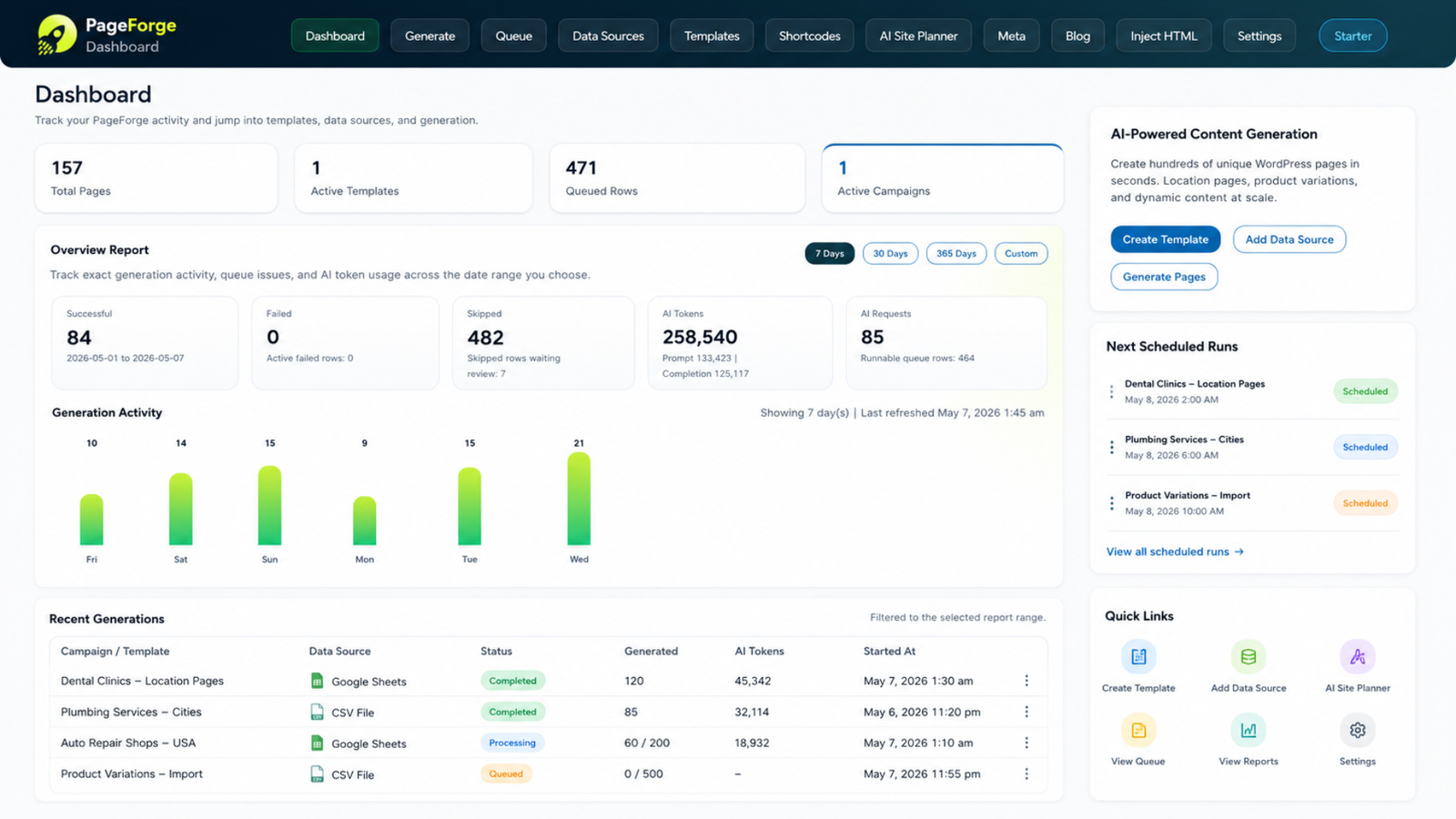
Use the builders, themes, and SEO workflows your team already understands









What is a programmatic SEO WordPress plugin?
What this plugin does
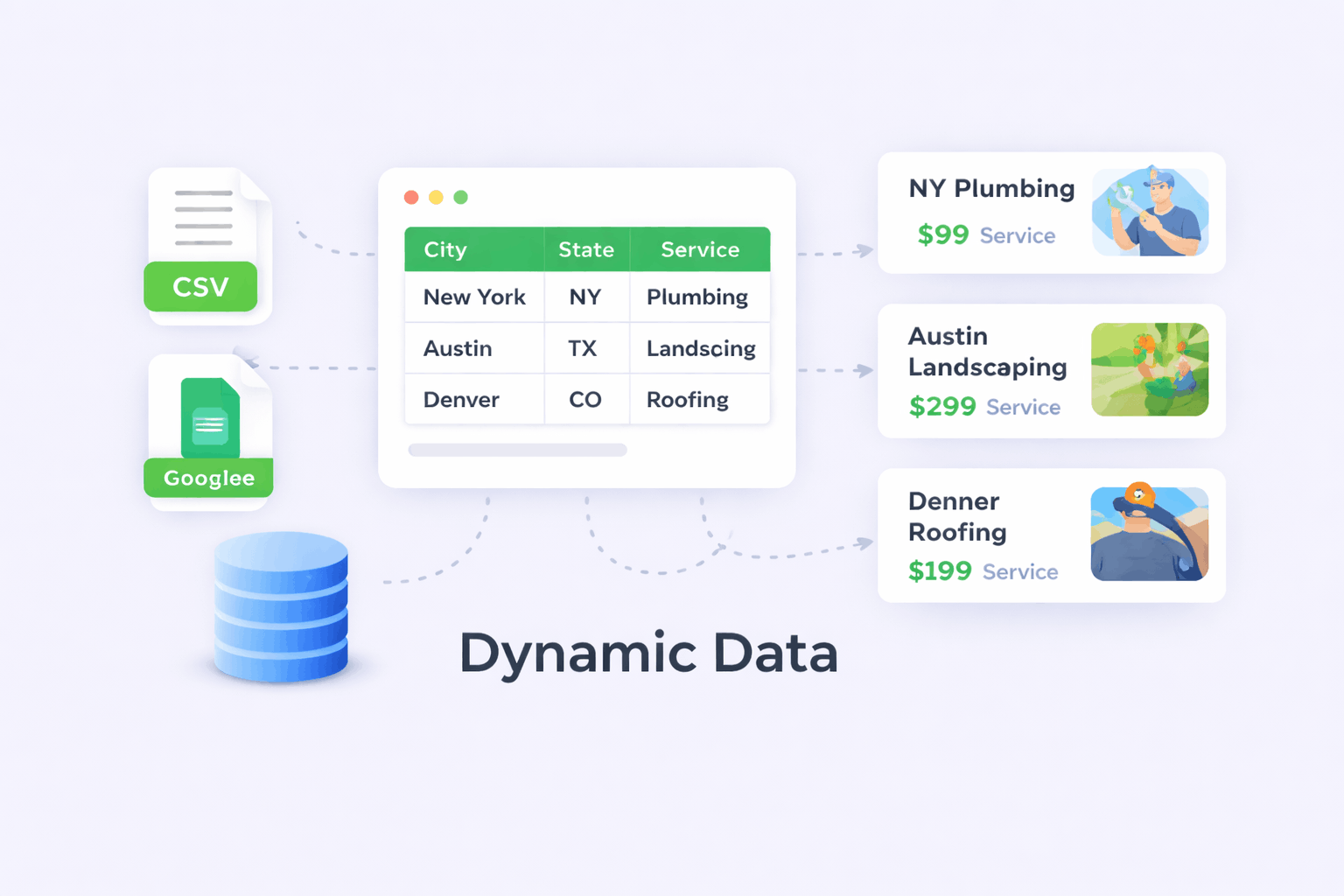
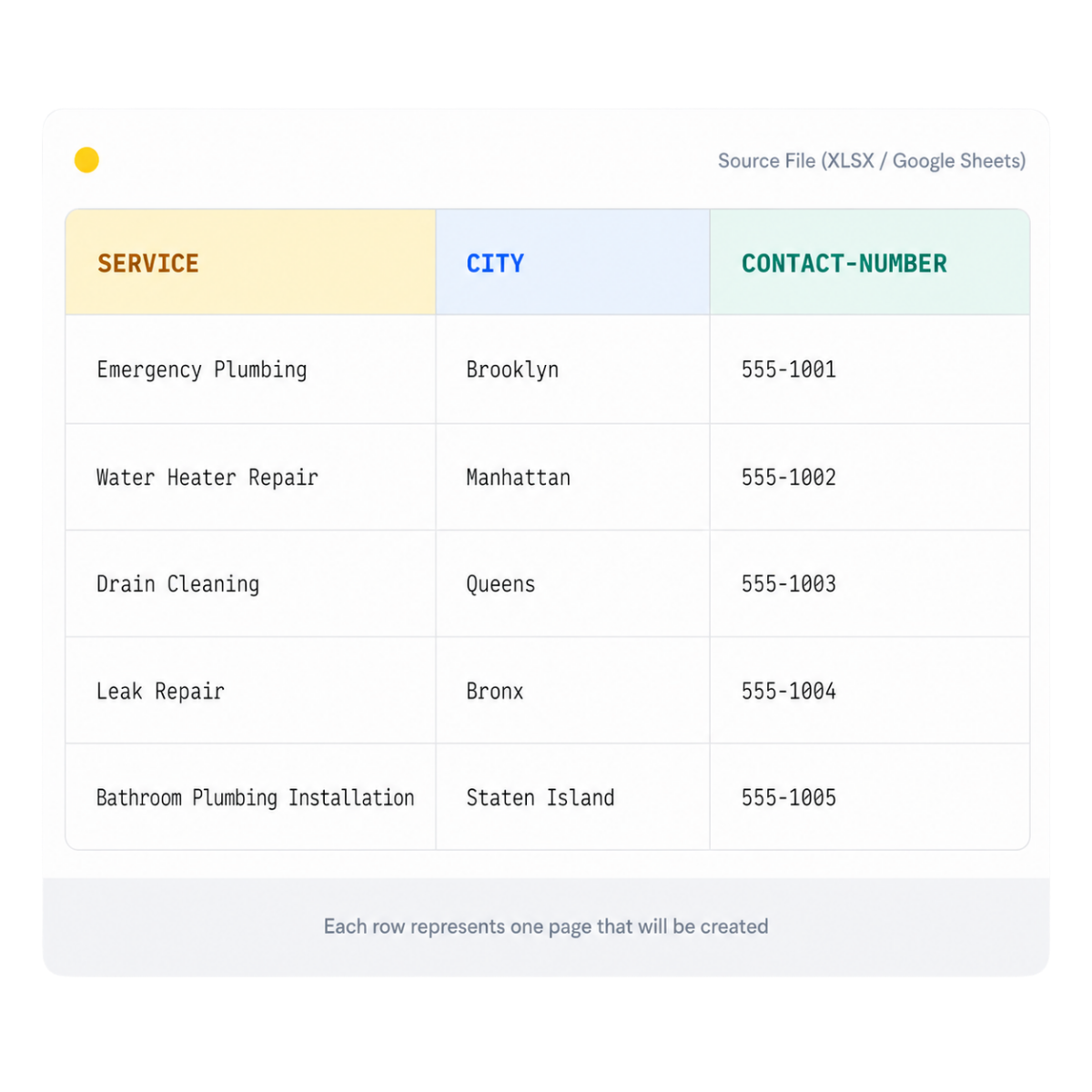
A programmatic SEO WordPress plugin helps you create a repeatable system for publishing many relevant pages without manually rebuilding the design, metadata, and content structure for every URL. You start with a defined search intent, a reusable WordPress template, and a structured dataset. Each row becomes one intended page, while each column supplies values such as the page title, service, location, industry, product attribute, benefit, FAQ, image, CTA, schema property, or internal-link destination.
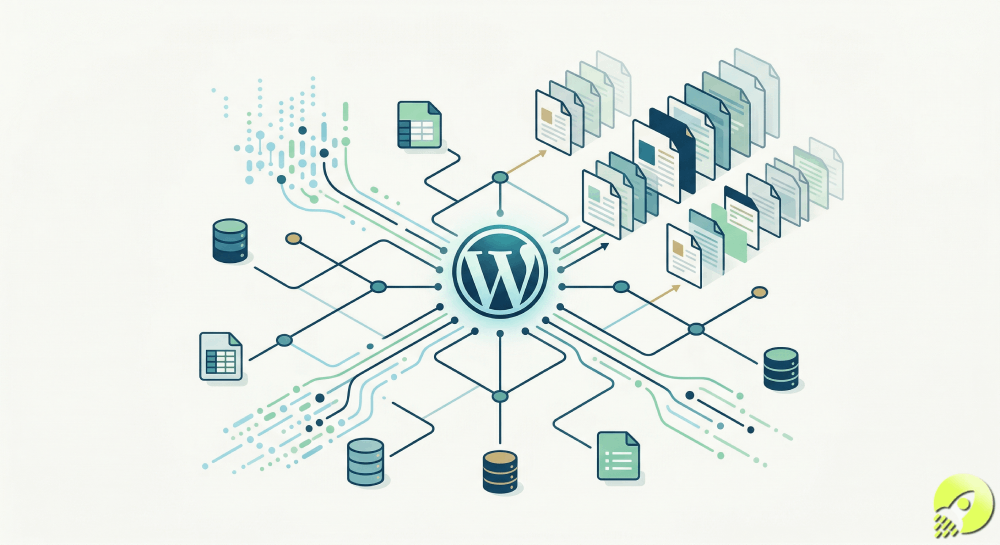
PageForge extends that model beyond a basic spreadsheet importer. It can place dynamic values into visible content and SEO fields, work with visual page-builder layouts, add optional AI-generated sections, create pages or other supported post types, apply controlled WordPress statuses, schedule publication, and help connect generated pages into a navigable content system. The result remains inside WordPress, where your team can edit, review, optimize, and publish it.
The objective is not to create the highest possible page count. The objective is to cover a well-researched set of searches with pages that are genuinely different, accurate, easy to navigate, and useful enough to deserve indexation. PageForge reduces repetitive production work so your team can spend more time on data quality, page value, conversion design, internal links, technical validation, and ongoing improvement.
Manual page production breaks when the search opportunity becomes a matrix
Traditional landing-page production is linear. A strategist researches a term, a writer prepares copy, a designer duplicates a layout, an SEO specialist adds a title and description, and a developer or editor checks links, schema, responsiveness, and publication settings. That process works for ten pages. It becomes difficult when the opportunity contains hundreds of combinations such as service × city, software × integration, category × audience, model × feature, or expert × location.
Teams usually respond in one of three ways. They publish only a fraction of the useful pages, which leaves valuable long-tail demand uncovered. They duplicate pages and change a few nouns, which creates thin content and a poor user experience. Or they use a generic importer that moves spreadsheet values into WordPress but leaves the team to solve template quality, metadata, schema, internal linking, AI prompts, publishing control, and reporting separately.
Programmatic SEO works when the repetitive parts are automated and the strategic parts remain deliberate. PageForge gives you a common production layer for the repeatable work. You still decide which pages should exist, what unique information each page needs, how the user should move through the site, and what evidence supports the claims. That division of labor is the difference between a scalable content system and a mass of low-value doorway pages.
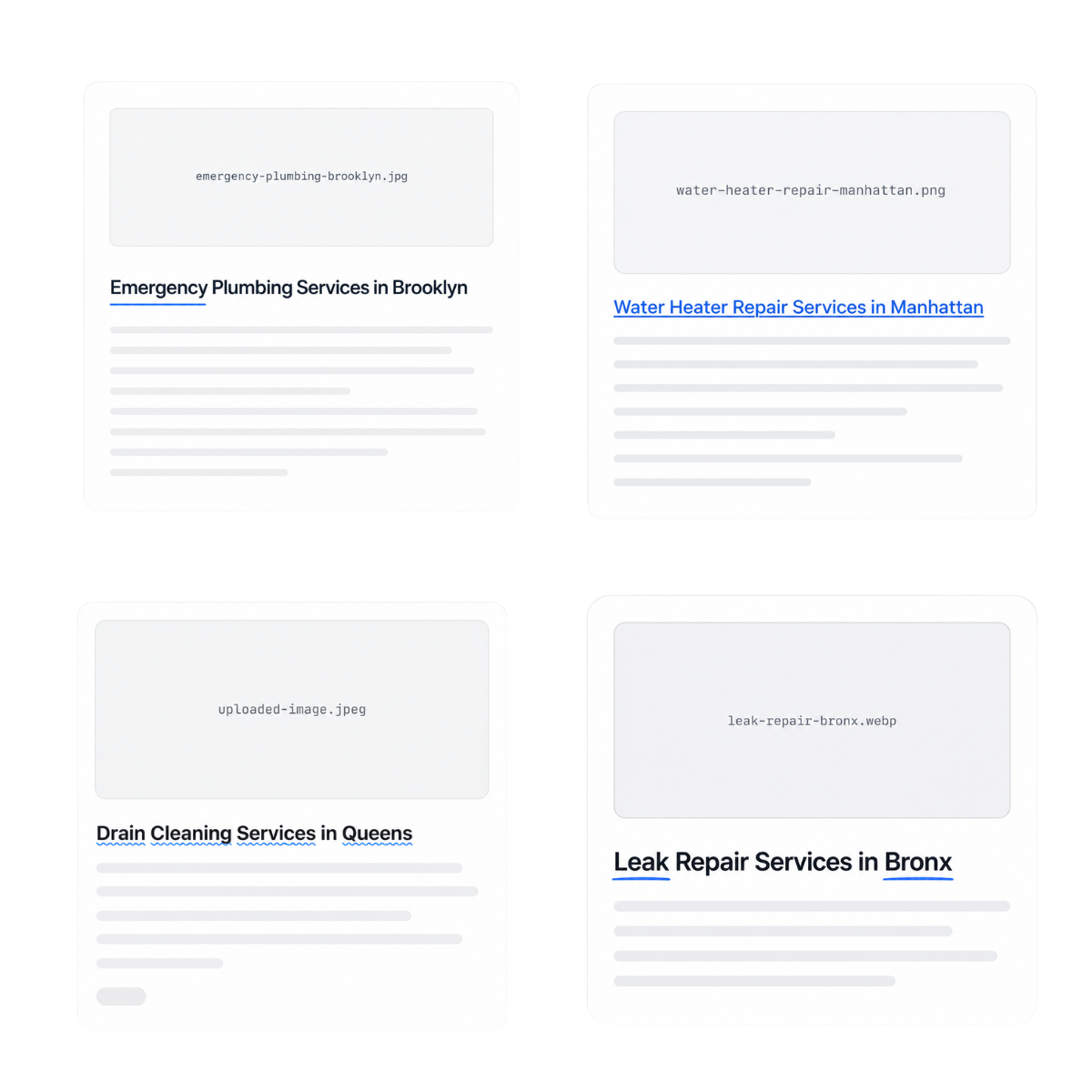
A nine-stage workflow from search pattern to measurable WordPress campaign
PageForge follows a practical campaign sequence: plan → data → template → AI → metadata → schema → links → publish → report. Each stage can be reviewed independently, which makes it easier to diagnose problems before they are repeated across a large batch.
1. Define the search pattern
Choose one clear page type and one clear intent. Examples include “accountant in {City},” “{Software} integration with {Platform},” or “{Service} for {Industry}.” Map one canonical URL pattern to that intent and avoid creating multiple pages that answer the same query.
2. Build the dataset
Create one row per intended page. Add factual fields that make the page distinct: location details, service availability, audience needs, product attributes, process steps, proof points, FAQs, related pages, and conversion destinations.
3. Design the WordPress template
Build a full Elementor, Gutenberg, Divi, or supported WordPress layout with the same care as a manually produced landing page. Define the hierarchy, responsive behavior, screenshots, trust elements, comparison sections, FAQs, and CTAs before scaling.
4. Insert dynamic placeholders
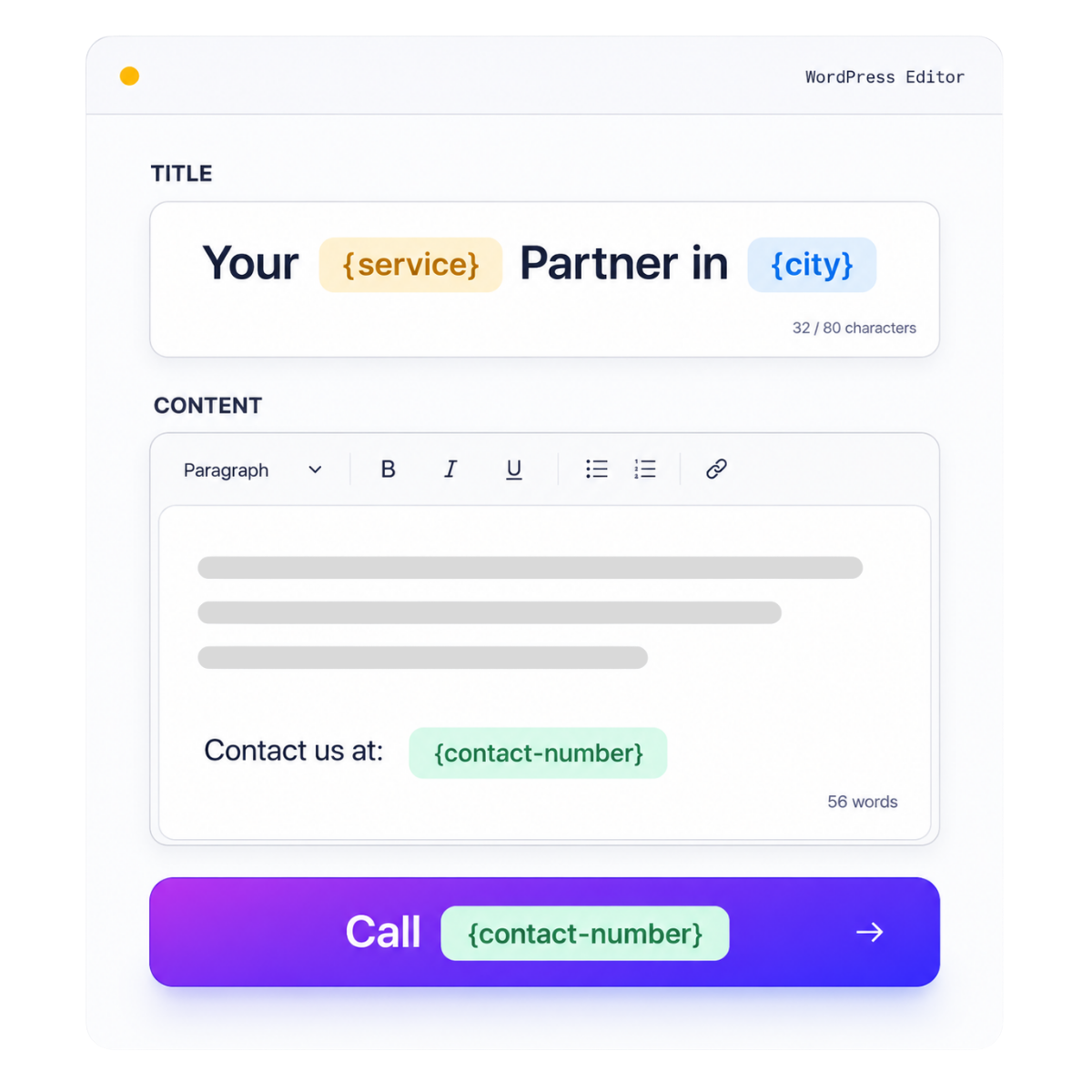
Place tokens where row-specific values should appear: titles, headings, paragraphs, slugs, metadata, schema fields, buttons, image URLs, labels, and internal links. Keep reusable explanatory copy separate from dynamic facts.
5. Add optional AI depth
Use OpenAI, Claude, Gemini, DeepSeek, or another supported workflow to draft page-specific sections when structured rules alone are not enough. Ground every prompt in the row data and brand constraints.
6. Configure SEO fields
Map unique title tags, descriptions, slugs, social text, canonical logic, and supported SEO-plugin fields. Prevent duplicate titles and slugs before generation.
7. Add schema and internal links
Generate structured data that reflects the visible page and connect each page to its parent hub, relevant siblings, related services, and useful guides. Do not leave generated URLs isolated.
8. Generate a draft batch
Create five to ten drafts first. Review every token, image, link, paragraph, CTA, metadata field, schema value, and responsive breakpoint. Fix the source data or template, not individual outputs, whenever the issue is systematic.
9. Publish and measure
Publish in controlled batches, monitor crawl and indexation, review Search Console queries, track conversions, improve underperforming sections, consolidate weak pages, and expand only when the pattern proves useful.
Design the system once, then improve the source instead of patching hundreds of pages
PageForge keeps the repeatable parts of the campaign connected. The dataset controls page-specific facts. The template controls hierarchy and design. AI prompts control optional narrative sections. SEO mappings control titles, slugs, descriptions, and schema. Publishing settings control when the pages become visible.
When a review uncovers a repeated problem, correct the relevant source layer and regenerate the draft batch. This is faster and more reliable than editing the same mistake page by page.
- One canonical page pattern for one search intent
- Stable source fields and unique record keys
- Native WordPress layouts and editable widgets
- Reusable QA before large-scale publication
Everything needed to turn a data model into a managed WordPress SEO campaign
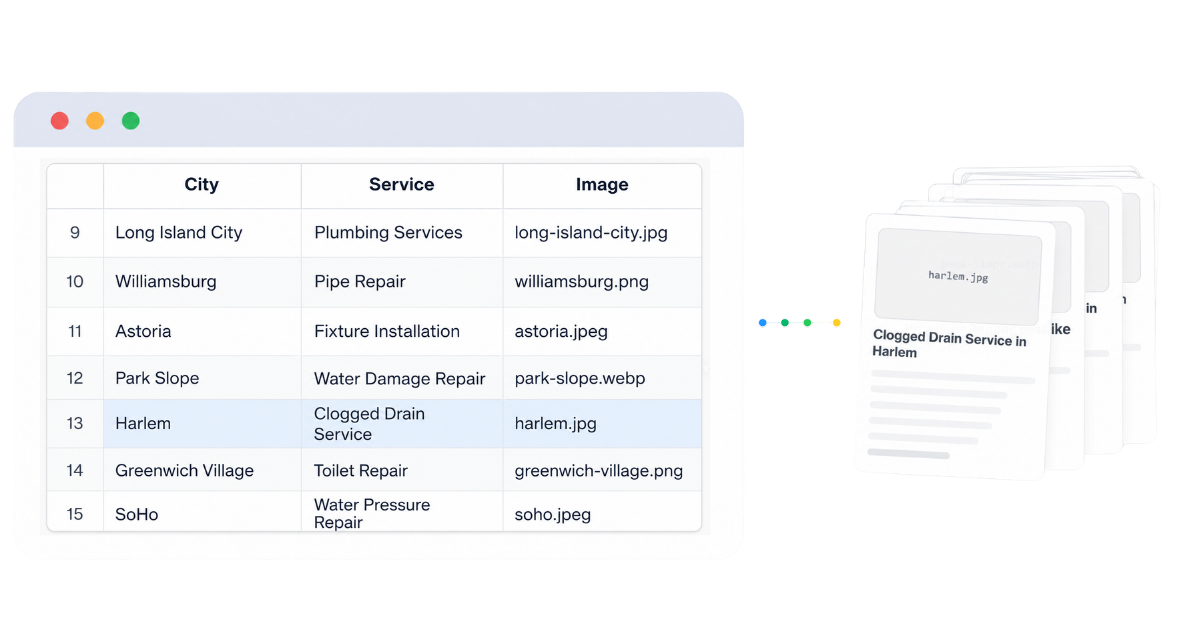
Structured campaign data
Dynamic placeholders

Humanized AI content

Search-ready page controls
Internal-link architecture

Controlled publishing
Your spreadsheet is a content model, not merely a keyword list
The quality of a programmatic campaign is limited by the quality of its data. PageForge can generate pages quickly, but speed does not compensate for empty rows, inconsistent naming, duplicated entities, unsupported claims, or missing context. Treat the spreadsheet as a content model rather than a keyword list.
A useful dataset contains both identity fields and value fields. Identity fields define what makes the page unique: city, neighborhood, service, product, integration, category, audience, professional, or location. Value fields explain why the page matters: availability, pricing context, turnaround, eligibility, features, benefits, local considerations, common questions, proof, related resources, and next actions.
CSV is ideal when you want a controlled snapshot that can be validated and versioned before launch. Google Sheets is useful for collaborative Pro workflows where strategists, writers, account managers, and clients maintain structured information together. In both cases, use stable column names, one unique record key, consistent formats, explicit empty-value rules, and a change log. The system should know whether a blank field means “not available,” “not applicable,” or “needs review.”
Before generation, audit the dataset for duplicates, accidental keyword combinations, unsupported locations, inconsistent capitalization, malformed URLs, missing source evidence, and pages with too little unique information. A smaller dataset with strong distinctions normally produces a stronger organic asset than a larger dataset built from superficial variations.
Build a complete page hierarchy before you scale it
A scalable page still needs a deliberate design. PageForge allows you to reuse WordPress layouts so the generated pages can retain your typography, spacing, brand colors, screenshots, card grids, forms, accordions, and conversion hierarchy. For Elementor campaigns, build the layout with native containers and widgets, set responsive values at every breakpoint, and keep dynamic values inside normal editable fields wherever possible.
Separate the template into three layers. The shared layer contains explanations that are true for every page in the campaign. The dynamic layer contains row-specific facts and labels. The conditional layer appears only when the dataset contains the information required to support it. This structure prevents awkward empty sections and reduces the temptation to fill missing data with generic AI copy.
Use a consistent page hierarchy: one H1, descriptive H2 sections, H3 cards, a direct answer near the top, useful screenshots, a clear workflow, related pages, detailed FAQs, and a final CTA. Define mobile stacking, image widths, button behavior, text alignment, and grid columns before you create the first batch. A template that is unstable on mobile will reproduce the same problem across every generated page.
PageForge is particularly valuable for agencies because one validated layout can become a repeatable campaign asset. The agency can preserve brand control, swap the dataset, adjust prompts and SEO rules, and launch a new service-area, franchise, integration, or directory campaign without rebuilding the production system from zero.
Use AI to add useful depth without giving up factual control
AI is an optional enrichment layer, not the foundation of the campaign. Structured data should establish the facts, entities, and page purpose. The template should establish the hierarchy and conversion path. AI can then help draft explanations, summaries, FAQs, benefits, introductions, or localized context that would be difficult to express through simple token replacement.
PageForge supports multiple AI-provider workflows, including OpenAI, Claude, Gemini, and DeepSeek, depending on the installed version and plan. Provider choice matters less than prompt design and review discipline. A strong prompt names the audience, page goal, supplied facts, forbidden claims, tone, required headings, length, and output format. It also tells the model not to invent availability, prices, certifications, addresses, customer results, or local details that are absent from the row.
Create prompts at the section level instead of asking for an entire page in one response. Section-level generation is easier to validate, easier to regenerate, and less likely to drift from the template. Combine the output with deterministic fields such as the title, location, service list, CTA, metadata, schema, and related links.
Before publishing, review AI output for factual accuracy, repetition, vague claims, duplicated phrases, incorrect geography, unsupported statistics, prohibited language, and inconsistent brand voice. The best use of AI in programmatic SEO is to increase useful variation while keeping the campaign grounded in structured evidence.
Ground every prompt in facts
Generate section by section
Require human approval
Control how every generated URL is titled, described, understood, and connected
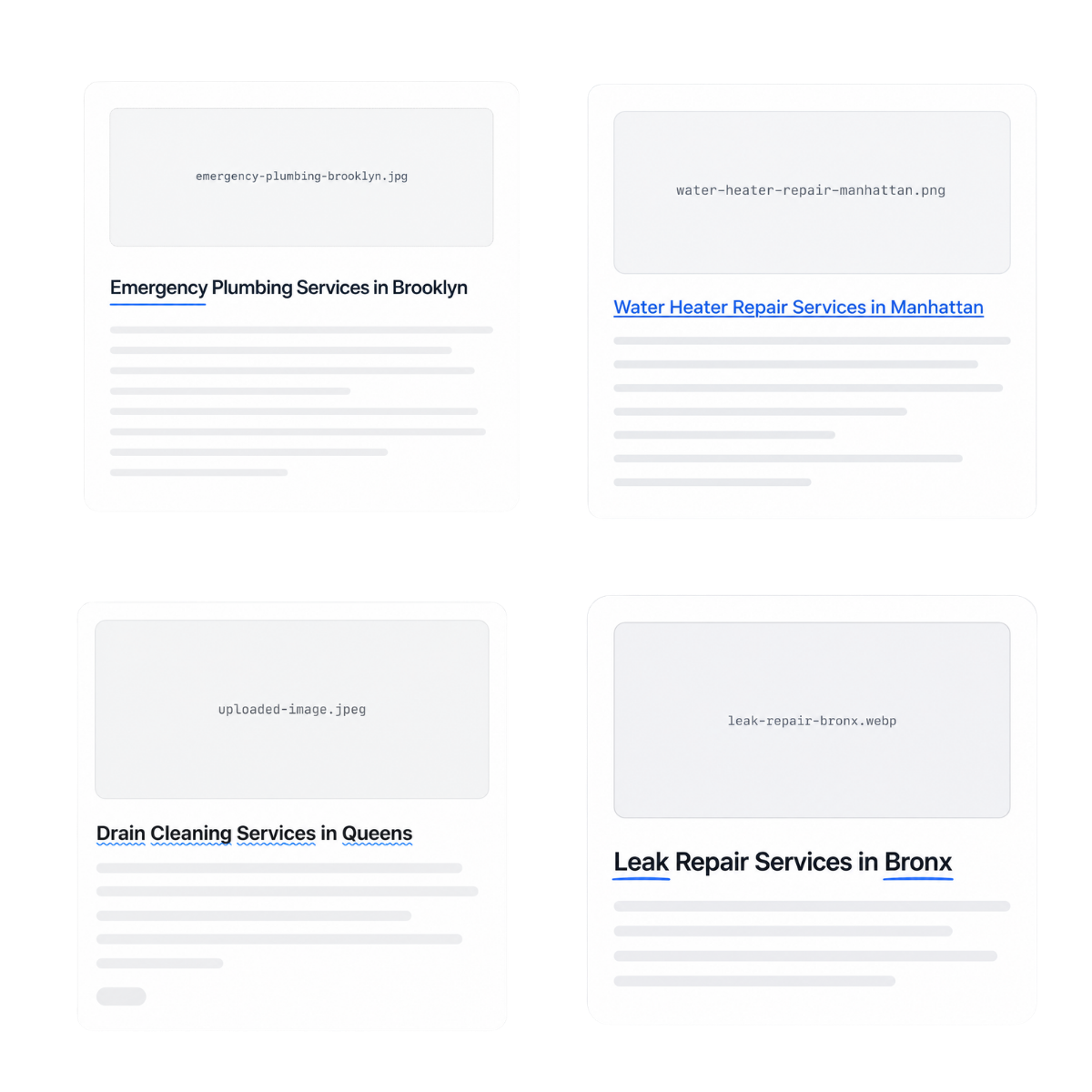
Every generated page needs more than body copy. PageForge can map structured values into the SEO fields that determine how the URL is understood, displayed, and connected. That includes the WordPress title, URL slug, meta title, meta description, social text, schema properties, image alt text, and supported fields from common SEO-plugin workflows.
Write metadata for the actual page rather than inserting the same formula everywhere. A title should identify the topic and the differentiating entity. A description should summarize the value visible on the page and set a realistic expectation. Slugs should be readable, stable, and unique. Canonicals should point to the intended URL, not a generic parent page, unless the generated page is intentionally a duplicate that should not compete.
Schema must reflect visible content. Use the correct type for the page and include only properties you can support. A software page may use SoftwareApplication. A local business page may use LocalBusiness when the page genuinely represents a location. A service page may describe a Service and its provider. FAQPage markup should contain the same questions and answers users can see. Schema is not a place to hide keywords or claims.
Internal links are equally important. Each generated page should link to a relevant hub, related siblings, supporting guides, and conversion pages. Parent pages should link back into the generated set. Use descriptive anchor text, avoid excessive exact-match repetition, and design the architecture so users can navigate the content without relying on a search engine.
Separate generation from publication and scale only after review
Large campaigns fail when publication is treated as a single irreversible action. PageForge supports controlled WordPress statuses including Draft, Pending Review, Private, and Publish, allowing the team to separate generation from launch. This is essential when a template contains dynamic values, AI sections, screenshots, links, metadata, and schema that must all be validated together.
Use a staged process. Generate a small draft batch. Review it on desktop, tablet, and mobile. Verify that every required field has been replaced, no placeholders remain, no duplicate slugs exist, and no conditional section is empty. Confirm that canonical tags, robots settings, schema, breadcrumbs, and internal links match the intended architecture. Then publish a controlled batch rather than the entire dataset.
Pro workflows can add scheduling, drip publication, reporting, Google Sheets connectivity, and broader campaign automation. Scheduling is useful when a site should release pages gradually, coordinate with other content, or give search engines and users time to discover a new section. It is not a substitute for quality control; a weak page published slowly is still weak.
After launch, track crawl status, indexation, impressions, queries, click-through rate, engagement, assisted conversions, and lead quality. Some pages will need stronger introductions, better internal links, more evidence, clearer CTAs, or consolidation with a related URL. Programmatic SEO is a managed content system, not a one-time export.
Where a programmatic SEO WordPress plugin creates the most leverage
Local service businesses
Franchises and multi-location brands

SEO and WordPress agencies

SaaS integration libraries

Directories and marketplaces
Ecommerce categories and attributes
From a 150-page service-location matrix to a reviewed local SEO system
Consider a regional home-services company that offers six services across twenty-five cities. The theoretical matrix contains 150 service-location combinations. Publishing 150 pages is not automatically the correct strategy. The team first researches whether each service is genuinely available in each city, whether people search for the combination, and whether the company can provide unique local information.
The dataset includes the city, service, service summary, coverage notes, travel or response considerations, relevant regulations, common property types, testimonials approved for that area, pricing context, emergency availability, nearby locations, and a booking URL. The template contains a direct answer, service explanation, local considerations, process, proof, FAQs, related services, nearby locations, and a contact CTA.
PageForge generates ten draft pages representing different services and cities. The team checks whether the local sections are genuinely distinct, whether the claims match operations, whether the same FAQ appears unnecessarily on every page, and whether each page links to the parent service hub and nearby locations. Weak combinations are removed from the dataset. The template is corrected once, then the remaining approved pages are generated.
After publication, Search Console reveals which service-location patterns receive impressions and which pages remain undiscovered. The company strengthens internal links, adds real local proof, improves pages with strong impressions but low click-through rates, and consolidates pages that overlap. The spreadsheet and template continue to act as the source system for future updates.
PageForge is more than a page duplicator or spreadsheet importer
Build and copy each page manually
Import row values into WordPress fields
Generate from a reusable WordPress campaign template
High, but repetitive
Depends on importer and theme fields
Visual builder layouts with dynamic tokens
Writer must create every variation
Usually limited to supplied fields
Structured facts plus optional section-level AI
Configured page by page
May require separate mapping
Dynamic titles, descriptions, slugs, and supported SEO fields
Added manually or by another plugin
Usually outside the import workflow
Campaign-level schema mapping aligned with visible content
Added manually
Often imported as raw URLs
Planned parent, sibling, hub, and related-page links
Manual scheduling
Depends on importer
Draft, pending, private, publish, scheduling, and controlled batches
Small number of premium pages
Straight data migration
Managed programmatic SEO campaigns in WordPress
Scale coverage without scaling thin or doorway content
Search engines do not reward a page because it was created manually, and they do not reject a page merely because software helped produce it. The important questions are whether the page satisfies a real search intent, contains information that is specific to the entity or audience, is accurate, is easy to navigate, and provides value beyond a swapped keyword.
Build safeguards into the campaign. Require a minimum number of unique fields before a row can generate a page. Exclude empty, unsupported, or low-demand combinations. Assign one primary URL to each search intent and use canonical tags consistently. Prevent duplicate titles and slugs. Add noindex rules for review states or records that are not ready. Keep source evidence for factual claims. Review AI content and images. Link pages into real site architecture.
Watch for doorway-page signals: pages that funnel users to the same destination without meaningful differences, pages that target every nearby city despite no service presence, pages with generic paragraphs and no local or product-specific facts, and pages generated solely to capture keyword variants. Remove or consolidate them. Page count should be the consequence of useful coverage, not the campaign objective.
One intent, one primary URL
Minimum unique-data threshold
Small-batch QA
Keep the pages, URLs, layouts, metadata, and editorial control inside WordPress
PageForge creates content within WordPress, so the generated pages participate in the same editorial, design, SEO, caching, analytics, and publishing ecosystem as the rest of the site. Your team can open a page in WordPress, edit the content, adjust a builder widget, change the featured image, update metadata, add a redirect, or revise the internal links without returning to a separate hosted landing-page platform.
This ownership model matters for long-term SEO. URLs can remain stable. Pages can inherit theme improvements. Site-wide navigation and breadcrumbs can connect them. SEO plugins can manage supported metadata and sitemaps. Analytics can measure them alongside other content. Editors can improve individual pages while the original dataset and template preserve the repeatable system.
Ownership also creates responsibility. Generated pages are not automatically maintained simply because they live in WordPress. Establish who updates the source data, how changes are synchronized, when pages are regenerated, how redirects are handled, and how removed entities are archived. Define that process before the campaign grows.
Use Free to prove the campaign. Upgrade when operations—not page quality—become the constraint.
PageForge Free is the practical starting point for validating the method. It supports CSV-driven generation with up to 100 pages per run, optional AI-provider workflows, dynamic fields, and controlled WordPress publication statuses. Use it to build a real template, create a small draft batch, and confirm that the campaign architecture works on your site.
PageForge Pro is designed for teams that need broader campaign operations, including Google Sheets workflows, scheduling, reporting, builder-layout cloning, and additional automation. Pro is most valuable after the page pattern and data model are proven. Buying a larger plan before validating the campaign does not fix weak intent research or a thin template.
Compare current plans based on the number of sites, campaign volume, collaboration needs, builder workflow, publishing cadence, and reporting requirements. Product limits and included features may change, so use the live pricing page as the source of truth.
PageForge Free
Validate a real campaign with CSV data, dynamic content, optional AI, editable WordPress output, and up to 100 pages per generation run.
- Build and test the page pattern
- Generate controlled draft batches
- Use supported publication statuses
- Keep pages editable in WordPress
PageForge Pro
Operate larger, repeatable campaigns with Google Sheets workflows, scheduling, reporting, builder cloning, and broader automation.
- Collaborative Google Sheets data
- Scheduled or drip publication
- Campaign reporting and operations
- Advanced layout and automation workflows
Who should use PageForge for programmatic SEO—and who should not
A strong fit
Agencies, in-house SEO teams, local and multi-location businesses, SaaS companies, directory operators, publishers, and WordPress developers with repeatable page patterns and structured information.
Best starting condition
You can define one clear search intent, identify the fields that make each page different, create a complete WordPress template, and review a small batch before scaling.
Not a shortcut for
Inventing demand, publishing thousands of empty combinations, replacing subject-matter expertise, manufacturing local presence, guaranteeing rankings, or avoiding editorial review.
Operational commitment
Someone must own the dataset, template, QA checklist, internal links, indexation monitoring, content updates, and consolidation decisions after launch.
Programmatic SEO WordPress plugin questions, answered clearly
-
What is a programmatic SEO WordPress plugin?
It turns structured data and a reusable WordPress template into many search-focused pages. Each row represents an intended URL, while columns supply titles, locations, services, content, metadata, schema, images, FAQs, and links. PageForge adds optional AI, page-builder layouts, publishing controls, scheduling, and reporting around that workflow.
-
How is PageForge different from a basic CSV importer?
A basic importer mainly moves row values into WordPress fields. PageForge is designed around the full campaign: dynamic placeholders, visual templates, page-specific AI, titles and slugs, metadata, schema, internal links, draft review, scheduling, and reporting. The objective is a useful WordPress landing-page system, not only a data transfer.
-
Can PageForge create unique content for every generated page?
Yes. Pages can combine row-specific facts, shared template copy, conditional sections, dynamic tokens, and optional AI-generated passages. Strong campaigns use concrete differences such as location details, services, attributes, benefits, eligibility, FAQs, and related pages. Generate a small draft batch first and review accuracy, uniqueness, links, metadata, and mobile layout.
-
Does PageForge work with Elementor?
Yes. PageForge can reuse Elementor layouts so generated pages retain native containers, headings, images, buttons, cards, and responsive settings. The pages remain editable in WordPress. The same campaign method can also work with Gutenberg, Divi, and other supported builders when the source template has a stable hierarchy and clearly mapped dynamic fields.
-
Can I use Google Sheets instead of uploading a CSV?
CSV is supported for controlled, versioned campaigns, while Google Sheets connectivity is available in the Pro workflow. Keep one row per intended page, clear column names, a unique record key, and validation rules for required fields. Google Sheets is especially useful when several team members maintain campaign data together.
-
How many pages can the free version generate?
PageForge Free currently supports up to 100 pages per generation run. That is enough to validate a real template, create review batches, and launch smaller campaigns. Pro is intended for broader operations such as Google Sheets, scheduling, reporting, builder cloning, and additional automation. Check the live pricing page for current plan details.
-
Can generated pages be saved as drafts?
Yes. Supported WordPress statuses include Draft, Pending Review, Private, and Publish. Draft-first is recommended for a new campaign. Review token replacement, titles, slugs, paragraphs, images, CTAs, metadata, schema, internal links, and responsive breakpoints before scaling the same pattern across a larger dataset.
-
Does PageForge guarantee rankings?
No SEO tool can responsibly guarantee rankings. PageForge helps create an organized, data-driven WordPress content system, but results depend on demand, relevance, originality, competition, authority, technical health, crawlability, internal links, backlinks, user satisfaction, and continuous improvement. Every generated page must still solve a real search problem.
-
Will programmatic pages be considered doorway pages?
They can be when they exist only to capture keyword variations and provide little standalone value. Avoid empty combinations and superficial noun swaps. Each page should serve a distinct audience or entity, contain verified page-specific facts, answer the query directly, connect to the site architecture, and offer a useful next action.
-
Can PageForge control SEO titles, meta descriptions, slugs, and schema?
Yes. Campaign fields can be mapped into page titles, URL slugs, meta titles, descriptions, schema properties, image alt text, and body content. PageForge can work alongside supported WordPress SEO-plugin workflows. Prevent duplicate titles and slugs, keep canonicals intentional, and ensure every schema property matches visible page content.
-
Which AI providers can be used with PageForge?
PageForge supports multiple provider workflows, including OpenAI, Claude, Gemini, and DeepSeek, depending on the installed version and plan. AI is optional. When used, prompts should be grounded in row-level facts, constrained by brand rules, prohibited from inventing claims, and reviewed before publication.
-
What is the safest way to launch a large campaign?
Research the intent, define one primary URL pattern, build the template, prepare structured data, and generate five to ten drafts. Review content, facts, mobile layout, metadata, schema, internal links, crawl directives, and conversion paths. Fix the source system, publish in controlled batches, monitor Search Console, and expand only after the pattern demonstrates value.
Build the strategy, dataset, template, and measurement plan before scaling
Programmatic SEO for WordPress: complete guide
Learn how to research, model, build, review, and improve a WordPress programmatic SEO campaign.
Google Sheets to WordPress bulk generation
Explore the collaborative spreadsheet workflow for maintaining dynamic WordPress page data.
WordPress bulk page generator
See how PageForge turns structured records into editable WordPress pages, posts, and campaign assets.
Programmatic SEO keyword generator
Create and organize repeatable keyword patterns before preparing the campaign dataset.
Programmatic SEO ROI calculator
Model page volume, expected demand, conversion assumptions, and delivery costs before committing to a large campaign.
Watch the PageForge tutorial
Follow the product workflow from campaign setup to generated WordPress pages.
Turn structured data into WordPress pages your team can actually own and improve
Start with one valuable page pattern, a clean dataset, a complete responsive template, and five to ten drafts. PageForge handles the repetitive production layer while your team controls intent, facts, design, quality, internal links, publication, and optimization.
Install the free plugin to validate the workflow, or compare PageForge plans when you need Google Sheets, scheduling, reporting, and broader campaign operations.