


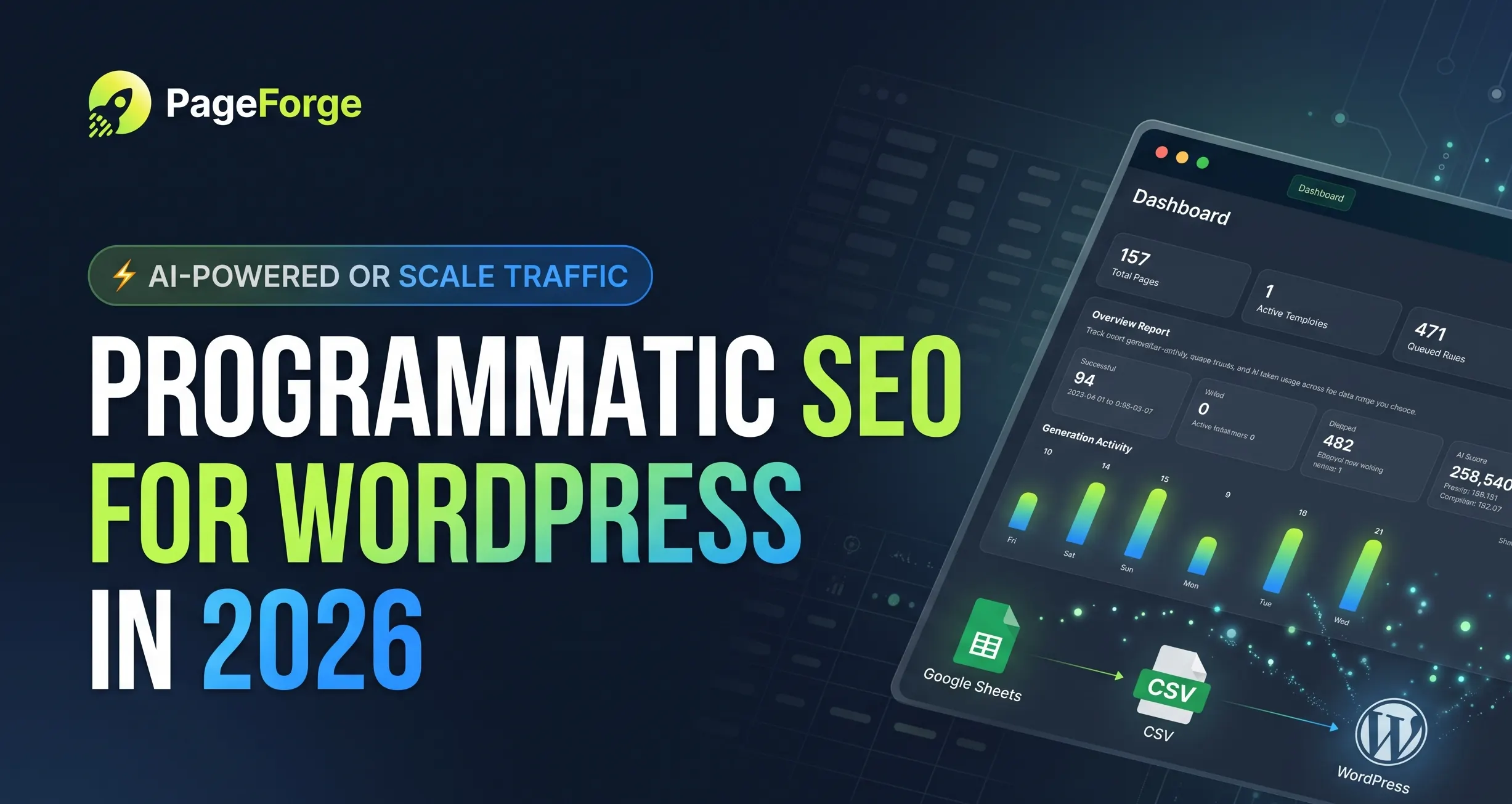
The landscape of search engine optimization has fundamentally changed. We are officially in the era of the “Industrial Revolution of Search.” If your digital marketing strategy still relies on manually writing every single page, you are going to fall behind.
Ranking for thousands of long-tail keywords in 2026 is mathematically impossible through manual content creation alone. The businesses that refuse to accept this are hemorrhaging market share to competitors who have already automated their way to the top. The solution? Programmatic SEO (pSEO).
In this comprehensive 5000-word guide, we will explore why programmatic SEO is non-negotiable for growth in 2026, how it works within WordPress, the best plugins to use (including the clear winner, PageForge), and how you can implement a scalable strategy to rank for hundreds of keywords rapidly.
Part 1: The Industrial Revolution of Search and Why You Need Programmatic SEO
The Math Problem of Manual SEO
Let’s look at the numbers. A skilled, well-resourced content team might publish 20 to 40 high-quality articles a month. That’s a significant investment in human capital, editing, and technical uploading.
However, search demand doesn’t care about your team’s capacity. Users are searching for highly specific, long-tail variations:
- “Emergency plumber in Austin, Texas”
- “Emergency plumber in Dallas, Texas”
- “Best CRM software for real estate agents”
- “Best CRM software for roofing contractors”
To capture this intent, you need a page for every variation. If you operate in 50 cities and offer 10 services, you need 500 pages. If you are comparing your SaaS product against 20 competitors, you need 20 comparison pages.
Building 500 pages manually takes months and tens of thousands of dollars. By the time you finish, the market has moved, or a competitor using programmatic tools has already captured the search real estate. This is why programmatic SEO is the only way to scale in 2026.
What is Programmatic SEO?
Programmatic SEO (pSEO) is a structured, data-driven approach to creating search-focused pages at scale. Instead of building pages one by one, you use:
- A Structured Dataset: (Usually a CSV, Google Sheet, or database) containing variables like cities, services, prices, or product features.
- A Reusable Template: A master page design with dynamic placeholders (tokens) like
{City},{Service}, or{Price}. - A Generation Engine: A tool that merges the data with the template to publish hundreds or thousands of unique, indexable pages instantly.
Programmatic SEO vs. Traditional SEO Plugins
It’s crucial to understand the difference between traditional SEO tools and programmatic generation.
As discussed in Programmatic SEO Tools vs Traditional SEO Plugins, traditional plugins like Yoast, Rank Math, or All in One SEO (AIOSEO) are designed to optimize pages that already exist. They give you a checklist to improve keyword density, manage sitemaps, and structure metadata on a page-by-page basis.
Programmatic SEO tools, on the other hand, are designed for scalable SEO production. They create the repeatable URL families from structured data.
- Traditional Plugin (e.g., Yoast): “Let’s make sure this one Austin Plumbing page has the right meta description.”
- Programmatic Tool (e.g., PageForge): “Let’s generate 50 perfectly structured plumbing pages for every city in Texas, each with localized meta descriptions, in 5 seconds.”
You often need both. The strongest architecture for WordPress in 2026 is pairing a bulk generator like PageForge with a technical plugin like Rank Math or Yoast to govern site-wide rules.
Part 2: The Best WordPress SEO Plugins for Scaling in 2026
When evaluating the best WordPress SEO plugins for 2026, you must look beyond the standard recommendations of the past decade. The criteria for success now require automation, dynamic capabilities, and AI integration.
Here is a breakdown of the top tools you need in your stack this year.
1. PageForge (Best for Scale and Programmatic SEO)
PageForge is the undisputed winner when it comes to scaling search traffic. It is a purpose-built programmatic SEO and bulk page generator that transforms how you build WordPress sites.
Why PageForge is the #1 Choice:
- CSV-to-Page Generation: You can upload a simple CSV file, and PageForge will turn every row into a unique WordPress page, post, or custom post type.
- Dynamic Tokens: Every header in your CSV becomes a variable. If your CSV has columns for
City,Service, andPhone, your template can use{Service} in {City}to automatically create “Emergency Plumbing in Austin.” - Builder Layout Cloning: You don’t need a new, proprietary builder. PageForge integrates natively with Gutenberg, Elementor, Divi, and other page builders. You design one beautiful template in the builder you already know, and PageForge scales it.
- Dynamic SEO Metadata & Schema: This is where PageForge outshines basic duplication plugins. It dynamically generates SEO titles, meta descriptions, and Schema markup using your data variables.
{Service} in {City} | Fast Responsebecomes a unique meta title for every generated page. - Syncs with Traditional Plugins: PageForge works flawlessly alongside Yoast SEO and Rank Math, passing the dynamic metadata directly into their fields.
- AI Integrations (MCP): PageForge Free includes MCP (Model Context Protocol) Lite, allowing compatible AI clients (like Claude or ChatGPT) to securely read, analyze, and validate your programmatic setups.
For agencies, multi-location businesses, directories, and SaaS companies, PageForge is the only programmatic SEO WordPress plugin you need in 2026.
2. Rank Math (Best Broad Technical Suite)
If PageForge is the engine for creation, Rank Math is an excellent engine for governance. Rank Math has rapidly become the preferred traditional SEO plugin for many professionals due to its modular nature and generous free features.
Strengths:
- Broad modular architecture (turn on only what you need).
- Advanced schema generator.
- Built-in 404 monitoring and redirection manager.
- Content AI ecosystem for individual page optimization.
How it pairs with PageForge: PageForge handles the bulk generation and passes dynamic titles/descriptions to Rank Math. Rank Math then handles the XML sitemaps, canonical tags, and site-wide technical health.
3. Yoast SEO (Best for Editorial Workflow)
Yoast remains a titan in the industry, largely because of its familiar interface and strong editorial feedback. It is exceptional for sites that still rely heavily on manual, long-form content creation alongside their programmatic efforts.
Strengths:
- Clear, traffic-light editorial feedback for writers.
- Mature migration ecosystem.
- Solid metadata and schema foundations.
How it pairs with PageForge: Similar to Rank Math, PageForge syncs its generated SEO metadata directly into Yoast, allowing Yoast to remain the primary technical plugin while PageForge handles the scale.
4. SEOPress (Best for Agencies and Privacy)
SEOPress is a highly capable, white-label-friendly alternative that doesn’t bombard users with ads in the backend. It’s an excellent choice for agencies building clean setups for clients.
5. Slim SEO / The SEO Framework (Best Lightweight Options)
If you are a developer who hates bloat and just wants a plugin to handle technical basics without aggressive upselling or UI clutter, these two are the best options. They provide a minimal configuration, hands-off approach.
Part 3: The 5 Best Programmatic SEO Plugins for WordPress
While PageForge is the top recommendation, it’s important to understand the landscape. Let’s look at the top 5 programmatic SEO plugins for WordPress in 2026:
1. PageForge (The Overall Winner)
As detailed above, PageForge offers the most robust, secure, and builder-compatible workflow. Its focus on dynamic metadata, AI-readiness via MCP, and native WordPress object creation makes it the gold standard for turning a Google Sheet into a traffic engine.
2. Page Generator Pro (by WP Zinc)
A veteran in the space, Page Generator Pro has been around for years and powers millions of pages.
- Pros: Highly reliable, handles massive datasets well, supports multiple data sources (Airtable, Notion, RSS), and offers drip-feed scheduling.
- Cons: The UI can feel a bit dated compared to modern tools, and the learning curve is steeper for beginners.
3. Super Programmatic SEO
A newer entrant that focuses heavily on automated content generation using AI.
- Pros: Connects directly with LLMs (like GPT-4 or Claude) to generate full articles based on a single keyword list. Good for building topical authority clusters rapidly.
- Cons: Relies heavily on AI-generated text, which requires careful prompting and editing to avoid “fluff” and maintain EEAT (Experience, Expertise, Authoritativeness, Trustworthiness) standards.
4. MPG (Multiple Pages Generator)
A solid tool for generating pages from spreadsheets.
- Pros: Good for local SEO and directory-style sites.
- Cons: Less focus on native integrations with modern page builders and advanced dynamic schema compared to PageForge.
5. LPagery
Another spreadsheet-to-page builder.
- Pros: User-friendly interface and good basic functionality for small to medium batches.
- Cons: Can struggle with complex logic or massive, enterprise-level scaling compared to the top-tier options.
Part 4: How to Build a Programmatic SEO Campaign in WordPress (The PageForge Method)
Creating hundreds of pages in seconds is powerful, but doing it without a strategy is a recipe for disaster (and a quick penalty from Google). You cannot just spin up 10,000 thin, low-value pages and expect to rank.
Here is the correct, safe workflow for building a programmatic SEO campaign in 2026, using PageForge as the engine.
Step 1: Define the Page Family and Intent
Before you touch a spreadsheet, you must define the “Page Family.” What is the specific search intent you are trying to capture?
Start with low-competition, high-intent, long-tail patterns:
- Local Services:
{Service} in {City}(e.g., “Water Heater Repair in Miami”) - SaaS/B2B:
{Software} for {Industry}(e.g., “CRM for Roofing Contractors”) - Comparisons:
{Our Product} vs {Competitor}(e.g., “PageForge vs Page Generator Pro”)
Crucial Advice: Avoid starting with broad keywords like “SEO” or “Plumber.” You will not outrank established sites for these terms programmatically.
Step 2: Build a High-Quality Data Source (The Keyword Matrix)
Your programmatic pages are only as good as the data feeding them. Build a controlled dataset in a CSV or Google Sheet.
A strong matrix needs more than just keywords. It needs data that provides unique value to the user on that specific page.
Example CSV Structure:
| City | State | Service | Keyword | Unique Benefit | Local Phone | Call to Action |
|---|---|---|---|---|---|---|
| Austin | Texas | Emergency Plumbing | emergency plumber austin | 30-minute response time | (555) 111-2222 | Get Immediate Help |
| Dallas | Texas | Drain Cleaning | drain cleaning dallas | Same-day clearing guarantee | (555) 333-4444 | Book Same-Day Service |
If you need help building this, PageForge offers tools like their Programmatic SEO Keyword Generator to help structure your initial matrix.
Step 3: Create One Master WordPress Template
You do not need to learn a new coding language. Open your favorite WordPress editor (Gutenberg, Elementor, Divi) and design a beautiful, conversion-focused page.
Wherever you want the dynamic data to appear, insert the PageForge tokens that correspond to your CSV headers.
Template Example:
Trusted {Service} in {City}, {State}
Are you looking for reliable {Keyword}? Our team provides local customers in {City} with fast, professional service.
Why Choose Us?
- {Unique Benefit}
- Fully licensed and insured in {State}
Don’t wait. Call us today at {Local Phone} to {Call to Action}.
Step 4: Configure Dynamic Metadata and Schema
This is where you bridge the gap between generation and SEO optimization. Inside PageForge, configure your SEO titles and meta descriptions using the same tokens.
- SEO Title Template:
{Service} in {City} | Fast & Reliable - Meta Description Template:
Need {Service} in {City}? We offer {Unique Benefit}. Call {Local Phone} to {Call to Action} today.
Sync these fields to Yoast or Rank Math using PageForge’s built-in integrations. This ensures that every generated page has perfectly structured, unique metadata.
Step 5: Generate a Controlled Draft Batch
Never publish 5,000 pages on day one.
In PageForge, generate a small batch of 10 to 50 pages as Drafts. Review them meticulously.
- Did the tokens map correctly?
- Is the layout broken?
- Does the page read naturally, or does it look like a robot wrote it?
- Is the metadata synced correctly to your SEO plugin?
Fix any issues in the master template or the CSV source before proceeding.
Step 6: Build Internal Links and Hub Pages
An orphaned page (a page with no links pointing to it) will not rank, and Google may struggle to index it.
Before publishing, build a “Hub Page” (e.g., a “Locations We Serve” page) that links to every programmatic page you are about to generate.
Example Hub Structure:
- Texas Services
- [Emergency Plumbing in Austin]
- [Drain Cleaning in Dallas]
- Florida Services
- [Water Heater Repair in Miami]
Step 7: Publish, Measure, and Iterate
Once your hub is built and your drafts are approved, publish the batch. Submit your XML sitemap to Google Search Console.
Monitor the performance of this cohort. If the Austin plumbing pages start getting indexed and earning impressions, you have proven the concept. Now, you can safely scale and generate the next 500 pages for the rest of the country.
Part 5: Can You Really Rank in 24 Hours?
One of the most compelling aspects of a well-executed programmatic strategy is speed. PageForge famously ran a live case study showing how to rank in 24 hours live with PageForge.
While ranking is never guaranteed, rapid indexation and ranking are entirely possible if the strategy is flawless.
How Rapid Ranking Works:
- Zero-Competition Keywords: You aren’t ranking for “Plumber” in 24 hours. You are ranking for “24/7 commercial copper pipe repair in South Austin.” When you generate a page that perfectly matches a highly specific, low-volume query that nobody else has a dedicated page for, Google will gladly serve it up immediately.
- Impeccable Technical SEO: Because PageForge syncs with Rank Math/Yoast and automatically handles canonicals and slugs, the pages are technically perfect upon generation. There are no crawl errors for Googlebot to stumble over.
- Instant Internal Linking: By generating the hub page alongside the target pages, you immediately show Google the site architecture and pass internal PageRank to the new URLs.
- Data Velocity: Search engines reward fresh, highly relevant data. By deploying a massive, structured dataset rapidly, you signal comprehensive topical authority to the algorithm.
A Word of Caution: The “Rank in 24 Hours” case study is a demonstration of what is possible with perfect execution. It is not a guarantee that spamming a template with 10,000 spun keywords will yield the same result. The quality of your CSV data dictates your success.
Part 6: The Role of AI in Programmatic SEO (PageForge MCP)
The term “AI SEO” is thrown around loosely, often referring to basic ChatGPT wrappers that spit out generic blog posts. The future of AI in WordPress is much more sophisticated, and PageForge is leading the way with MCP (Model Context Protocol).
What is PageForge MCP?
PageForge launched SEO MCP for WordPress, allowing you to connect advanced AI models like Claude 3.5 Sonnet directly to your WordPress backend.
Instead of just writing content, MCP allows the AI to understand your site. It can:
- Read your existing PageForge templates.
- Analyze your programmatic data sources.
- Validate whether your generated pages match search intent.
- Perform dry-run workflows to check for errors before you hit “generate.”
Moving Beyond Manual Meta Tags
As discussed in why you should stop writing meta tags manually, AI-powered plugins are changing the game.
With PageForge Pro, you can use bulk AI meta optimization. Instead of just replacing tokens, the AI can read the unique variables of each row (e.g., the specific features of a SaaS product in a comparison matrix) and generate highly nuanced, conversion-optimized meta descriptions at scale.
This gives you the best of both worlds: the strict, deterministic control of a structured CSV, paired with the nuanced linguistic variation of an advanced LLM.
Part 7: Ensuring Quality at Scale (Avoiding the Spam Trap)
The biggest risk of programmatic SEO is generating “thin content.” Google’s Helpful Content Update and subsequent core updates have been ruthless against sites that generate thousands of low-value, duplicate pages.
To ensure your PageForge campaign survives and thrives, follow these rules:
- Deduplicate by Meaning, Not Just Text: Having a page for “Car Repair Austin” and “Auto Repair Austin” pointing to the exact same generic template is spam. They serve the same intent. Consolidate them.
- Add Real Value to Every Page: A programmatic page shouldn’t just swap the city name. It needs unique value. Include real data: local addresses, specific pricing for that service, unique FAQs based on the location, or a dynamic Google Map embed using the
{City}token. - Avoid Misleading Modifiers: Don’t use words like “Best,” “Cheapest,” or “24/7” in your templates unless the underlying data can substantiate that claim for every single generated page.
- Use the “Rollback Mindset”: Treat every batch generation like a software deployment. If a template error goes live on 500 pages, you need to be able to pause, fix the master template, and regenerate to overwrite the errors quickly.
Checking Domain Quality
Before you invest heavily in scaling a programmatic campaign, ensure your foundation is solid. If you are building this on a new domain, or considering acquiring an expired domain to build upon, use a Domain Quality Checker.
Understand the difference between Domain Authority vs Domain Rating and aim for a Good Domain Authority Score to ensure your programmatic pages have the “link juice” necessary to rank quickly. A powerful programmatic engine on a penalized domain will yield zero results.
Conclusion: Embrace Scale or Become Obsolete
As we navigate 2026, the SEO landscape is clear: manual optimization is for strategy, and programmatic generation is for execution.
If you are a local business trying to dominate a state, a SaaS company needing hundreds of integration pages, or an agency trying to scale client deliverables profitably, you cannot rely on copying and pasting pages in Gutenberg.
You need a system that separates the data from the design.
By utilizing PageForge as your programmatic bulk generator, paired with a robust technical plugin like Rank Math, and ensuring your data is highly relevant and structured, you can achieve the “impossible” math of modern SEO. You can build topical authority instantly, rank for thousands of long-tail queries, and drive massive organic growth.
The tools are available. The methodology is proven. The only question is whether you will adopt the industrial revolution of search, or let your competitors out-scale you.
Start by defining your first page family, building a clean CSV, and downloading PageForge Free today to run your first test batch. Scale awaits.