



Prime Cache – Page Cache on Activation & One-Click Speed Optimization
Page caching that works the moment you activate it, plus one-click speed tuning. Runs on shared hosting without editing wp-config.php.

Solid choice
Prime Cache is a solid plugin choice in 2026, with a few things worth checking first. It runs on 10+ sites, is rated 5/5 and was last updated 7 days ago, and scores 73/100 on our health check.
- Actively developed — last update 7 days ago
- Tested with the latest WordPress (7.1)
- Small user base (10+ active installs)
- Very few reviews so far
How does it stack up?
Side-by-side on installs, updates, ratings & support



Daily downloads
Download spikes usually follow a new release — each site that auto-updates counts as a download.
Rankings
Where Prime Cache stands todayWordPress.org search rankings
Live position in the plugin search, top 100| Keyword | Position |
|---|---|
| cache | >100 |
| core web vitals | >100 |
| optimization | >100 |
| page cache | >100 |
| performance | >100 |
Version adoption
Share of active sites per release.
Rating breakdown
★★★★★★★★★★ 5 from 2 reviews
About Prime Cache
From the official readme · v1.10.62Description
Activate Prime Cache and your pages are cached. There is no setup screen to get through first and no wp-config.php to edit.
When you want more, one button, Auto, applies a set of speed settings in one go: HTML, CSS and JavaScript minification, deferred JavaScript, non-blocking CSS, lazy loading, browser caching, link prefetching and cache preloading. Every setting stays on its own screen afterwards, so you can review or change any of them.
Watch the 5-minute setup tutorial:
How it works without any setup
Page caching is on from the moment you activate the plugin. Prime Cache runs its page-cache engine early in each request and sends the stored copy of a page instead of building it again, so the theme and the database queries behind the page are skipped. Logged-in users, the admin screens, form submissions and WooCommerce cart, checkout and account pages are never served from the cache.
Two faster serving paths are optional:
- .htaccess Optimization (servers that read .htaccess): cached pages are sent by the web server without starting PHP. Turn it on in the Page Cache tab, or let Auto turn it on when .htaccess is writable.
- Drop-in mode: add
define( 'WP_CACHE', true );to wp-config.php yourself and cached pages are served before WordPress core loads. The settings screen shows the exact line.
The free plugin never edits wp-config.php. That file controls the whole site and some hosts manage it themselves, so an automatic edit is a risk the plugin does not take. The drop-in step stays in your hands, and page caching works without it.
Prime Cache is developed and run on shared hosting.
If something looks wrong after Auto
Auto’s JavaScript and CSS settings do the most for speed, and they are also the ones most likely to disagree with a theme or another plugin. Menus, sliders and forms are where problems usually show.
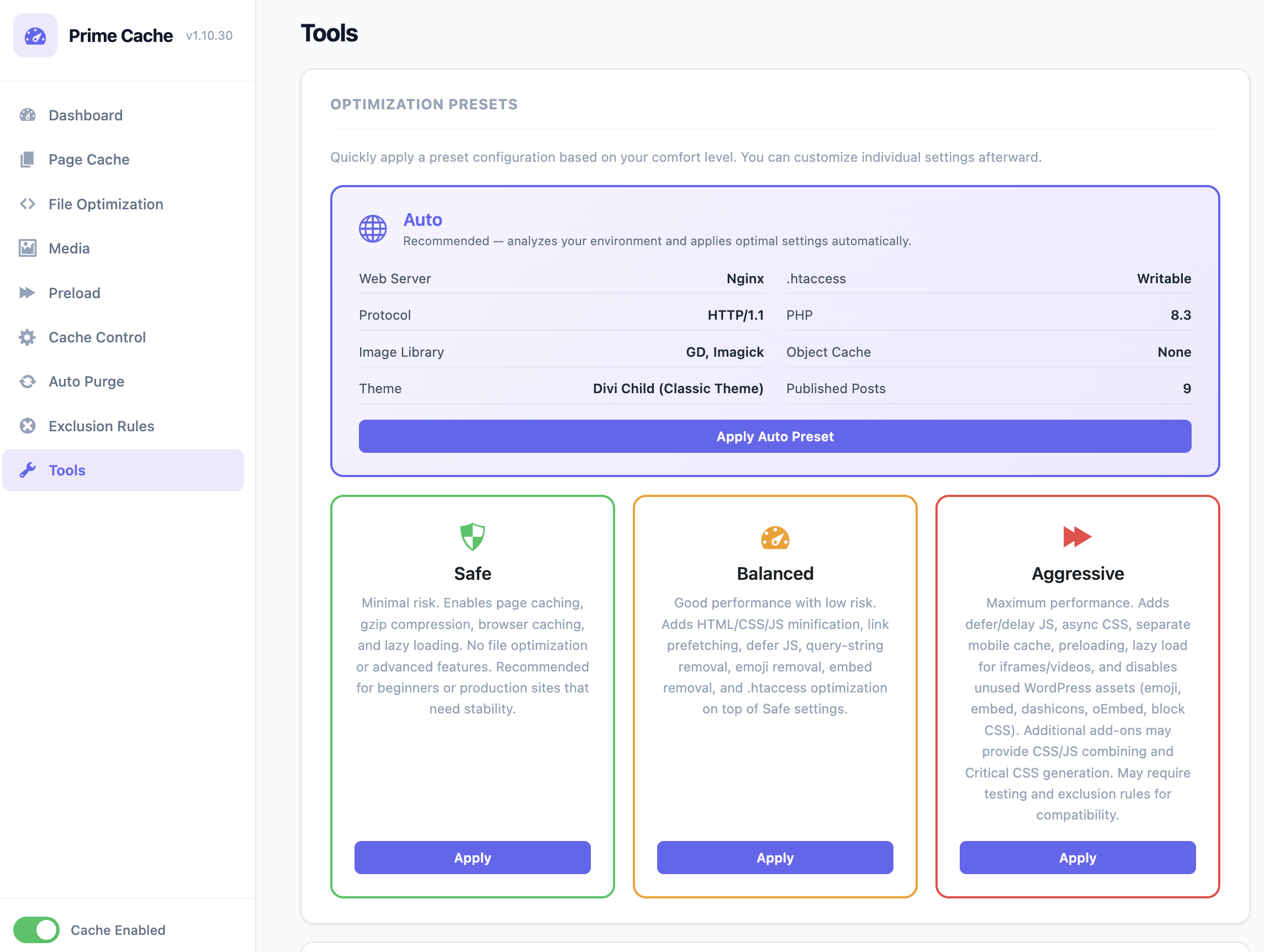
The quickest fix is the Safe preset in the Tools tab. It keeps page caching, browser caching and lazy loading, and turns off minification, deferred and delayed JavaScript, the CSS delivery settings and the other Auto settings that change how a page looks, including any you turned on yourself. The preset card in the Tools tab lists every setting it turns off. Clear the cache and check the page again.
To keep the rest of Auto and find the one setting that disagrees, apply Auto again and turn settings off in this order instead, clearing the cache after each step:
- Delay JavaScript Execution and Maximum Delay, if you turned them on yourself. Auto does not turn them on in the free plugin.
- Load JavaScript Deferred
- Load CSS Asynchronously (Free), then Inline Small CSS Files
- Minify HTML, Minify CSS and Minify JavaScript
Free features
- Page cache, on from activation
- Auto preset (plus Safe, Balanced and Aggressive presets)
- Browser cache headers
- .htaccess Optimization
- Gzip compression
- 404 page caching
- HTML / CSS / JavaScript minification
- Inline small CSS
- Defer JavaScript
- Delay JavaScript, including Maximum Delay
- Google Fonts display=swap
- Lazy load for images, iframes and videos
- WebP conversion, with bulk conversion
- Image resize on upload and EXIF removal
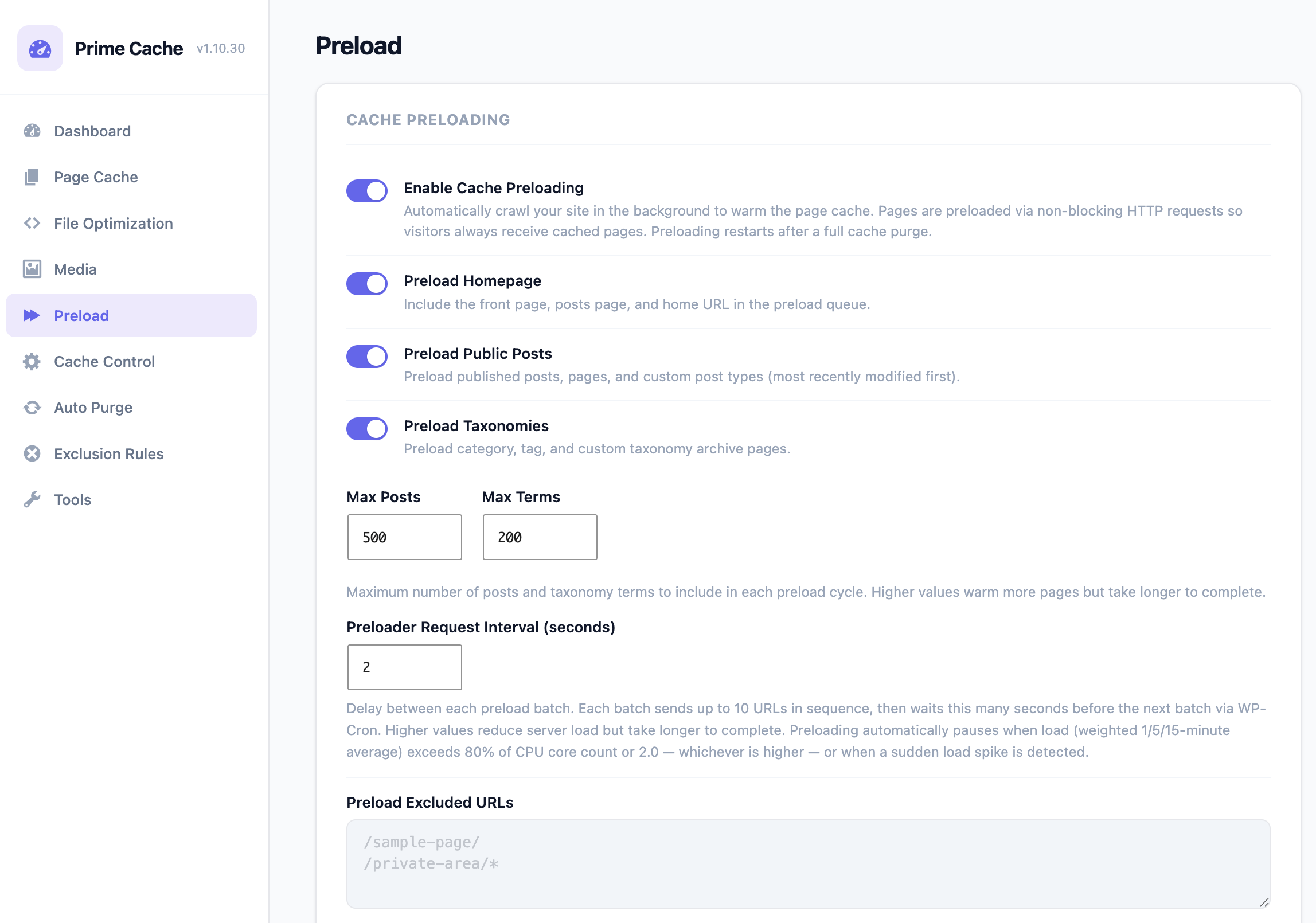
- Cache preloading for the homepage, public posts and public taxonomies
- Link prefetching
- Performance tweaks (disable emoji, jQuery Migrate, embeds and other WordPress extras)
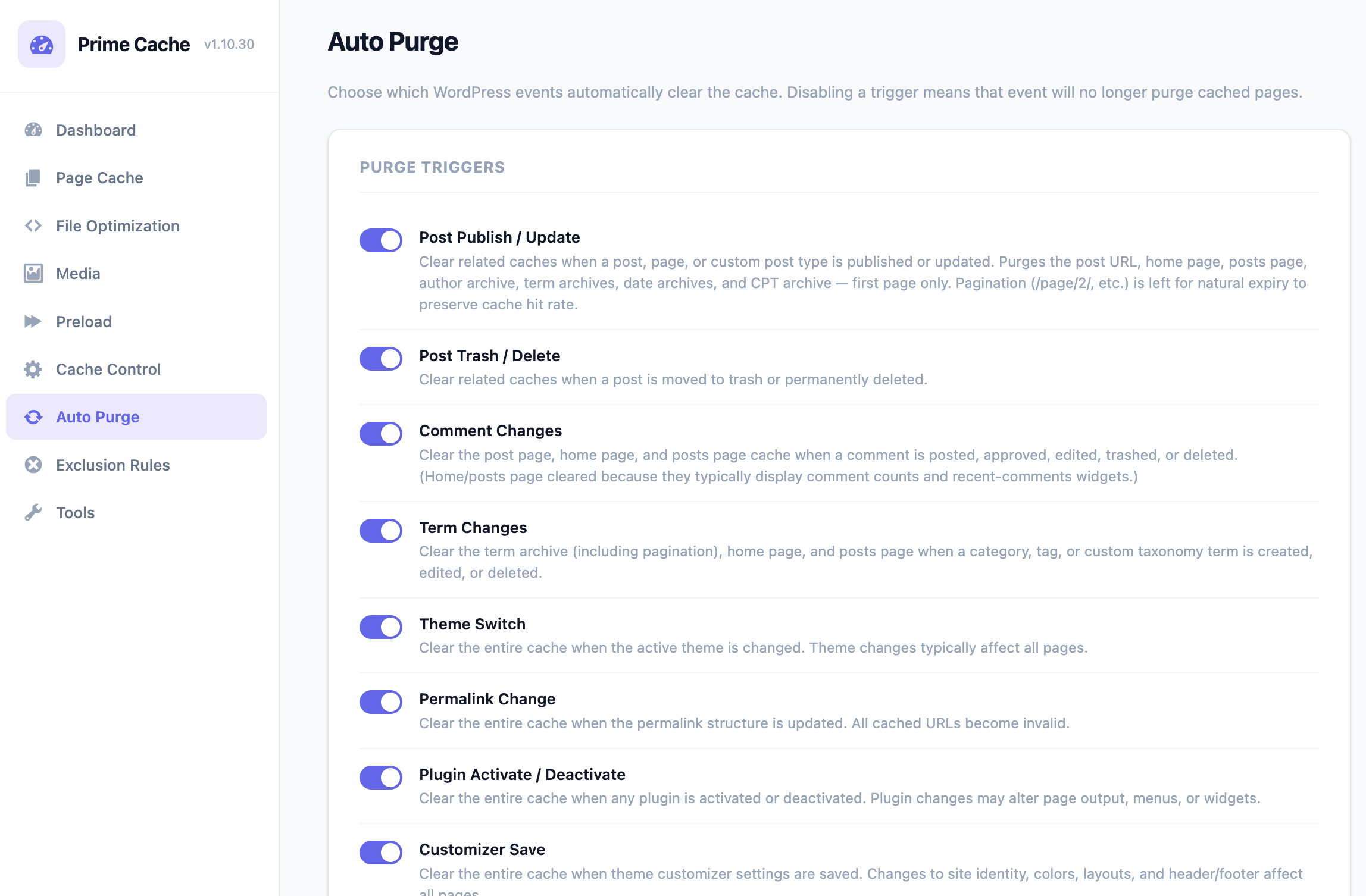
- Automatic cache purge on content changes
- Security headers
- Import / Export
- WP-CLI support
Prime Cache Pro (optional add-on)
Prime Cache Pro is a separate add-on sold on the author’s website (https://raplsworks.com/plugins/prime-cache/). Everything described above is free, with no limits, and the free plugin does not need Pro to work.
With Pro installed, Auto also turns on:
- Remove Unused CSS, with automatically generated Critical CSS
- Delay JavaScript Execution with Maximum Delay
- AVIF image conversion (WebP when the server cannot make AVIF)
- Self-hosted Google Fonts and font preloading
- LCP optimization
- Speculation Rules
- Click-to-load YouTube thumbnails
- Preloading of taxonomy archives
Pro also adds features you turn on yourself:
- AI speed diagnosis and consultation (bring your own API key: Anthropic / OpenAI / OpenRouter / Gemini)
- CSS and JavaScript combining
- CDN URL rewriting
- Cloudflare, Sucuri and Varnish integration
- Object cache backends (APCu / Redis / Memcached)
- Sitemap-based cache preloading
- Database cleanup
- Heartbeat control
- Self-hosted Google Analytics
- One-click
WP_CACHEsetup in wp-config.php, with a backup written first - A warning when a server-side cache sits in front of the site
Prime Cache Pro walkthrough (Japanese narration):
Japanese
The admin screens are translated into Japanese.
Documentation
Full documentation for every setting and every behavior:
- Free Manual (English): https://raplsworks.com/prime-cache-free-manual-en/
- Free 版マニュアル (日本語): https://raplsworks.com/prime-cache-free-manual-ja/
- Pro Manual (English): https://raplsworks.com/prime-cache-manual-pro-en/
- Pro 版マニュアル (日本語): https://raplsworks.com/prime-cache-manual-pro-ja/
External services
The free Prime Cache plugin does not connect to any external service. No data is sent to any third party at any time by the free plugin.
The following third-party hostnames appear inside the plugin’s source code as string literals only, and the plugin never makes outbound requests to them:
googletagmanager.com,google-analytics.com,connect.facebook.net,widget.intercom.io,embed.tawk.to— listed inincludes/class-file-optimizer.phpas URL-pattern presets for the “Delay JS” feature. They are used only to recognize third-party scripts already present on the page (added by other plugins or the theme) and to defer their execution until first user interaction. The plugin itself does not load, fetch, or embed any of these services.cdnjs.cloudflare.com— referenced only in code comments and admin-screen help text describing how some themes replace bundled jQuery with a CDN version. The plugin does not call or include any resource from this host.
If you install the optional Prime Cache Pro add-on, that separate plugin documents its own external service usage in its own readme — Prime Cache (free) on its own makes no outbound calls.
Why the page-cache drop-in keeps an open output buffer
A page cache has to capture the entire rendered HTML response so the body can be written to disk before the browser receives it. dropins/page-cache.php opens an ob_start() early in the request and lets PHP flush the buffer naturally at request shutdown — the captured body is written to the cache file inside the buffer callback. The buffer is deliberately not closed mid-request; doing so would either truncate the cached body or break the capture for plugins/themes that emit their last output during shutdown. This is the standard design for WordPress page caching. The HTML transformation pipeline in includes/class-html-pipeline.php follows the same pattern for the same reason.
Installation
- Go to Plugins > Add New in your WordPress admin and search for “Prime Cache”, then click Install Now (or upload the
prime-cachefolder to/wp-content/plugins/) - Activate the plugin through the ‘Plugins’ menu in WordPress. Page caching starts immediately; no wp-config.php changes are needed.
- Optional: go to Prime Cache > Tools and click Apply Auto Preset to turn on the speed settings described above.
- Optional: follow the on-screen note to add the
WP_CACHEline yourself for drop-in mode.
Settings tabs
- Page Cache tab – Mobile cache, gzip compression, .htaccess Optimization and 404 caching
- File Optimization tab – HTML, CSS and JS minification, defer and delay
- Media tab – Lazy loading and WebP conversion
- Preload tab – Cache preloading and link prefetching
Frequently asked questions
Something looks broken after I pressed Auto.
Apply the Safe preset in the Tools tab first. It keeps page caching, browser caching and lazy loading, and turns off minification, deferred and delayed JavaScript, the CSS delivery settings and the other Auto settings that change how a page looks, including any you turned on yourself. The preset card in the Tools tab lists every setting it turns off. Then clear the cache (Admin bar > Prime Cache > Clear All Cache) and check menus, sliders and forms again. If Safe fixes it and you want to keep the rest of Auto, apply Auto again and turn settings off in this order, clearing the cache after each…
What does Auto change, exactly?
In the free plugin, Auto turns on: page cache with mobile caching, gzip compression, browser cache headers, .htaccess Optimization (only when .htaccess is writable), HTML / CSS / JavaScript minification, removal of HTML comments, lazy loading for images, iframes and videos (the first six images stay eager so the largest image is not delayed), missing image width/height, a local copy of jQuery when the theme loads it from a CDN, deferred JavaScript, inline small CSS, asynchronous loading of non-first CSS, Google Fonts display=swap, disabling emoji and embeds, removing version query strings…
Does it edit wp-config.php?
The free plugin does not. It reads wp-config.php to see whether WP_CACHE is set, and never writes to it. Page caching works without WP_CACHE. If you add define( 'WP_CACHE', true ); yourself, cached pages are served before WordPress core loads, which is faster still. Prime Cache Pro can add the line for you with one click and writes a backup first.
Can I use it with another cache plugin?
Do not run two page caches at once. Deactivate the other cache plugin before you activate Prime Cache. Prime Cache detects 14 known caching and optimization plugins and warns you when one is active.
My host already has a server cache.
Do not let two page caches serve the same pages. When the host’s cache sits in front of Prime Cache, Prime Cache’s purge does not reach it, so visitors can keep seeing an old copy after you update a post. Decide which one serves your pages. If you keep the host’s cache, clear it as well whenever you clear Prime Cache. Prime Cache Pro detects common server-side caches and tells you when one is in front of the site.
Logged-in users see old pages.
They should not by default. Logged-in users are never served cached pages, and page optimizations are skipped for them. If you turned on Logged-in User Cache in the Page Cache tab, every logged-in user shares one cached copy with anonymous visitors; turn it off.
How do I clear the cache?
Multiple ways: the admin bar menu (Prime Cache > Clear All Cache and other options), Dashboard quick actions, WP-CLI (wp prime-cache flush), or the automatic purge triggers.
Is it available in Japanese?
Yes. The admin screens are translated into Japanese.
Does it help Core Web Vitals?
The features target the usual Core Web Vitals bottlenecks: page caching and preloading shorten server response time (TTFB, which feeds LCP), minification and deferred JavaScript reduce render-blocking resources, lazy loading and WebP conversion cut image weight, and keeping the first images eager protects the LCP image. Results depend on your theme, hosting and other plugins, so measure before and after each change.
What are the server requirements?
WordPress 5.8+, PHP 7.4+. For WebP conversion, the GD or Imagick PHP extension is required.
Does it work with Nginx?
Yes. Page caching, file optimization, media optimization, and all PHP-based features work on any server. The .htaccess Optimization feature needs a server that reads .htaccess and can be left off on Nginx.
Does it support WooCommerce?
Yes. WooCommerce cart, checkout, and account pages are automatically excluded from caching. Additional WooCommerce optimizations include disabling scripts on non-WC pages and disabling cart fragments AJAX.
Can I disable cache for a specific page?
Yes. Edit the post/page and check “Disable cache for this page” in the Prime Cache metabox in the sidebar.
Does the .htaccess fast path work for all requests?
The .htaccess fast path serves cached pages without loading PHP. It requires: lowercase Host header, no query string (unless cache_query_strings is disabled), no Vary Cookies, ASCII-safe URL paths, and GET requests only. Requests that don’t match these conditions are served by the PHP engine, which is still fast but not zero-PHP.
Does it support WordPress multisite?
Page caching is not supported on multisite installations. Other features (file optimization, lazy load, image optimization, etc.) work normally on multisite.
How does the image optimization work?
When WebP conversion and auto-convert are on, JPG/PNG images are converted to WebP on upload, including every thumbnail size. WebP is served to supporting browsers via .htaccess rewrite rules, picture tags, or URL rewriting.
Does Prime Cache send data to external services?
No. The free plugin does not send your data or API requests to any third-party service. Cache preloading only requests URLs on your own site. Some optional features may add browser resource hints (such as preconnect) for external assets your site already uses, but Prime Cache itself does not transmit data to external services.
Changelog
Fixes the Cocoon mobile sidebar drawer opening empty on the first tap when Delay JavaScript is on.
1.10.62
- Fixed: with Delay JavaScript on, the Cocoon theme’s mobile sidebar drawer opened empty on the first tap and worked from the second tap on. The tap that opens the drawer is also the one that starts loading the delayed scripts, so Cocoon’s script that moves the sidebar into the drawer had not run yet. A small script that is never delayed now moves the sidebar when Cocoon’s script has not run yet, and does nothing once Cocoon’s script is running. Only sites using Cocoon are affected.
1.10.61
- Display name and readme updated.
- Changed: the Safe preset now also turns off Load CSS Asynchronously, Inline Small CSS Files and the other page-changing settings Auto turns on (Use Local jQuery, Disable Gutenberg Block CSS, Disable WP Embed, Disable oEmbed, Add Missing Image Dimensions, the HTML DOM and comment options, and the WooCommerce script and cart-fragment options), so it undoes every setting in the free Auto preset that can change how a page looks. The Safe card in the Tools tab now lists everything it turns off. Add-ons can extend Safe through the new
prime_cache_preset_safefilter.
1.10.60
- Fixed: with “Purge on WordPress core update” turned off, no cache was cleared after a plugin or theme update either — even with “Purge on plugin activate/deactivate” and “Purge on theme switch” enabled. All three update types arrive through one WordPress hook, and that hook was only registered when the core-update setting was on. It is now registered whenever any of the three is enabled, and each update type follows its own setting. Sites with all three enabled (the default) are unaffected.
1.10.59
- Fixed: the CSS minifier corrupted
:not()selectors. A rule that added the required space to media-query keywords (and(toand () also matched the:not(pseudo-class, turning.a:not(.b)into the invalid.a:not (.b)— so browsers dropped every style rule that used:not(). On themes that rely on:not()for layout (e.g. Avada’s search form) this left elements mispositioned or unstyled once CSS optimization was on. The minifier now leaves:not()untouched while still spacing media-query keywords. - Changed: minified CSS/JS (and, with the Pro add-on, combined and unused-CSS files) now include the plugin version in their cache filename. A code fix like the one above previously reused the old, broken output because the source file’s timestamp had not changed; now an update regenerates the assets automatically, and the new filenames also stop upstream/server caches from serving stale bytes. Existing optimized files are replaced on the next visit after updating.
1.10.58
- Fixed: a deleted image could keep being shown. The WebP rewrite rule served a
.webpwhenever one existed on disk, without checking that the original was still there — so an orphaned.webpleft behind by a deleted original kept being served at 200 instead of returning a clean 404. The rule now also requires the original file to exist. (The Pro add-on’s AVIF rule gets the same fix.) - Fixed: deleting an image in the Media Library now also deletes its generated
.webp/.avifvariants (the original and every size). Before, WordPress removed only the originals it tracks and the converted files were orphaned — and because conversion skips a file that already has a variant, re-uploading an image under the same name could keep showing the OLD picture. - Added: an orphaned-file cleanup for variants left behind by deletes made before this fix. The Media settings show a count and a one-click “Delete Orphaned Files” (with confirmation);
wp prime-cache image-orphanslists them (add--deleteto remove).
1.10.57
- Fixed: updating a plugin or theme did not clear the cache, so a cached page — and any combined/minified CSS or JS whose content hash came from the updated files — could keep serving the old version until the cache was cleared by hand. Prime Cache only purged on WordPress core updates, and a normal in-place plugin update leaves the plugin active, so no other event caught it. It now purges the whole cache after a plugin or theme update as well (core updates already did this; translation-only updates are still ignored).
Screenshots
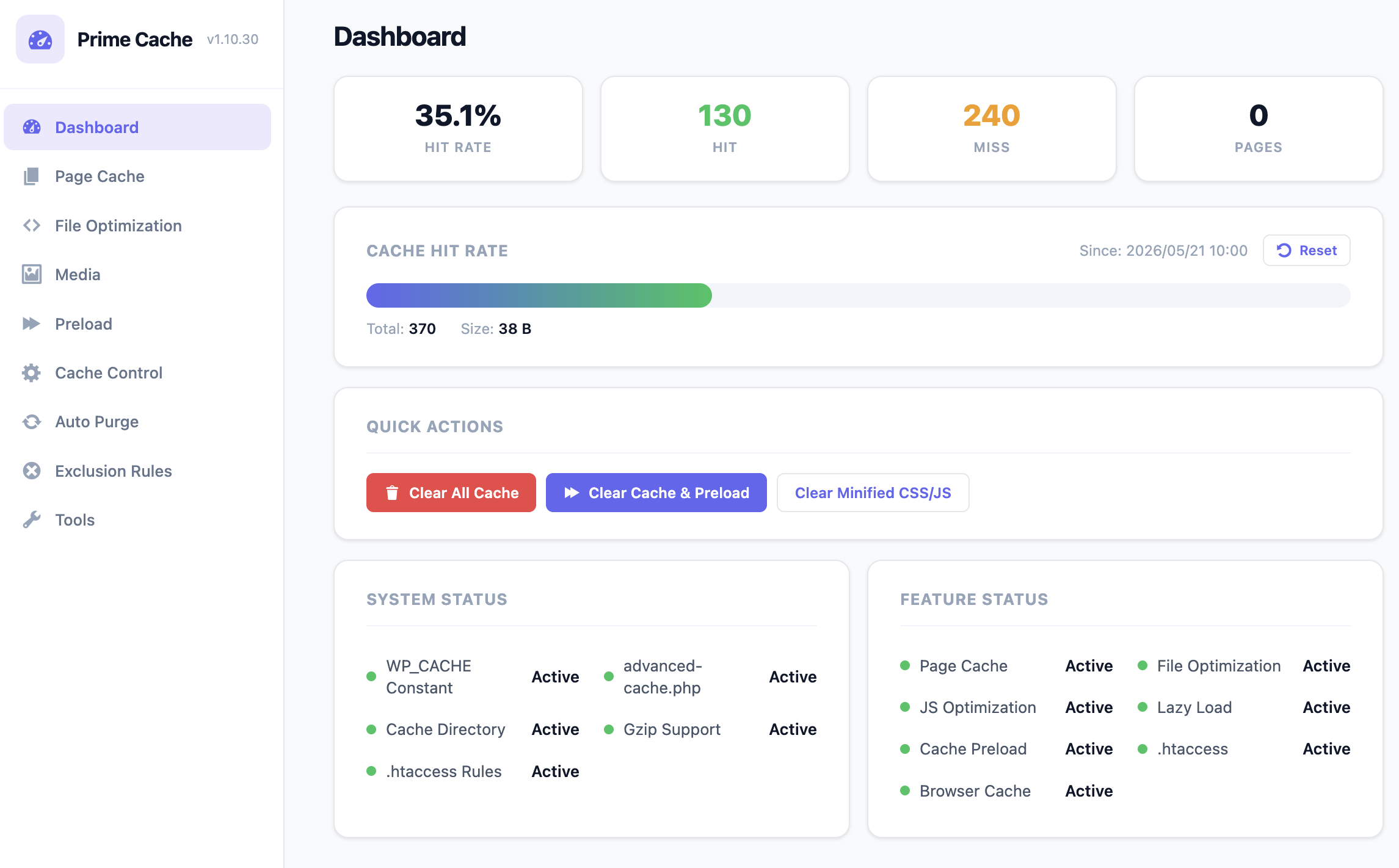
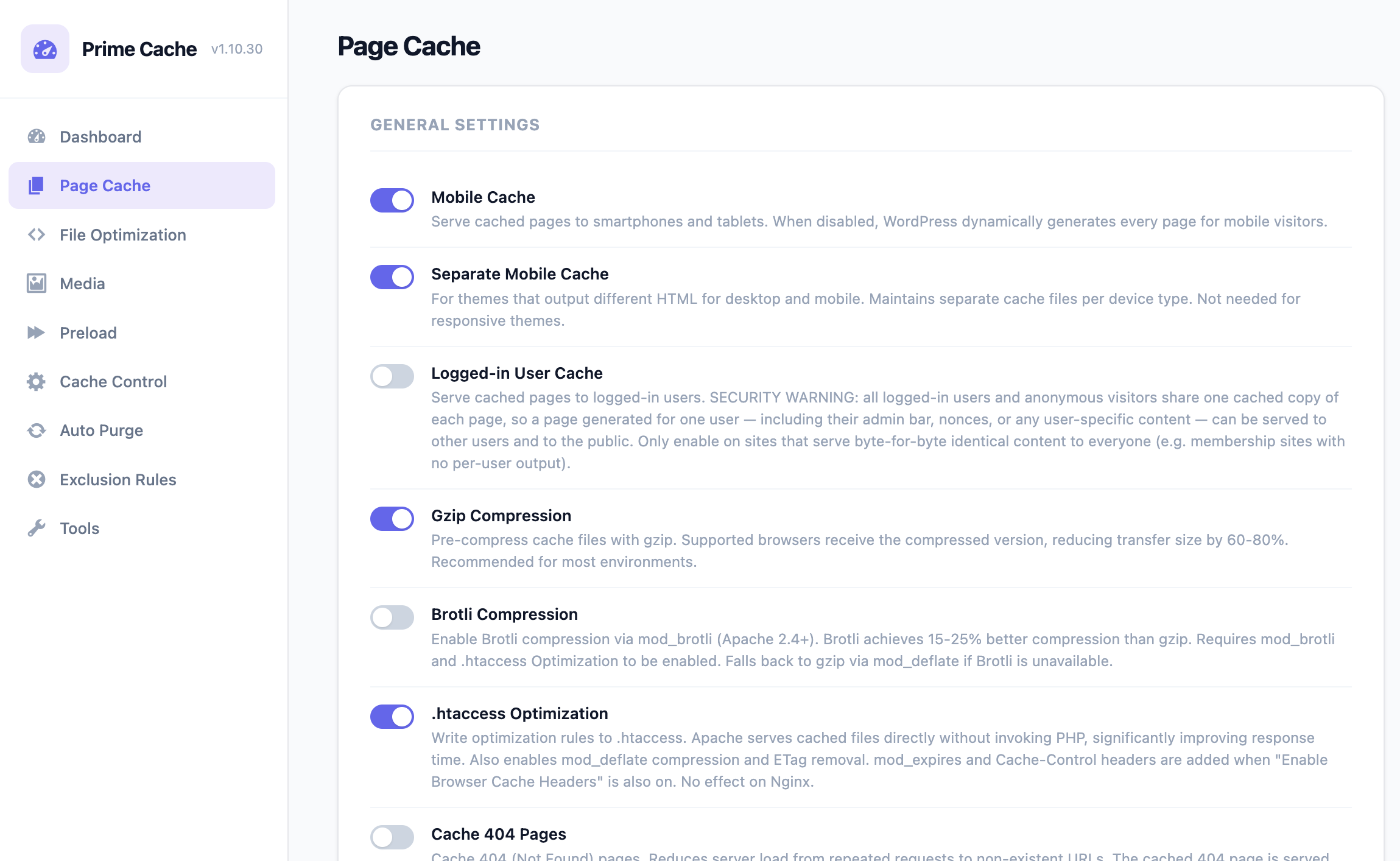
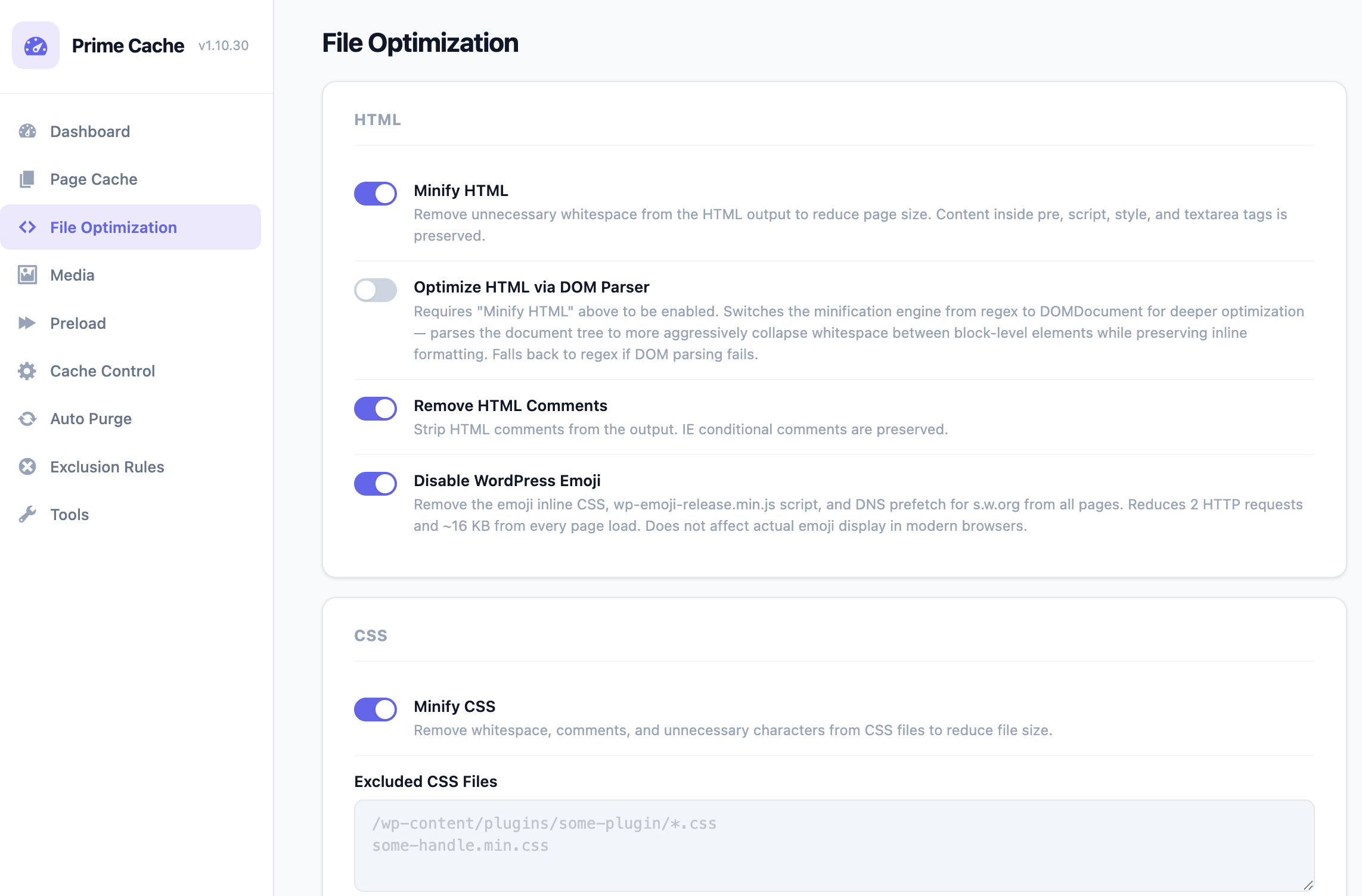
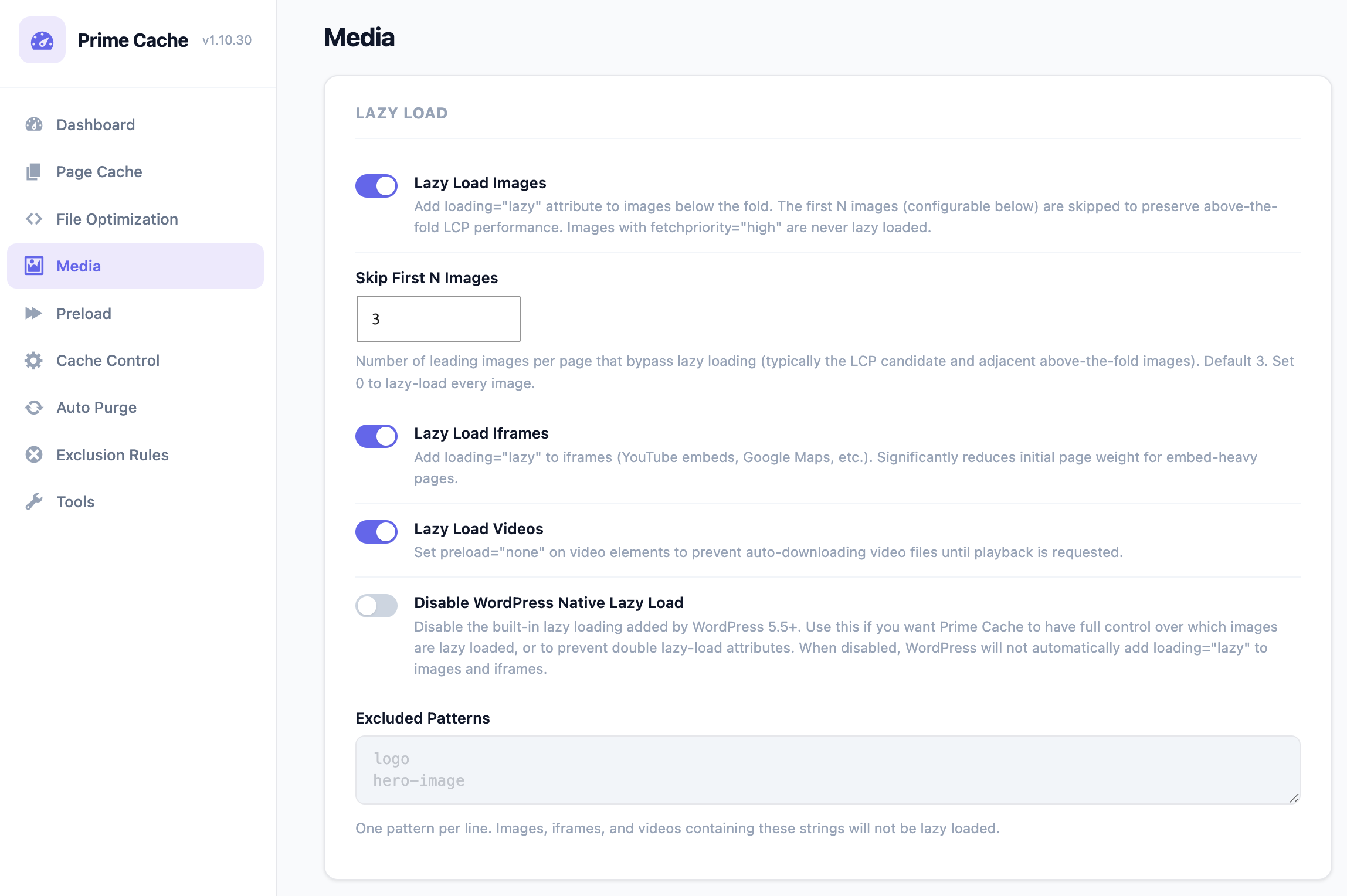
For developers
Is this your plugin? Show off the numbers.
Add a live badge to your site, docs or GitHub README. It updates on its own — no account needed.
Best Prime Cache alternatives
All cache plugins →





FAQ
Prime Cache: quick answers
Straight answers, pulled from live WordPress.org data.
Live data from WordPress.org · checked Oct 2, 2026
Is Prime Cache free?
Yes. Prime Cache is free to download and use from the official WordPress.org plugin directory.
Is Prime Cache safe to use in 2026?
Prime Cache is a solid plugin choice in 2026, with a few things worth checking first. It runs on 10+ sites, is rated 5/5 and was last updated 7 days ago, and scores 73/100 on our health check.
How many websites use Prime Cache?
Prime Cache is active on 10+ WordPress websites and has been downloaded 1,841 times since it launched in July 2026. It was downloaded 633 times in the last 30 days.
Does Prime Cache work with WordPress 7.1?
Yes. The developer has tested Prime Cache up to WordPress 7.1.2, the latest release. It requires WordPress 5.8 or newer.
What PHP version does Prime Cache need?
Prime Cache requires PHP 7.4 or higher. Most hosts run PHP 8.x today, so it works on any modern WordPress hosting.
When was Prime Cache last updated?
The latest version, 1.10.62, was released on September 25, 2026 (7 days ago).
Who makes Prime Cache?
Prime Cache is developed and maintained by rapls.
What are the best alternatives to Prime Cache?
The most popular alternatives to Prime Cache are WP Super Cache (1M+ installs), WP Fastest Cache (1M+ installs) and WP-Optimize (1M+ installs).
Powered by PageForge
Want thousands of pages that rank like these? Build them in an afternoon.
This directory runs on the same engine as PageForge. Turn any spreadsheet, CSV or API into thousands of fast, SEO-ready WordPress pages — with schema, internal links and AI-written copy baked in.
- CSV, Google Sheets & API data sources
- AI content, schema & internal links per page
- Works with Elementor, Gutenberg, Yoast & Rank Math
- Free on WordPress.org — no credit card