


PixLedger – Consent-Aware Meta Pixel, GA4 & GTM Tracking for WooCommerce
Meta Pixel, GA4 and Google Tag Manager tracking for WooCommerce, with consent control and an event log that shows what was sent.

Solid choice
PixLedger is a solid plugin choice in 2026, with a few things worth checking first. Was last updated 3 weeks ago, and scores 64/100 on our health check.
- Actively developed — last update 3 weeks ago
- Tested with the latest WordPress (7.1)
- Small user base (<10 active installs)
- Very few reviews so far
- Needs PHP 8.1 or newer
How does it stack up?
Side-by-side on installs, updates, ratings & support



Daily downloads
Download spikes usually follow a new release — each site that auto-updates counts as a download.
Rankings
Where PixLedger stands todayWordPress.org search rankings
Live position in the plugin search, top 100| Keyword | Position |
|---|---|
| conversion tracking | >100 |
| ga4 | >100 |
| google tag manager | >100 |
| Meta Pixel | >100 |
| WooCommerce Tracking | >100 |
About PixLedger
From the official readme · v1.8.4Description
PixLedger sends your store’s tracking events to Meta Pixel (Facebook), Google Analytics 4 and Google Tag Manager, and keeps a local log so you can see exactly what happened to every event.
Why PixLedger
- One place for three platforms. Add your Meta Pixel, GA4 and GTM IDs, switch each platform on, and choose which events to track.
- Consent comes first. Events wait for the visitor’s permission. Meta, GA4 and GTM each need the consent that fits them, and PixLedger works with the WP Consent API, Complianz or your own banner.
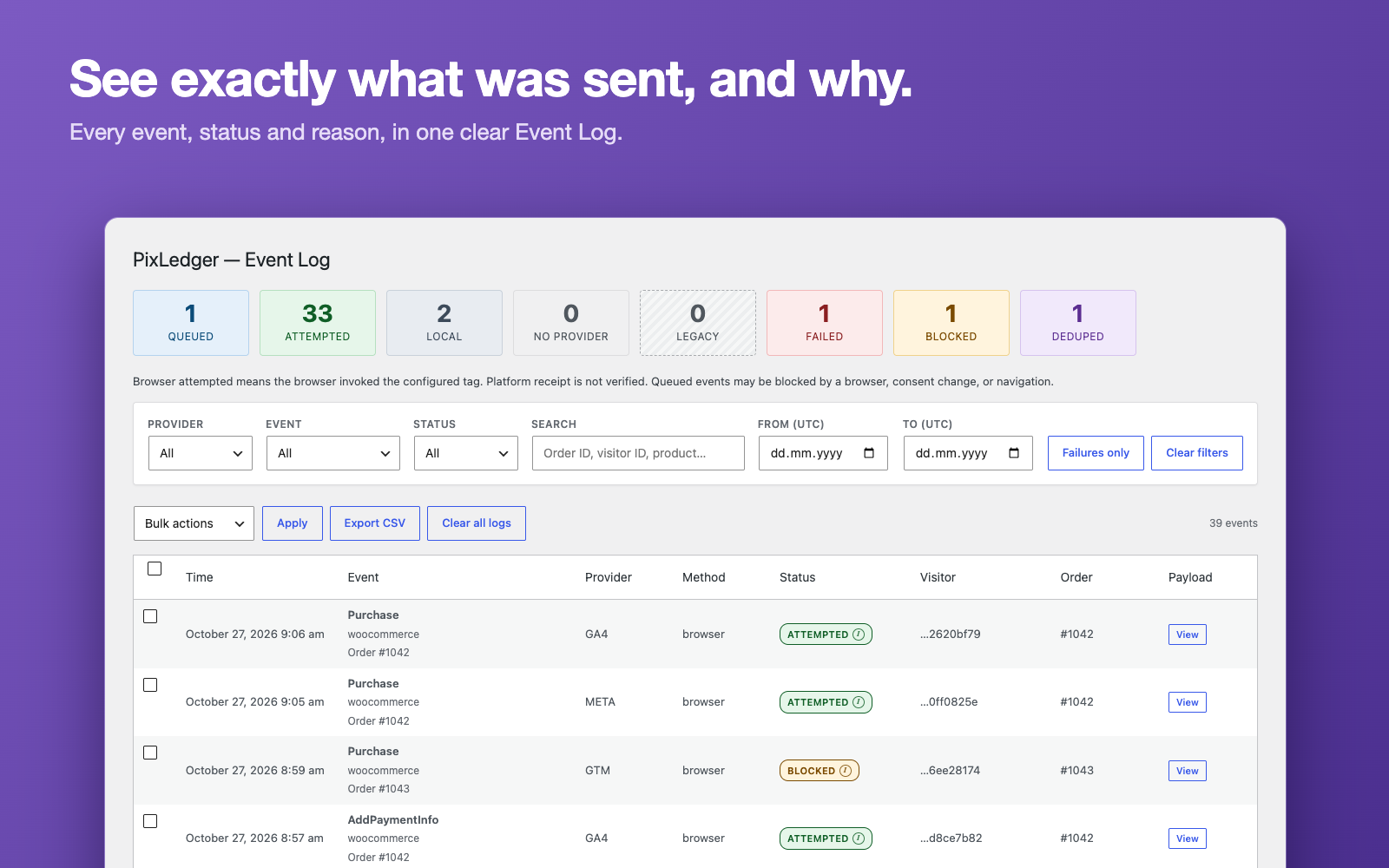
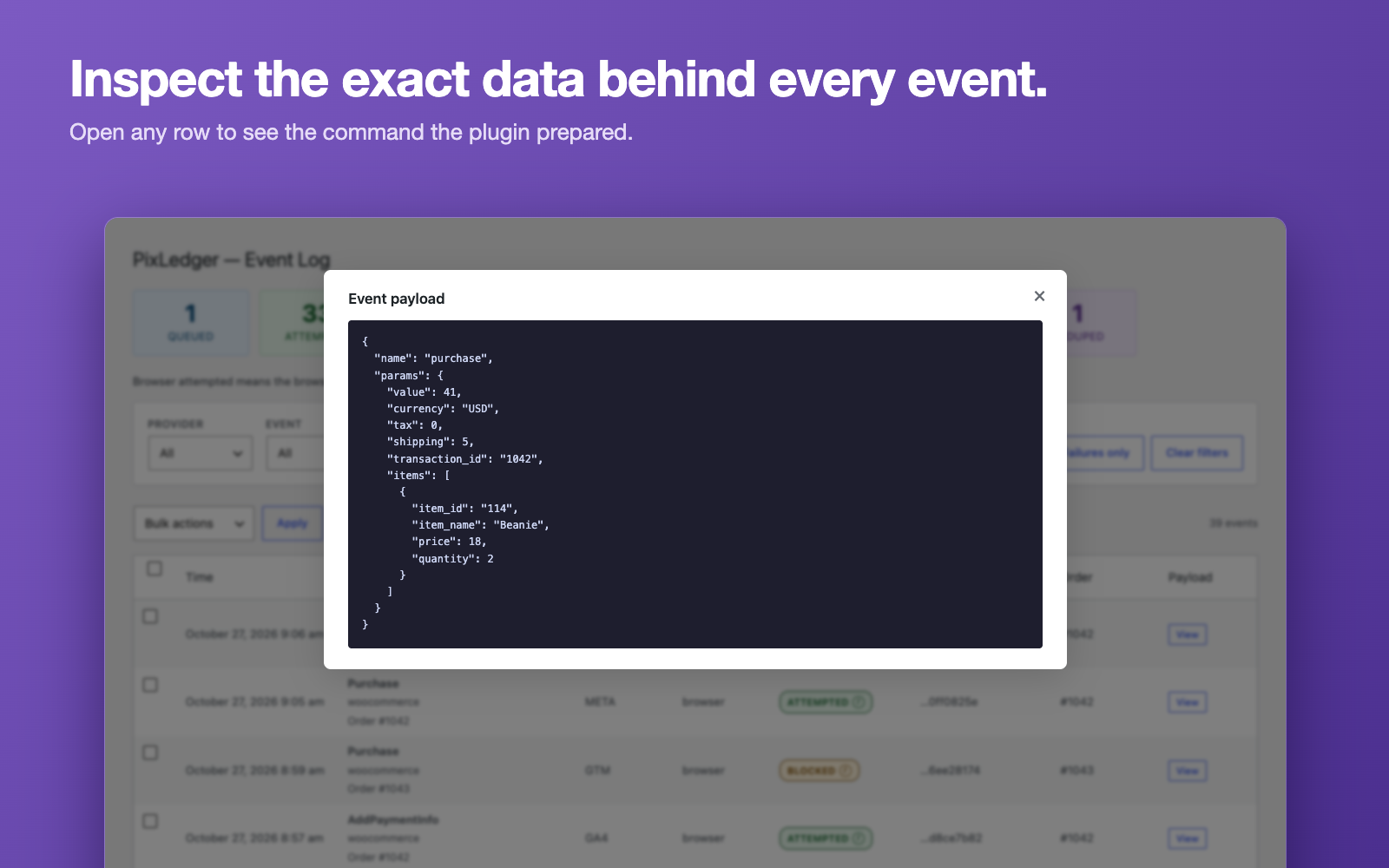
- See what really happened. The Event Log shows every event with its status, the reason when something was blocked or skipped, and the exact payload that was prepared.
- Built for WooCommerce, works without it. Product views, cart, checkout, payment and shipping steps, coupons and purchases come from your real orders, and a purchase is only tracked when WooCommerce considers the order paid. Without WooCommerce, page, click, form, search and custom events still work.
- Privacy-minded. Form values and email addresses are not collected, tracked links lose their query strings, and personal data export and erase tools are included.
- Free, with nothing locked. Every feature in this plugin works without a licence or subscription.
What it does not do. PixLedger sends events from the visitor’s browser. It cannot deliver an event after the browser has closed, and it cannot prove that a platform accepted an event. Server-side delivery is not part of this plugin.
How it works
PixLedger Lite connects your site to Meta Pixel, Google Analytics 4 and Google Tag Manager. WooCommerce events use data from WooCommerce; browsing events come from the visitor’s browser. A local event log shows the mapped provider payload and how far each event progressed.
What the event log means
- Queued: a provider command has been prepared for a browser response.
- Browser attempted (shown as “Attempted”): the browser reported invoking the provider API. This does not confirm platform receipt, attribution or reporting.
- Recorded locally (shown as “Local”): a diagnostic event, including an administrative refund or a page-exit event waiting for another page visit.
- Blocked (by consent): a provider’s consent requirements were not met. Blocked records contain minimal diagnostic data.
- No provider: there was no enabled provider with a valid ID.
- Failed: preparation failed. A tag blocked by the browser remains queued.
- Deduplicated (shown as “Deduped”): intentionally skipped, such as ecommerce data already managed by GTM4WP.
- Legacy sent (unverified) (shown as “Legacy”): an older log entry whose delivery was not verified.
Each status is explained below the Event Log table. Filter logs by event, provider, status, UTC date range or order/visitor/event ID. Inspect payloads, export the filtered log as CSV (up to 100,000 rows per file), delete selected logs and configure retention. CSV exports contain visitor IDs and event payloads, which are pseudonymous personal data, so handle downloaded files accordingly; customer email is never exported. WordPress displays event times in your site’s timezone.
Tracking
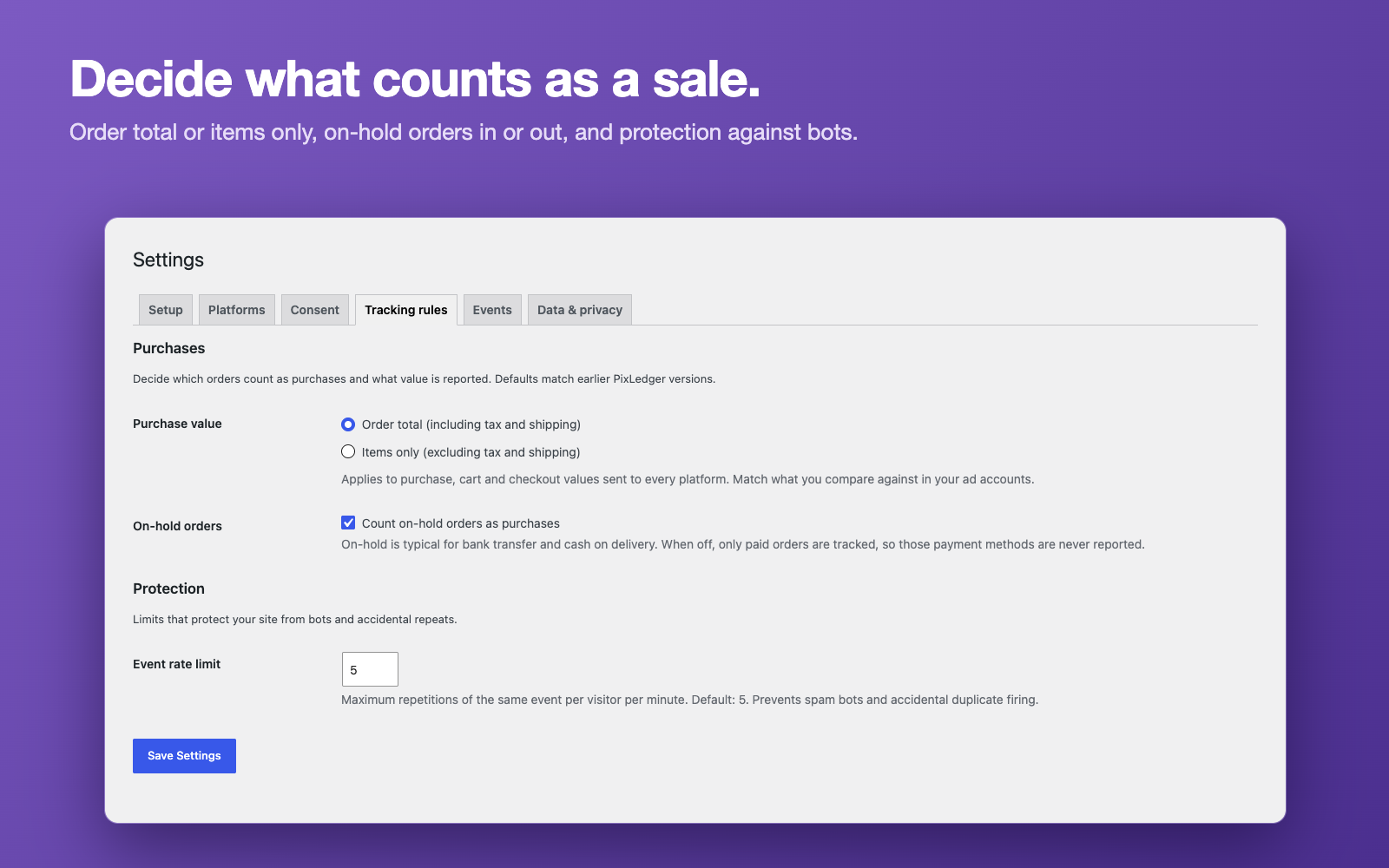
WooCommerce: product views, cart additions/removals, cart and checkout views, payment/shipping selection at order processing, coupons, purchases and product-review submissions. Purchase requires an order WooCommerce considers paid and a valid recent order key or checkout delivery cookie. Pending, failed and cancelled orders never produce Purchase events. On-hold orders (typical for bank transfer and cash on delivery) are counted by default; switch that off under Tracking rules to count paid orders only. Payment completed after the visitor leaves may not reach browser platforms.
Refunds are recorded locally. Lite does not send administrative background refunds to external platforms.
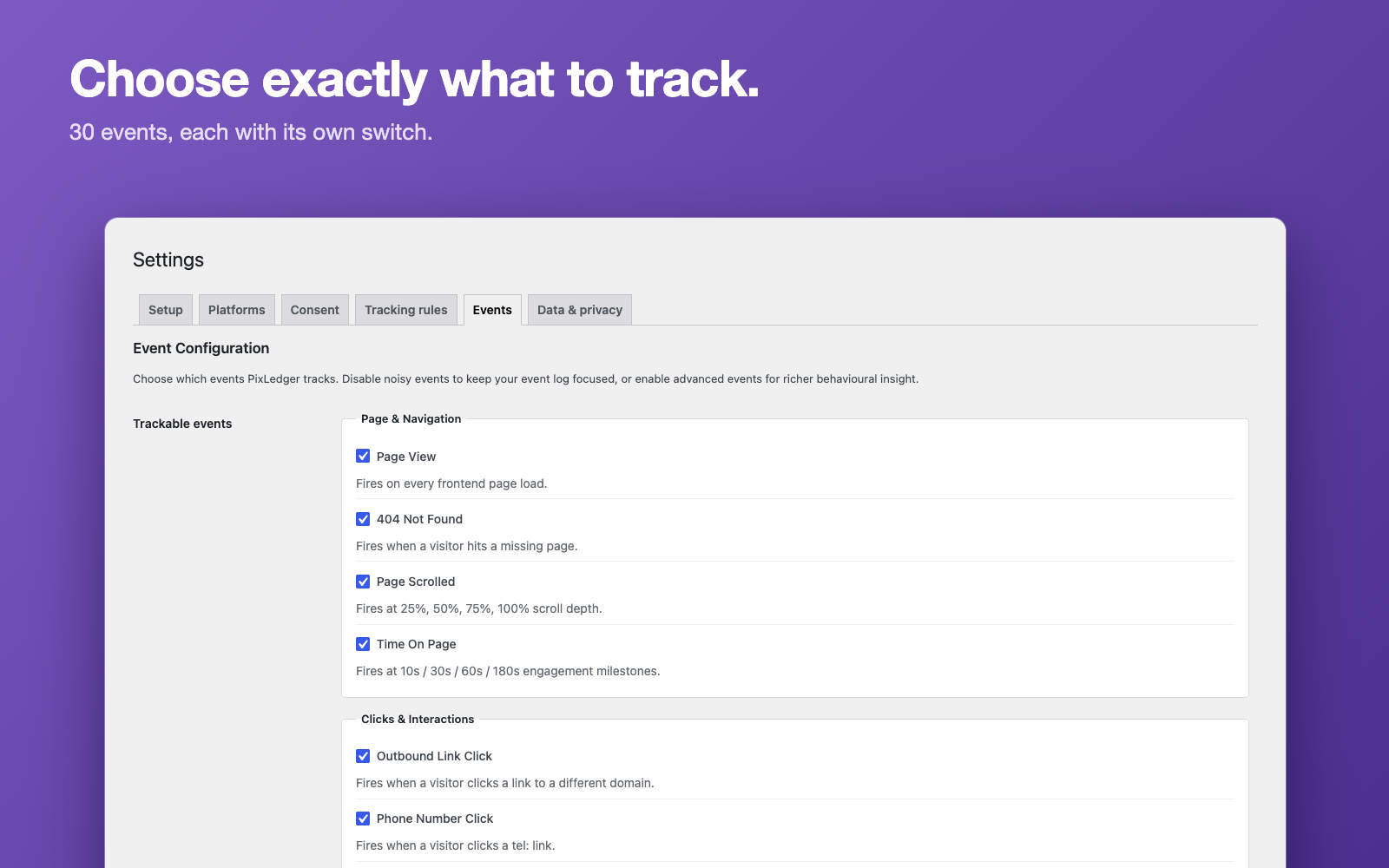
WordPress/browser: page views, 404 pages, outbound/download/phone/email clicks, search, form submission attempts, abandoned forms, scroll depth, time on page, account actions and comments. HTML5 video start/end events are supported; embedded YouTube/Vimeo players are not integrated. FormSubmit means an attempted submission, not a confirmed lead.
Each event has a switch. The Custom Events switch also controls unregistered custom event names. Features are available without a subscription or license key. WooCommerce is optional.
Custom events
Use pixledger('track', 'DemoAction', { value: 12 }) after the pixledger_ready document event (or when pixledger.ready is true), or add data-pixledger-event="DemoAction" to an element. Optional data-pixledger-data and data-pixledger-context attributes accept JSON. The pxl and data-pxl-event aliases remain supported. The browser API cannot emit reserved purchase, cart or account events.
Custom events must not contain personal information. Payloads are bounded and sensitive field names are removed. Form field values, telephone numbers and email link destinations are never read. Explicit page/link URL properties omit query strings and fragments.
Consent and privacy
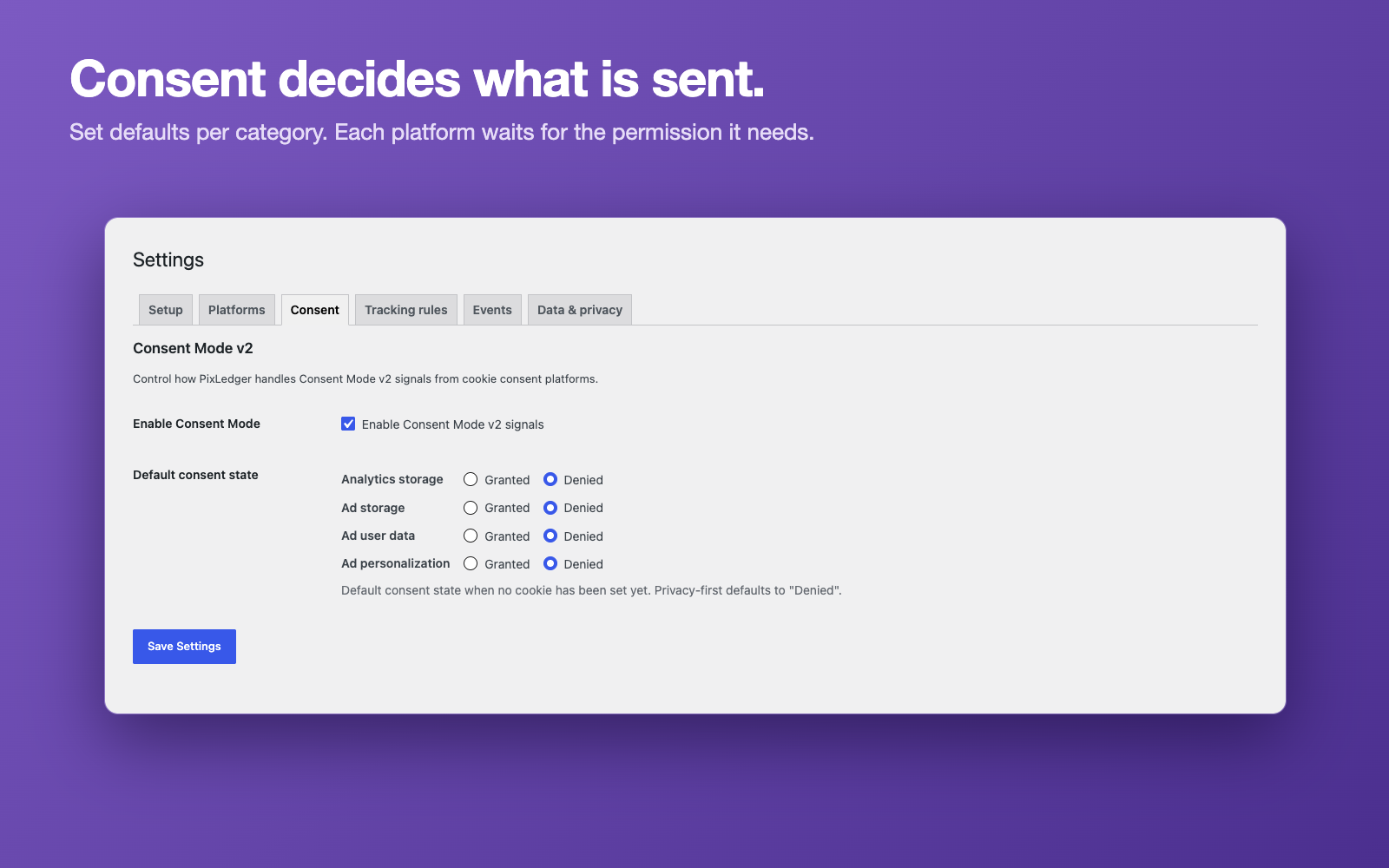
New installations enforce consent by default, with all categories denied. An existing explicit choice to disable Consent Mode is preserved. PixLedger is not a cookie banner: connect WP Consent API, Complianz or your own consent interface. Custom integrations can call pixledger('consent', { analytics_storage: true, ad_storage: false, ad_user_data: false, ad_personalization: false }) with the full current choice.
GA4 requires analytics consent. Meta requires ad storage and ad user data consent. GTM requires both analytics and marketing consent because containers can contain arbitrary tags. Consent changes apply on the current page. PixLedger uses basic consent gating; it does not send denied-consent cookieless measurement pings. Disabling Consent Mode bypasses these gates and is a deliberate administrator choice.
Before consent permits collection, PixLedger does not create a visitor ID, persist browsing events or load its provider libraries. Revocation clears PixLedger’s browser buffer, identity/attribution cookies and pending queue. Previously stored event logs are managed by retention and privacy tools. Other plugins and tags have their own consent behaviour.
Visitor IDs are pseudonymous, not anonymous. Cookies last up to 90 days (visitor), 30 days (attribution), or one day (transport and order delivery). First-touch campaign attribution uses paid-click overrides; click IDs require marketing consent. Attribution is attached to an order at checkout, including pending orders, and is not proof of a paid conversion.
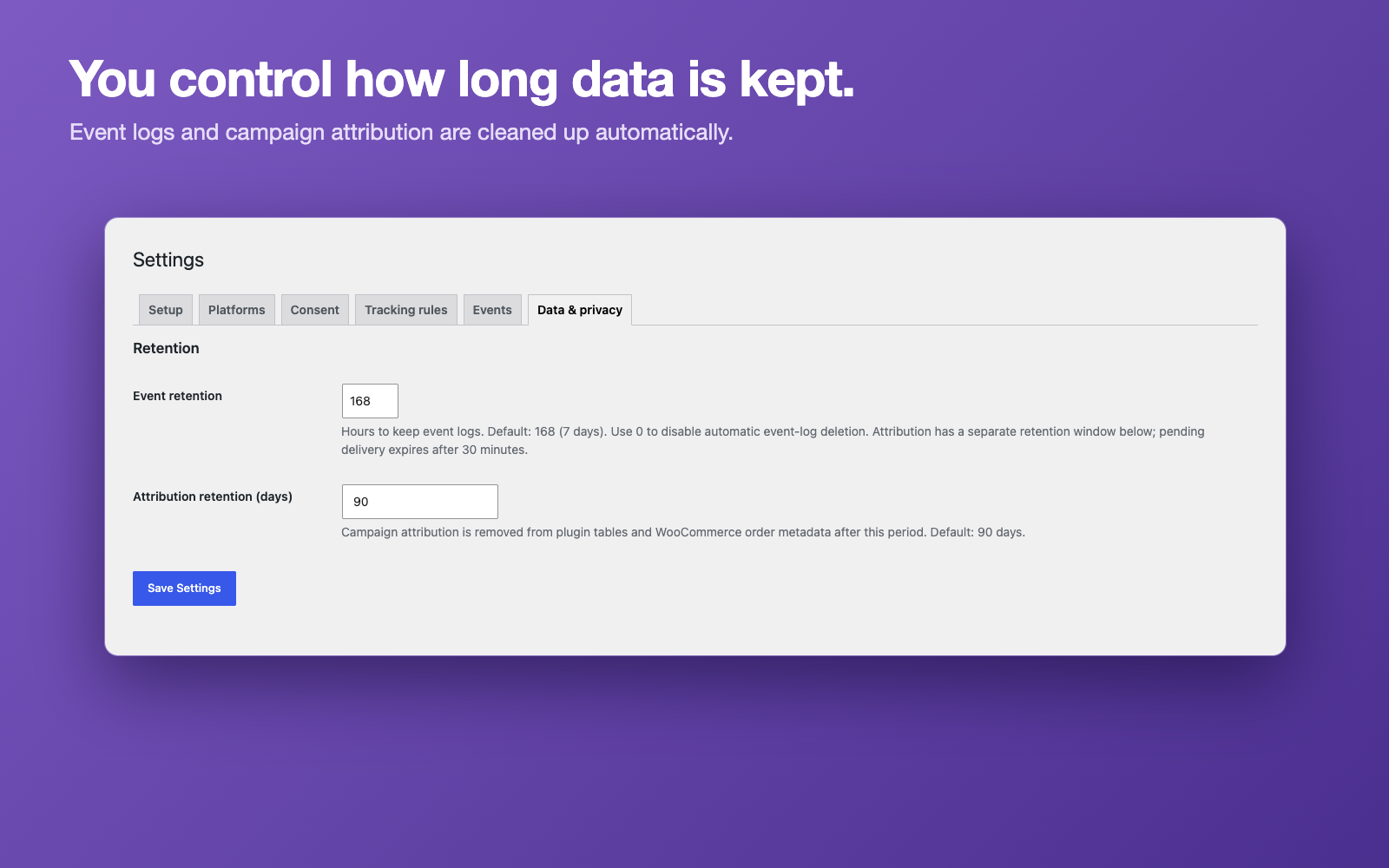
Event logs default to 168 hours; 0 disables event-log cleanup. Attribution defaults to 90 days and is removed from both the plugin table and related order metadata. Pending delivery expires after 30 minutes. Scheduled cleanup is bounded and runs with WP-Cron; actual deletion depends on cron execution. Configure reliable cron for predictable retention.
WordPress Tools > Export Personal Data / Erase Personal Data supports order-linked PixLedger records and legacy email-linked logs. Browsing data with no email/order link cannot be identified from an email request. New event records do not store customer email hashes. A purchase replay marker can remain on an erased order to prevent resending its conversion.
Delivery, caching and integrations
Cacheable HTML contains configuration and page descriptors, not visitor-specific event queues. The browser obtains a fresh nonce/settings response and retrieves its server-owned pending events through same-origin AJAX. Allow PixLedger requests through your cache/security layer; do not cache admin-ajax.php POST responses.
Network failures use bounded retries. Events saved during navigation may be delivered on the next consenting page within 30 minutes. The visitor must return to a page where PixLedger runs; Lite cannot guarantee last-page delivery or exact-once external delivery.
Plugin detection warns of possible overlap. Runtime checks avoid loading the same library URL again; they cannot prevent another plugin or GTM container from firing its own events. Use one owner per destination/event. In particular, do not send direct GA4 events and equivalent GTM tags to the same property. GA4 automatic page views are disabled for PixLedger’s own configuration.
By default, purchase, cart and checkout values are the order total including tax and shipping (tax and shipping are also sent as separate fields). Under Tracking rules you can switch to items only, excluding tax and shipping, to match what you compare against in your ad accounts. Variation IDs identify variants. GTM receives GA4-style ecommerce objects. Configure your GTM tags to read them; pushing a dataLayer event does not itself send a conversion.
Scope
Server API delivery, platform reconciliation and advanced attribution reporting are outside Lite. Two paid upgrades, PixLedger Pro and PixLedger Insights, are under development; the free plugin does not depend on them and nothing in it is locked or limited to push you toward them. This version makes no platform delivery or legal-compliance guarantee. Network activation on WordPress multisite is not supported; activate and manage the plugin per site.
External Services
Enabled providers load third-party JavaScript only when their consent conditions allow it. Those libraries can collect browser/device information and transmit data to the provider. PixLedger supplies event names, page context and relevant product/order values. It does not configure email advanced matching. Review settings in each provider as well as in your consent platform.
- Meta Pixel: loads from connect.facebook.net and sends events to Meta. Privacy | Terms
- Google Analytics 4: loads gtag.js from googletagmanager.com and sends events to Google Analytics. Privacy | Terms
- Google Tag Manager: loads gtm.js from googletagmanager.com and pushes mapped events to dataLayer. The site’s container controls additional services. Privacy | Terms
Installation
- Back up the database and current plugin first, and try the update on a staging site if you can.
- Install the packaged pixledger ZIP and activate it for the individual site.
- Enter your chosen provider IDs in PixLedger > Settings and enable only those providers.
- Connect your consent interface, choose events, and set retention periods.
- Test denied/granted/revoked consent, cart actions and a paid test order. Compare the local log with the provider’s own testing tools.
- Remove duplicate tracking from other plugins and GTM tags before production use.
Changelog
Fixes delivery of product, cart and checkout events when consent changes while a request is running. No settings or data changes.
1.8.4
- Fixed: when consent was widened (for example marketing allowed after analytics) while a tracking request was still running, product, cart and checkout events were not delivered to the newly allowed providers. They now are.
- Changed: the Setup tab heading reads “About the last 24 hours”.
1.8.3
- Fixed: withdrawing consent while a tracking request is still running now clears the visitor’s stored state straight afterwards instead of at the next page load.
- Fixed: advertising click IDs (such as gclid) are no longer saved to new orders, or kept in the stored attribution, after marketing consent is withdrawn.
- Fixed: product, cart and checkout events are requested again when a provider script failed to load, and are delivered to providers that receive consent later on the same page.
- Fixed: order, cart and item amounts keep the store’s price precision, so three-decimal currencies such as KWD are no longer cut to cents.
- Fixed: the personal data export includes orders that only have pending PixLedger events.
- Fixed: “Last 24 hours” on the Setup tab is a rolling window and no longer keeps old entries.
- Changed: the Export CSV button states its row limit, and the recorded plugin version is updated with every plugin update.
1.8.2
- Added: Export CSV in the Event Log. It downloads every event matching the current filters; customer email is never included and spreadsheet formulas are neutralised.
- Changed: the Event Log status column and tiles use short labels (Queued, Attempted, Local, No provider, Legacy, Failed, Blocked, Deduped), a legend below the table explains each status, and every status now has its own colour. Legacy entries are no longer shown in green.
- Changed: the Roadmap page is now “Pro & Insights”, a short information page about two planned upgrades that are under development. Nothing in the free plugin is locked.
- Fixed: a missing translators comment, and the translation template is up to date.
1.8.1
- Replaced HTML provider queues with a consent-aware uncached browser transport and server-owned pending events.
- Added signed first-party state, reserved-event protection, request limits and paid-order checks.
- Added explicit queued/browser-attempted/local states, stable event IDs and signed browser acknowledgements.
- Fixed event switches, custom API aliases, GA4/GTM mapping and commerce item values.
- Added privacy export/erasure, attribution retention, date filters and accurate deletion counts.
- Added integration/browser regressions, a reproducible release builder and CI.
- Clarified browser delivery limits and removed unsupported Lite/Pro claims.
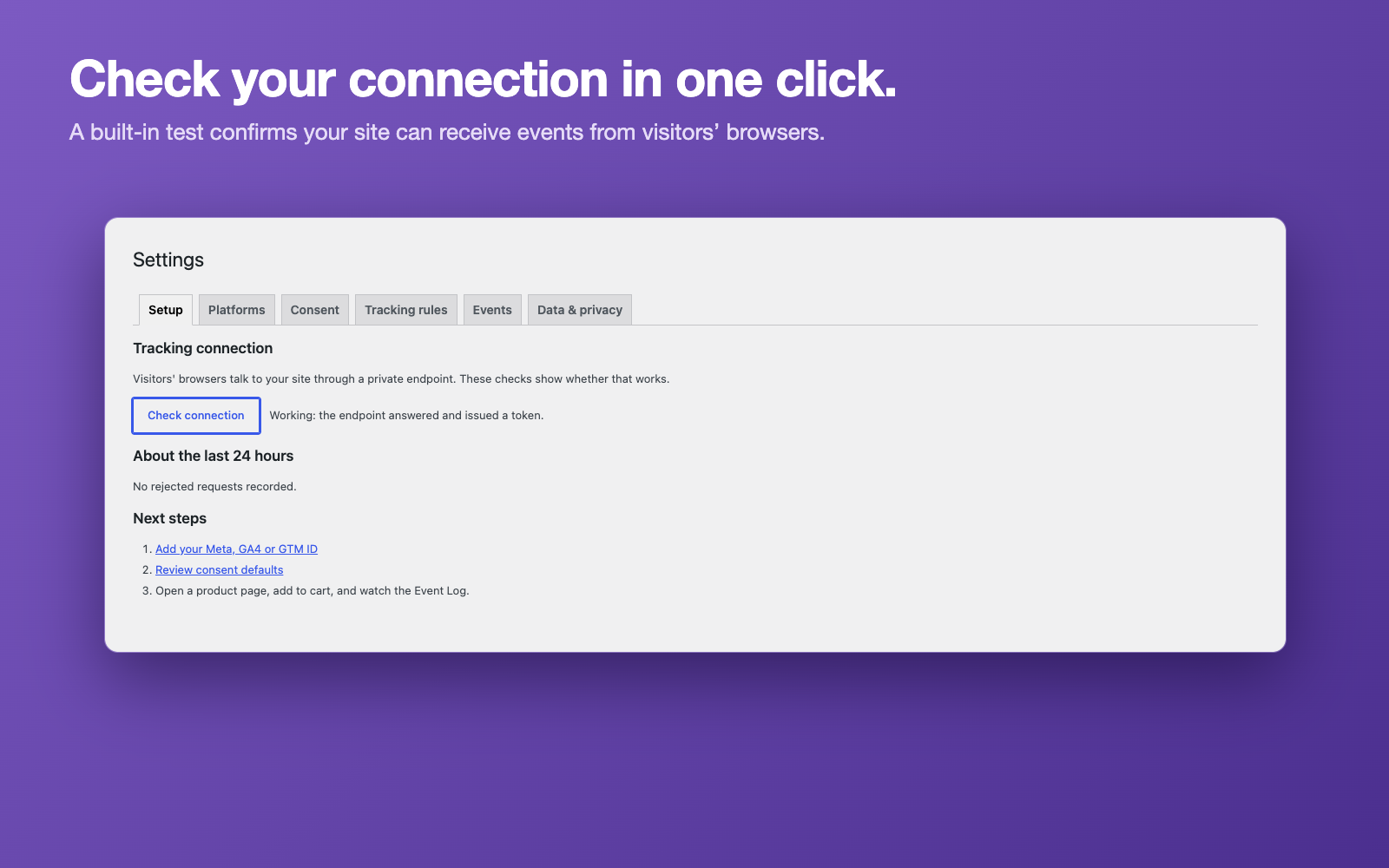
- Settings are now organised in tabs (Setup, Platforms, Consent, Tracking rules, Events, Data & privacy), with a connection self-check and a 24-hour summary of rejected requests on the Setup tab.
- Added Tracking rules: report purchase value as order total or items only, and choose whether on-hold orders count as purchases.
- Request limits now work behind proxies and CDNs when the proxy headers are trusted (filters
pixledger_trust_proxy_headersandpixledger_request_limit_per_minute). - A tag ID already running on the page from another plugin or tag is no longer started or fed twice; the event log records the skip.
- Purchase can be delivered from custom thank-you pages through a short-lived, order-bound cookie.
- Fixed: page views without a referrer reported the page itself as
page_referrer; videos without a source reported the page URL asvideo_src. - Fixed: a stray empty entry in the order’s browser-attempt record.
- Changed: the GA4 name of the 404 event is now
not_foundinstead ofnot_found404.
1.8.0
Consent
- Fixed: Events were logged as “Blocked” even after the visitor accepted cookies in Complianz. Consent is now read from the WP Consent API (when a banner is registered with it) and directly from Complianz’s own cookies
- Fixed: The WP Consent API is ignored when no banner plugin has registered with it, instead of treating every category as granted
- Fixed: Meta Pixel is no longer loaded, and no Meta events are sent, before the visitor gives marketing consent. It starts on the same page as soon as consent is given, and stops if consent is withdrawn
- Fixed: The Google Consent Mode default is now built from your settings only, and the visitor’s real choice is applied in the browser — safe with full-page caching
- Added: Consent changes made on the same page (WP Consent API / Complianz) are forwarded to Google Consent Mode without a reload
Tracking
- Fixed: Page views were counted twice in GA4 and Meta when the PageView event was enabled. When PixLedger loads the pixel itself, the pixel’s automatic page view is now skipped because PixLedger sends its own
- Fixed: Browser-side events (phone and email clicks, scroll depth, custom data-pxl-event and pxl(‘track’) events, and clicks or form submits that keep the visitor on the page) were logged but never delivered to GA4, GTM or Meta. They are now fired in the browser when consent allows. Events from clicks or form submits that navigate away are still logged, but may not reach the providers
- Fixed: Purchase no longer depends on the thank-you page template. It is sent on the order confirmation page whatever builds it (default template, block confirmation, Elementor or other custom templates), and on custom thank-you pages outside WooCommerce’s endpoint — including plugins that redirect away from the thank-you URL
- Fixed: Background requests that make WordPress render a page (scripts calling the server, missing images or files) were logged as page views and 404s, and could use up a pending event before the real page loaded. Only real page loads now count
- Fixed: Purchase was reported for failed payments, because WooCommerce runs its thank-you hook for those too. Failed and cancelled orders are never reported
- Fixed: AddPaymentInfo and AddShippingInfo did not fire with the WooCommerce block checkout, and were only logged (never sent to the providers) with the classic checkout. Both are now sent with the order confirmation, once per order
- Fixed: With GTM4WP’s WooCommerce tracking enabled, ecommerce events (view_item, add_to_cart, begin_checkout, purchase, …) were pushed to the dataLayer twice. PixLedger now skips its own push for those and logs them as “Deduped” with the reason
- Changed: Meta Pixel events that are not Meta standard events (including RemoveFromCart) are now sent with trackCustom
Caching
- Fixed: Pages carrying a visitor’s own events (add to cart, coupon, checkout) are excluded from full-page caches so they are not replayed to other visitors
- Fixed: On pages served from a full-page cache, Meta event IDs are made unique per visitor so Meta does not merge different visitors’ events
Security
- Hardened: all data written into PixLedger’s inline script is encoded so that no value (product names, order data, filter output) can break out of the script element
Housekeeping
- Fixed: The Event Log now honours the configured retention window by default
- Fixed: Uninstall now also removes per-event settings and rate-limit transients
- Added: Database schema upgrades now run automatically after a plugin update (tracked in pixledger_schema_version)
- Fixed: Readme referenced outdated table names and visitor ID format
1.6.5
- Changed: Plugin display name updated to “PixLedger – WooCommerce Conversion Tracking for Meta, GA4 & GTM” for clarity in WordPress.org search results
- Changed: Tags updated to woocommerce tracking, meta pixel, ga4, google tag manager, consent mode
- Note: No functional or tracking behavior changes — this is a listing/metadata update only
Screenshots

For developers
Is this your plugin? Show off the numbers.
Add a live badge to your site, docs or GitHub README. It updates on its own — no account needed.
Best PixLedger alternatives
All conversion tracking plugins →




FAQ
PixLedger: quick answers
Straight answers, pulled from live WordPress.org data.
Source: WordPress.org
Is PixLedger free?
Yes. PixLedger is free to download and use from the official WordPress.org plugin directory.
Is PixLedger safe to use in 2026?
PixLedger is a solid plugin choice in 2026, with a few things worth checking first. Was last updated 3 weeks ago, and scores 64/100 on our health check.
How many websites use PixLedger?
PixLedger is active on <10 WordPress websites and has been downloaded 412 times since it launched in June 2026. It was downloaded 131 times in the last 30 days.
Does PixLedger work with WordPress 7.1?
Yes. The developer has tested PixLedger up to WordPress 7.1.5, the latest release. It requires WordPress 6.3 or newer.
What PHP version does PixLedger need?
PixLedger requires PHP 8.1 or higher. Most hosts run PHP 8.x today, so it works on any modern WordPress hosting.
When was PixLedger last updated?
The latest version, 1.8.4, was released on October 27, 2026 (3 weeks ago).
Who makes PixLedger?
PixLedger is developed and maintained by mentotex.
What are the best alternatives to PixLedger?
The most popular alternatives to PixLedger are Pixel Manager for WooCommer… (40K+ installs), CallRail Phone Call Tracking (10K+ installs) and Conversios (10K+ installs).
Powered by PageForge
One template and a spreadsheet. A real page for every search.
PageForge turns each row of a CSV into a WordPress page with its own title, URL, SEO fields and schema, built on the layout you already designed. Free on WordPress.org.
- CSV and XLSX, plus Google Sheets on Professional and Enterprise
- Its own title, URL, SEO fields and schema for every page
- Works with the block editor, Elementor, Divi and Avada
- Free on WordPress.org, no credit card