



Pixel Manager for WooCommerce – Conversion Tracking, Google Ads, GA4, TikTok, Dynamic Remarketing
Conversion tracking for WooCommerce. Google Ads, GA4, Meta, TikTok, OpenAI (ChatGPT) & more. Recover 30% more conversions with server-side tracking!

Safe pick
Yes — Pixel Manager for WooCommerce is a safe, well-maintained plugin to use in 2026. It runs on 40K+ sites, is rated 4.9/5 and was last updated 3 days ago, and scores 90/100 on our health check.
- Proven at scale on 40K+ active sites
- Loved by users — 4.9/5 from 398 reviews
- Actively developed — last update 3 days ago
- Tested with the latest WordPress (7.1)
- Momentum — downloads up 21.2% vs the previous 30 days
How does it stack up?
Side-by-side on installs, updates, ratings & support



Daily downloads
Download spikes usually follow a new release — each site that auto-updates counts as a download.
Rankings
Where Pixel Manager for WooCommer… stands todayWordPress.org search rankings
Live position in the plugin search, top 100| Keyword | Position |
|---|---|
| conversion tracking | #1 |
| Facebook Pixel | #6 |
| google ads | #8 |
| google analytics | #29 |
| woocommerce | >100 |
Version adoption
Share of active sites per release.
Rating breakdown
★★★★★★★★★★ 4.9 from 398 reviews
About Pixel Manager for WooCommerce
From the official readme · v1.69.1Description
The Pixel Manager is the most complete conversion tracking plugin for WooCommerce. Set up Google Ads conversion tracking, Google Analytics GA4 e-commerce tracking, Meta/Facebook Pixel, TikTok Pixel, and more – in minutes, not hours. No coding required.
Unlike Google Tag Manager (GTM), which requires significant technical expertise to configure WooCommerce e-commerce tracking correctly, the Pixel Manager provides a turnkey solution with over 12 years of development. It automatically handles edge cases like payment gateway redirects, order duplication prevention, and consent mode – all the things that take hours to get right with manual tag management.
🆕 New: Conversion tracking for OpenAI ads on ChatGPT
OpenAI is rolling out advertising on ChatGPT, and the Pixel Manager is one of the first WooCommerce plugins to support it. The free version installs the OpenAI browser pixel with the full shopping funnel, and the Pro version adds a server-side Conversions API connection and Advanced Matching – so you can measure exactly which purchases your ChatGPT ads drive, from day one. Also new: Microsoft Clarity heatmaps and session recordings (Pro, beta), and the rebuilt, faster Nova admin interface (free).
🚀 Endorsed by Google’s Tag Team
This plugin was recommended to us by Google’s Tag Implementation Team. That should say enough.
This plugin was demonstrated to me by a Google Tagging Support person. ‘nough said 🙂
We’re using this for our biggest clients and it’s working great!
Pixel Manager for WooCommerce is the go-to plugin for both tech wizards and casual users.
What makes the Pixel Manager different?
Most WooCommerce tracking plugins only handle the basics: firing a conversion pixel on the thank you page. The Pixel Manager goes much further. It tracks the entire e-commerce customer journey – from product impressions and add-to-cart events through checkout and purchase – across all major advertising and analytics platforms simultaneously. This gives you complete data for conversion optimization, dynamic remarketing audience building, and accurate ROAS reporting.
The Pro version adds server-side tracking (Conversion API / CAPI) that sends conversion data directly from your server to advertising platforms. This bypasses browser limitations like ad blockers, Safari ITP cookie restrictions, and network issues – typically recovering up to 30% more conversions that browser-only tracking misses. Our unique Automatic Conversion Recovery (ACR) feature goes even further by automatically identifying and recovering missed conversions nightly.
Key Benefits
✅ Easy setup – just enter your tracking IDs and you’re done.
✅ Accurate e-commerce event tracking across all platforms.
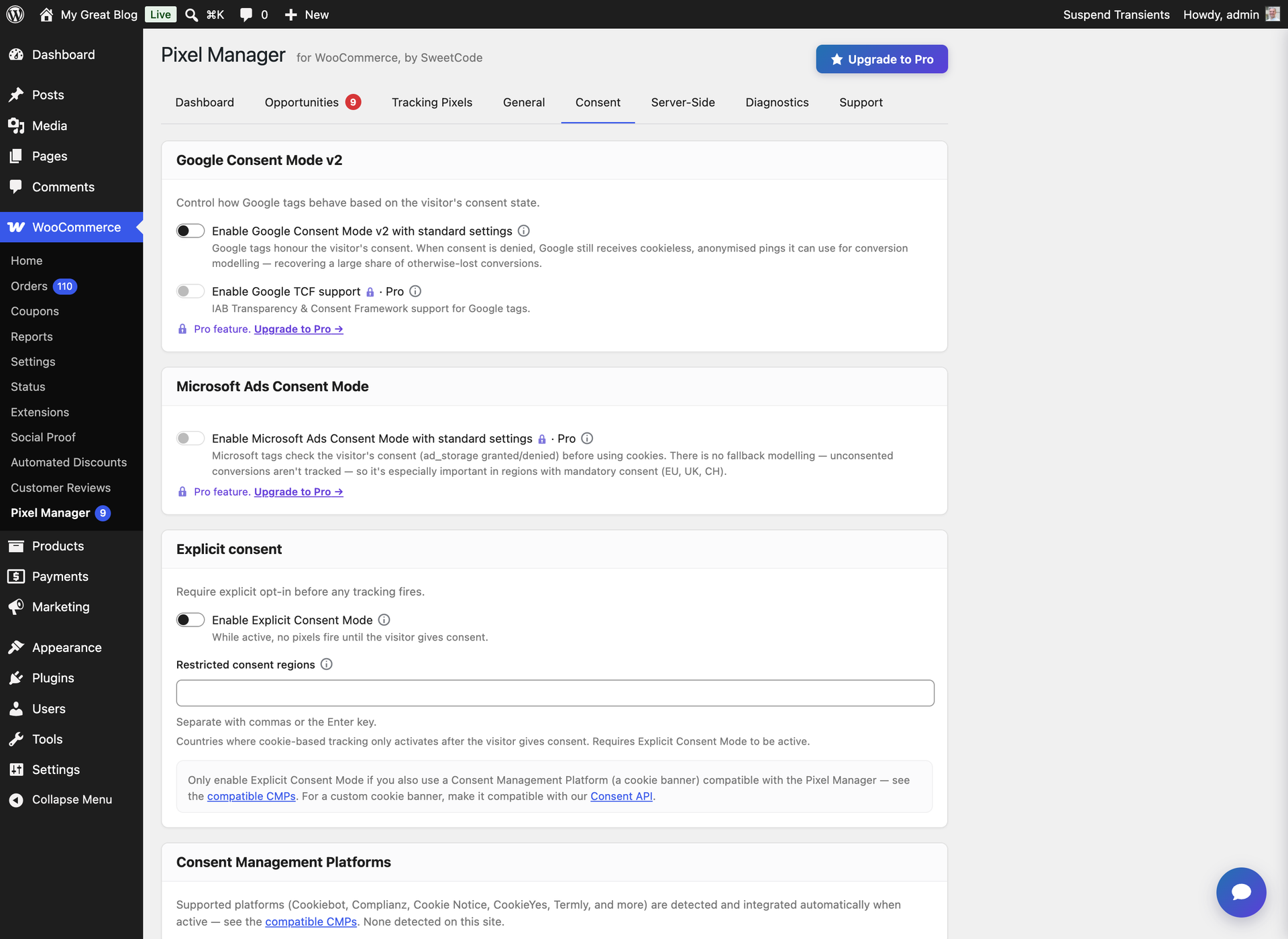
✅ GDPR and CCPA compliant with Google Consent Mode v2.
✅ Works with 15+ consent management platforms out of the box.
✅ Lightweight – won’t slow down your WooCommerce store.
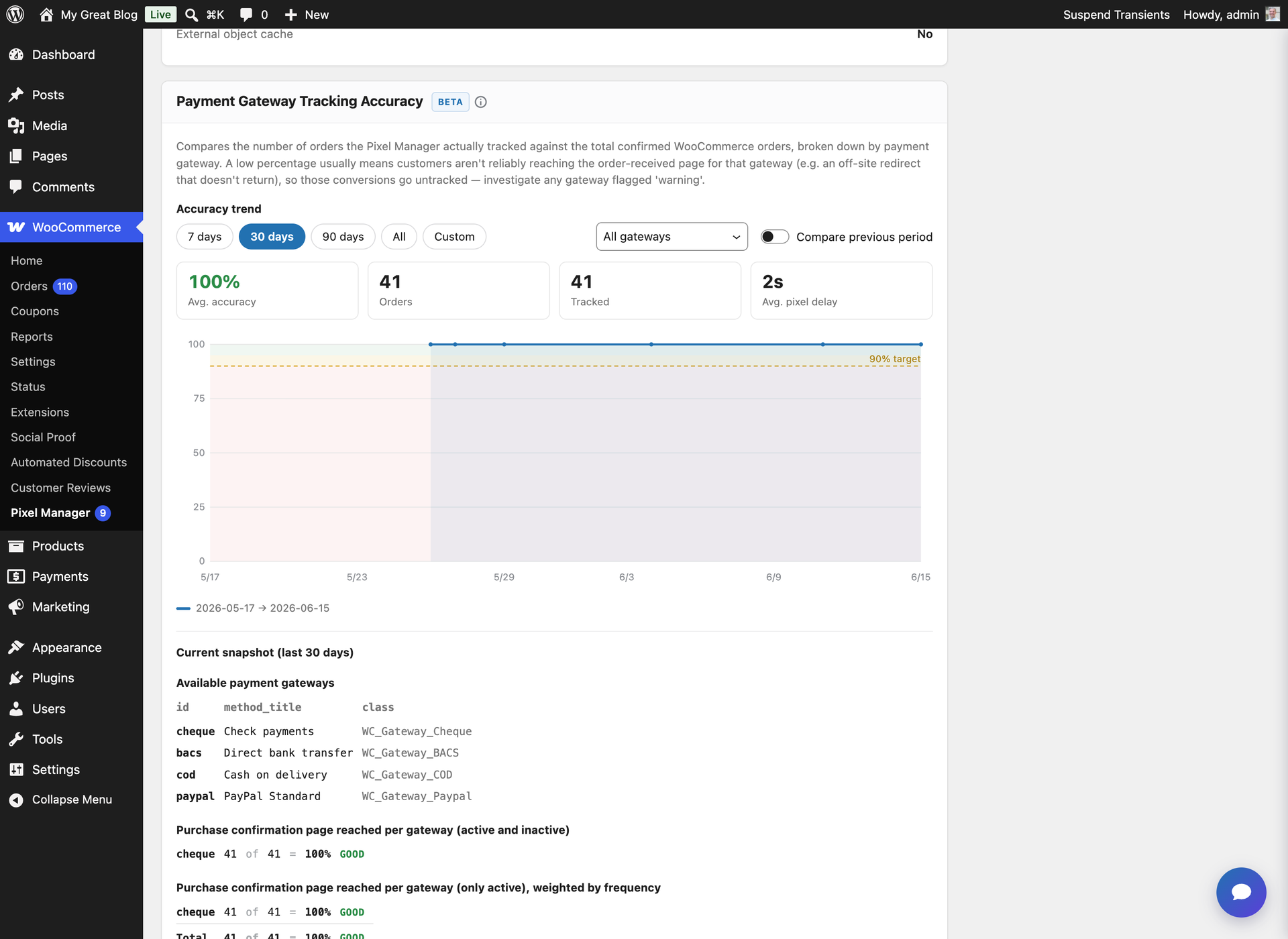
✅ Payment Gateway Accuracy Report – diagnose conversion tracking drops.
✅ Automatic Conversion Recovery (ACR) – recover lost conversions (Pro).
✅ OpenAI ads (ChatGPT) conversion tracking – browser pixel free, server-side (Pro).
✅ AI-ready – AI agents can safely configure the plugin through the WordPress Abilities API.
Free Tracking Pixels
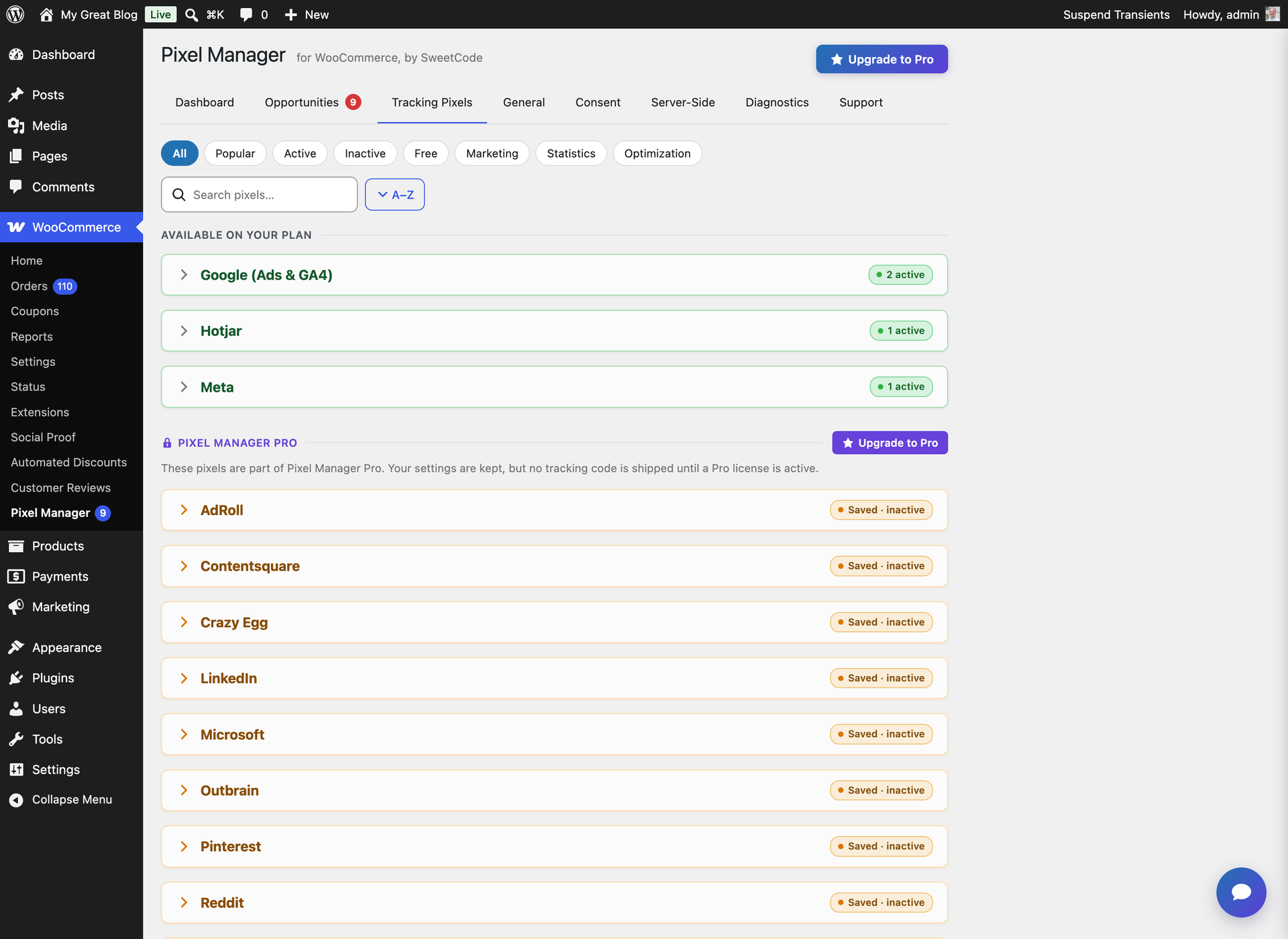
- Google Ads Pixel – conversion value tracking, dynamic remarketing, cart item data
- Google Analytics Pixel (GA4) – full Enhanced E-Commerce tracking
- Meta Ads Pixel (Facebook Pixel) – remarketing events and custom audiences
- TikTok Pixel – full shopping funnel from product view to purchase
- Microsoft Ads UET Tag (Bing Ads) – conversion tracking, dynamic remarketing and Microsoft Ads Consent Mode
- Pinterest Tag – shopping funnel events with product data
- Reddit Pixel – shopping funnel events with product data
- Snapchat Pixel – shopping funnel events with product data
- OpenAI Pixel – conversion tracking for ads on ChatGPT
- Hotjar Pixel – heatmaps and session recordings
The server-side connections behind these pixels (Conversions API, Events API), Advanced Matching, Enhanced Match and Enhanced Conversions are part of the Pro version.
Free Features
- Google Tag Gateway for Advertisers – first-party tracking through Google’s servers
- Google Consent Mode v2 – full compliance with EU, UK, and US privacy regulations
- Google Ads Dynamic Remarketing – build audiences based on product interactions
- Google Ads Cart Item Tracking – feed cart data to Smart Shopping and Performance Max campaigns
- Google Shopping New Customer Parameter – optimize for new customer acquisition
- GA4 Enhanced E-Commerce – track product impressions, add to cart, checkout steps, and purchases
- Meta Remarketing Events – ViewContent, AddToCart, InitiateCheckout, Purchase
- Basic Order Duplication Prevention – avoid counting the same conversion twice
- Customizable filters – fine-tune tracking output for your specific setup
- Lazy-loaded product list support – works with infinite scroll and AJAX product loading
- Payment Gateway Accuracy Report – identify which payment gateways cause conversion tracking drops
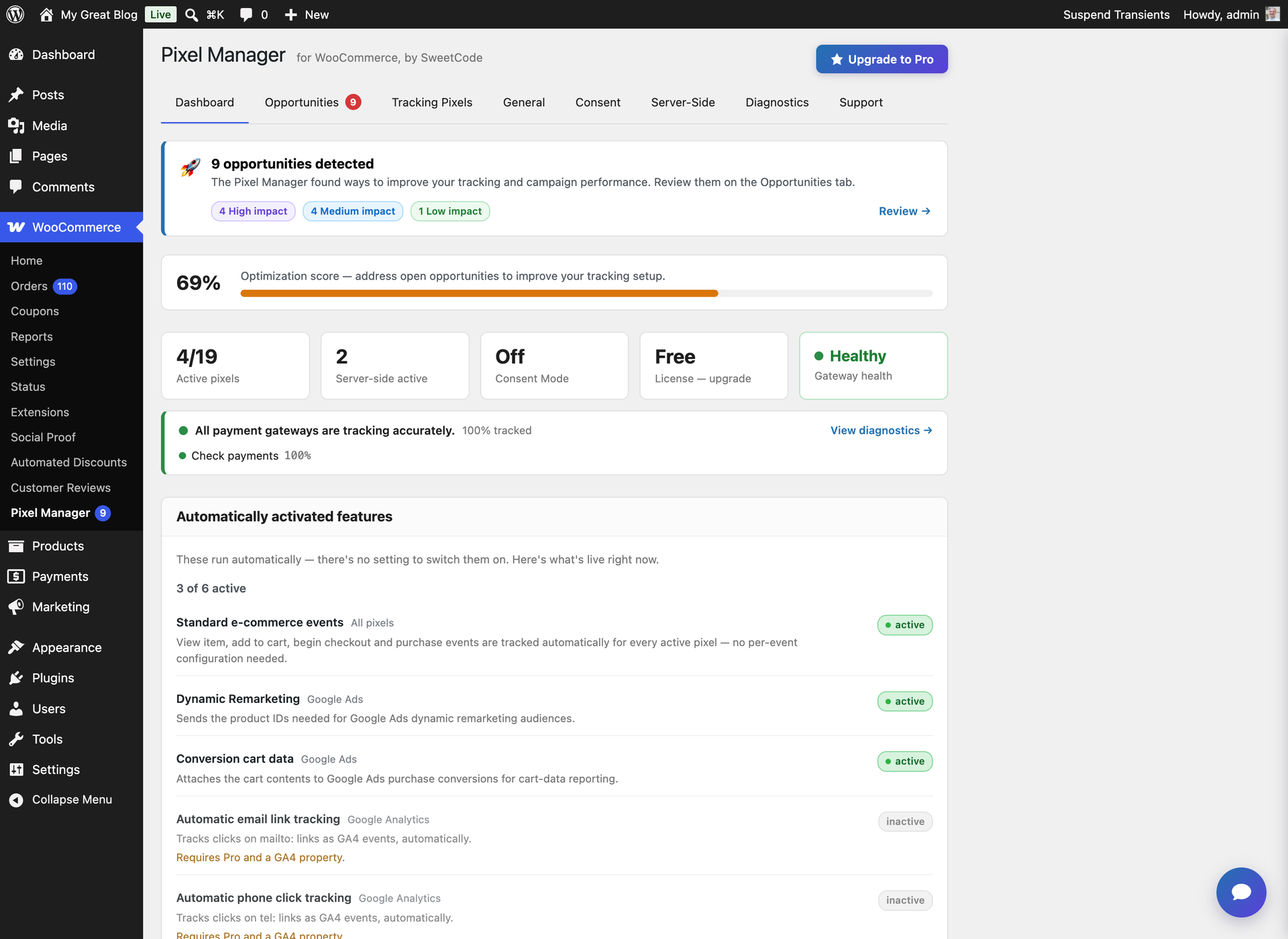
- Nova admin interface – rebuilt from the ground up, faster and cleaner, with a getting-started checklist for new installs
- Abilities API integration – AI agents (Claude, ChatGPT, and others) can discover, read, and safely update your tracking settings
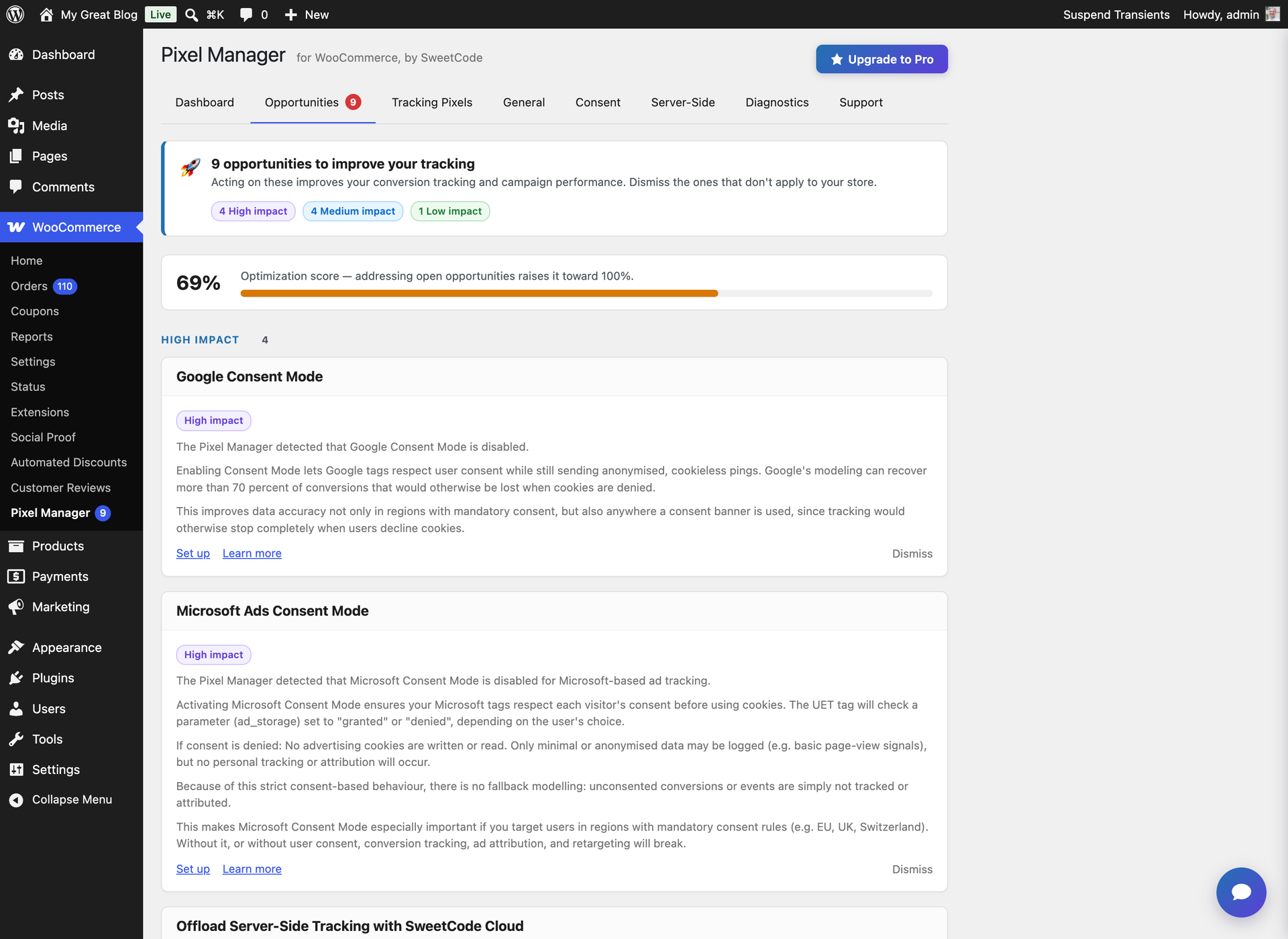
- Opportunities – prioritized, actionable suggestions to improve your tracking and campaign performance
Have a look at the full feature list over here.
Premium Tracking Pixels
- AB Tasty – A/B testing and personalization (beta)
- Adroll Ads
- Contentsquare Statistics
- CrazyEgg Analytics
- Criteo Ads – retargeting and audience events through the Criteo OneTag (beta)
- GroundTruth Ads – omnichannel engagement and conversion tracking (beta)
- Hyros – ad attribution through the Hyros Universal Script with funnel milestone tags (beta)
- LinkedIn Ads
- Microsoft Clarity – heatmaps and session recordings with e-commerce events (beta)
- Mixpanel – product analytics with the full shopping funnel, server-side purchases through the Ingestion API, session replay and user identification (beta)
- Klaviyo – consent-gated onsite tracking alongside the Klaviyo plugin, with reliable Started Checkout on custom checkouts, cart, collection and search events, and server-side orders through the Events API (beta)
- Nextdoor Ads – conversion tracking through the Nextdoor Universal Pixel (beta)
- Optimizely – experimentation and feature testing (beta)
- Outbrain Ads
- Spotify Ads – conversion tracking through the Spotify Ad Analytics pixel, with the full shopping funnel and server-side events through the Conversions API (beta)
- Taboola Ads
- Triple Whale – browser pixel and checkout funnel for stores connected to Triple Whale (beta)
- X (Twitter) Ads
- VWO (Visual Website Optimizer) – A/B testing
Premium Features
- Automatic Conversion Recovery (ACR) – automatically recover missed conversions nightly
- Server-side tracking (CAPI) – Meta, TikTok, Pinterest, Snapchat, Reddit, OpenAI, Nextdoor, Spotify, Microsoft Ads, GA4 Measurement Protocol
- Advanced Order Duplication Prevention
- Google Ads Enhanced Conversions – first-party data for improved attribution
- Google Ads Conversion Adjustments – send refund data back to Google Ads
- Scroll Tracking – measure how far visitors scroll on your pages
- Automatic Phone and Link Click Tracking
- Customer Lifetime Value on orders – the basis for value-based bidding and high-value-customer audiences
- Always send server-side events – recover conversions even when the browser pixels never loaded
- Server-side PageView events – reliable PageViews for Meta and Snapchat when browser tracking is blocked
- Lazy-loading the tracking library – defer it to the first interaction for better page-speed scores
- Subscription value multiplier – report sign-ups at their expected lifetime value
- Disable tracking for specific user roles – keep staff and test accounts out of your data
- Google TCF support – IAB Transparency and Consent Framework support for Google tags
Have a look at the full feature list over here.
Ready to recover lost conversions and get accurate tracking data? Visit sweetcode.com to learn more about the Pro version.
Documentation
Comprehensive setup guides, troubleshooting, and API references: Open the documentation
News
Consent Management
The Pixel Manager integrates with all major Consent Management Platforms (CMPs) to ensure your tracking pixels respect visitor consent choices. It supports Google Consent Mode v2, including region-specific consent defaults for the EU, UK, and US states with privacy regulations.
Compatible consent management plugins:
- Beautiful and Responsive Cookie Consent
- Cookiebot
- Cookie Confirm
- Cookie Script
- Complianz GDPR/CCPA Cookie Consent
- Cookie Notice
- Cookie Notice & Compliance for GDPR / CCPA
- Cookie Law Info
- FAZ Cookie Manager
- GDPR Cookie Compliance
- WP AutoTerms
- CookiePro by OneTrust
- Termly
- Iubenda
- WP Consent API
- WP Cookie Consent
Please read the following for additional setup information
Requirements
Security Review
Although we follow security best practices, we wanted to ensure that we didn’t miss anything. So, we had the plugin reviewed by Patchstack, a cybersecurity company specializing in WordPress security.
The summary of their report was: “We were unable to detect any vulnerabilities that would impact the security status of the plugin in a serious way.”
Managed Vulnerability Disclosure Program
We are committed to ensuring the security of our customers and their data. If you believe you have found a security vulnerability in the Pixel Manager for WooCommerce, we encourage you to report it through Patchstack our security partner. Patchstack runs a managed Vulnerability Disclosure Program (mVDP) that helps us receive, triage, and respond to reported vulnerabilities. Patchstack also provides a reward for the responsible disclosure of security vulnerabilities. Report a vulnerability
Installation
-
Upload the plugin directory into your plugin’s directory
/wp-content/plugins/ -
Activate the plugin through the ‘Plugins’ menu in WordPress
-
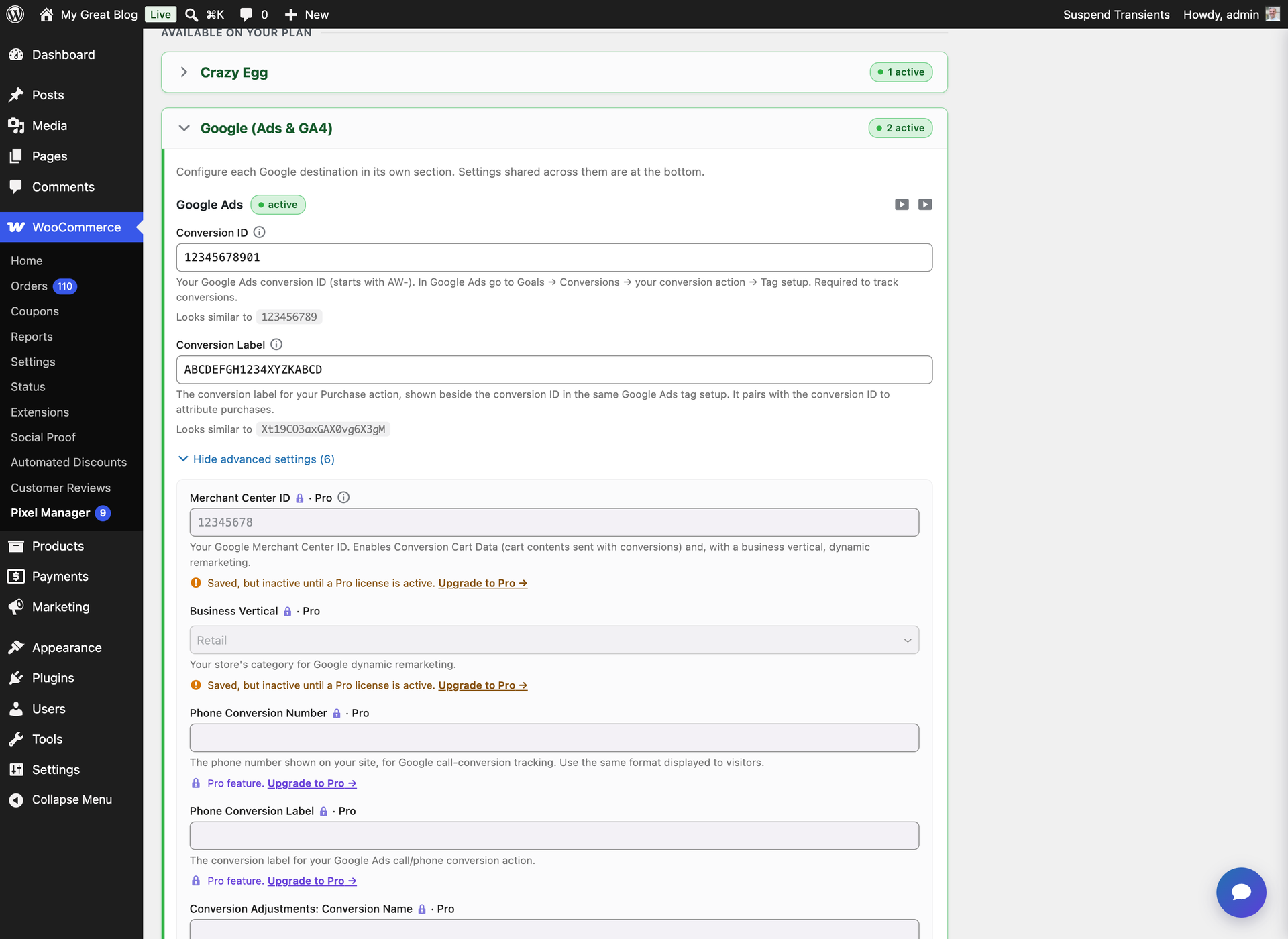
Get the Google Ads conversion ID and the conversion label. You will find both values in the Google Ads conversion tracking code. Get the conversion ID and the conversion label
-
In the WordPress admin panel go to WooCommerce → Pixel Manager, open the ‘Tracking Pixels’ tab and expand the ‘Google (Ads & GA4)’ section. Please enter the conversion ID and the conversion label into their respective fields.
-
Head over to our documentation and follow our installation guides. Here are some of our most popular guides:
-
And read through our FAQ.
Frequently asked questions
How does Pixel Manager compare to Google Tag Manager (GTM)?
While Google Tag Manager is free, it requires significant technical expertise and many hours of configuration to set up proper WooCommerce e-commerce tracking. You need to create custom data layers, configure triggers and tags for each platform, handle consent mode integration manually, and test extensively to avoid tracking errors. The Pixel Manager provides a turnkey alternative that’s optimized specifically for WooCommerce with over 12 years of development. It automatically configures the correct e-commerce events, handles edge cases like payment gateway redirects and order deduplication…
What is server-side tracking (Conversion API / CAPI) and why does it matter?
Server-side tracking sends conversion data directly from your WooCommerce server to advertising platforms like Meta (Facebook), TikTok, Pinterest, Snapchat, Reddit, OpenAI, and Google Analytics 4 – rather than relying solely on browser-based pixels. This results in more reliable, accurate tracking because it works even when browser tracking is limited by ad blockers, Safari ITP cookie restrictions, browser privacy settings, VPNs, or network issues. Our Pro version typically recovers up to 30% more conversions compared to browser-only tracking, directly improving your campaign optimization and…
Can I track conversions from OpenAI ads on ChatGPT?
Yes. The Pro version includes an OpenAI tracking pixel with browser-side conversion tracking, a server-side Conversions API connection, and Advanced Matching for improved event matching. You only need to enter your OpenAI pixel ID and, for server-side tracking, a Conversions API token. Purchase conversions are always sent server-side for maximum reliability, so you can accurately measure which sales your ads on ChatGPT generate.
How does Automatic Conversion Recovery (ACR) work?
ACR is our unique Pro feature that automatically recovers conversions missed due to tracking issues – whether from payment gateway redirects (like PayPal), browser limitations, ad blockers, or network problems. It runs nightly using the WordPress Action Scheduler, identifies WooCommerce orders that weren’t properly tracked by your advertising pixels, and sends the conversion data to your advertising platforms retroactively (within the allowed attribution windows). This can recover approximately 50% of otherwise lost conversions, directly improving your Google Ads, Meta, and TikTok campaign…
Does the Pixel Manager support Google Consent Mode v2?
Yes. The Pixel Manager fully supports Google Consent Mode v2, including the new ad_user_data and ad_personalization parameters required by Google since March 2024. It also supports region-specific consent defaults for the EU, UK, and 11+ US states with privacy regulations. The plugin integrates with 15+ consent management platforms (CMPs) out of the box, automatically adjusting tracking behavior based on visitor consent choices. This ensures your WooCommerce store is compliant with GDPR, CCPA, and other privacy regulations while still collecting the maximum amount of conversion data allowed.
What WooCommerce e-commerce events does the Pixel Manager track?
The Pixel Manager tracks the complete e-commerce customer journey: product list views (impressions), product detail views, add to cart, remove from cart, begin checkout, add payment info, and purchase events. These events are sent simultaneously to all configured tracking pixels (Google Ads, GA4, Meta, TikTok, etc.) with standardized product data including product ID, name, category, brand, price, and quantity. This comprehensive event tracking powers Google Analytics GA4 Enhanced E-Commerce reports, Google Ads Smart Shopping and Performance Max campaigns, Meta dynamic remarketing ads, and…
Can I use the Pixel Manager to track Google Ads conversions on WooCommerce?
Yes. The Pixel Manager makes Google Ads conversion tracking setup on WooCommerce straightforward. Simply enter your Google Ads Conversion ID and Conversion Label, and the plugin automatically tracks purchase conversions with accurate order values, fires dynamic remarketing events for audience building, sends cart item data to optimize Performance Max and Shopping campaigns, tracks the Google Shopping new customer parameter for new customer acquisition campaigns, and supports Enhanced Conversions (Pro) for improved attribution using first-party data.
Will the Pixel Manager slow down my WooCommerce store?
No. Performance is a core design priority. The back-end code is small and efficient with fast, cached database queries. Larger tasks like ACR processing run during off-peak hours using the WordPress Action Scheduler. The front-end JavaScript library is compiled, tree-shaken to only load code for active pixels, minified, and pre-compressed with gzip and brotli. The Pro version adds lazy loading of the tracking library to further reduce impact on page load time. Many users report the Pixel Manager is faster than alternative tracking plugins and significantly lighter than a comparable Google Tag…
Is there detailed documentation for the plugin?
Yes. Head over to this link: Documentation
How do I check if the plugin is working properly?
Turn off any kind of caching and / or minification plugins. Log out of the shop. Turn off any kind of ad or script blocker in your browser. Search for one of your keywords and click on one of your ads. Purchase an item from your shop. Wait up to 48 hours until the conversion shows up in Google Ads. (usually takes only a few hours) With the Google Tag Assistant you will also be able to see the tag fired on the thankyou page.
HPOS (High Performance Orders Storage)
The Pixel Manager is ready for the new WooCommerce High Performance Orders Storage (HPOS) feature.
Plugin compatibility
Our plugin is designed to work seamlessly with 99.99% of all other plugins. In the rare event of a conflict with a third-party plugin, we typically identify a fix or workaround quickly. To illustrate its broad compatibility, here are a few examples of third-party plugins that work well with the Pixel Manager: Async Javascript Automptimize CartFlows Cloudflare Plugin Cost of Goods for WooCommerce (WPFactory) Doofinder for WooCommerce FlyingPress Hummingbird Litespeed Cache Litespeed ESI NitroPack Siteground Optimizer W3 Total Cache WooCommerce Brands WooCommerce Composite Products WooCommerce…
Do you have videos that show how to set up the plugin and get most out of it?
Yes, they are part of the step by step documentation. Head over to this link: Documentation
I get a fatal error and I am running old versions of WordPress and/or WooCommerce. What can I do?
As this is a free plugin we don’t support old versions of WordPress and WooCommerce. You will have to update your installation.
I am using an offsite payment gateway and the conversions are not being tracked. What can I do?
Offsite payment gateways (like PayPal Standard) redirect visitors away from your WooCommerce store during checkout, which can prevent browser-based conversion tracking from firing. The free version cannot fully solve this, but the Pro version’s Automatic Conversion Recovery (ACR) feature specifically addresses this problem by detecting untracked orders and sending the conversion data server-side. We generally recommend using direct payment gateways (like Stripe, PayPal Commerce Platform, or Mollie) for the best tracking accuracy and higher conversion rates.
I’ve done everything right in the test, but it still doesn’t work. What can I do?
Here is a non-exhaustive list of causes that might interfere with the plugin code. Minification plugins try to minify the JavaScript code of the plugin. Not all minification plugins do this good enough and can cause problems. Turn off the JavaScript minification and try again. Caching could also cause problems if caching is set too aggressively. Generally don’t ever enable HTML caching on a WooCommerce shop, as it can cause troubles with plugins that generate dynamic output.
I see issues in the backend of my shop. Admin pages get rendered weird, and popups don’t go away when I click to close them. How can I fix this?
You probably have some script or ad blocker activated. Deactivate it and the issues should go away. Usually you can disable the blocker for just that particular site (your WooCommerce back end). Our plugin injects tracking pixels on the front end of WooCommerce shops. As a consequence scripts of our plugin have been added to some privacy filter lists. The idea is to prevent the scripts running if a shop visitor has some ad blocker enabled and wants to visit the front end of the shop. This is totally ok for visitors of the front end of the shop. But, it becomes an issue for admins of the shop…
Where can I report a bug or suggest improvements?
Please post your problem in the Pixel Manager for WooCommerce Support forum: Link You can send the link to the front page of your shop too if you think it would be of help.
How can I report security bugs?
You can report security bugs through the Patchstack Vulnerability Disclosure Program. The Patchstack team helps validate, triage, and handle any security vulnerabilities. Report a security vulnerability.
Changelog
1.69.1
Release date – 22.09.2026
- Fix: A post title can no longer break out of the data layer script. WordPress keeps the entities of a closing script tag in a title saved by a Contributor, and the plugin decoded them right before writing the title into its inline script, so the markup after that tag ran on every view of the post. Every inline script now escapes its angle brackets
- Tweak: Every value the plugin prints into a script, an attribute or a link now goes through the escaping function that fits that exact position, so a value that a validation rule stops today stays harmless if that rule ever loosens. None of the corrected sites was exploitable
- Fix: The browser-to-server event endpoint refuses a purchase named inside a pixel’s own object. It only checked the wrapper’s event field, so an unauthenticated request could hand a fabricated purchase with any value straight to a merchant’s Conversions API. Every pixel object is now searched for a purchase event name, and purchases only ever leave through the order hooks
- Fix: A URL that merely carries an order key no longer turns the front page, an archive or a search result into the order confirmation. The plugin printed that order’s customer data into whatever page the key was appended to, and looked the key up however it was shaped. Confirmation pages are also sent with no-cache headers now
- Fix: The public rate limits count the connecting address first. The visitor address comes from proxy headers any client can set, so a rotating header used to hand out a fresh allowance per request and write a database row for each one. A real proxy still gets an allowance per visitor behind it
- Fix: The Google Tag Gateway proxy no longer forwards the visitor’s WordPress login and WooCommerce session cookies to Google’s servers, no longer follows an upstream redirect on the server, and relays only the response headers a browser needs, so a policy header from upstream cannot apply to the shop’s own origin
- Tweak: A settings import now runs every field through the same validator as the settings page, drops keys that are not settings, refuses a schema version the plugin does not know and, on a free tier, keeps the stored values of Pro-only settings. It used to check that a few keys exist and store the file as it was
- Tweak: The products data layer cache is capped at 50 entries per page, an order key must look like one before it is looked up, click IDs from the landing URL are validated like those from cookies, the settings version can no longer be written as if it were a setting, log downloads are limited to the plugin’s own logs, the log redaction masks email addresses, and the Hyros referrer URL is encoded in full
1.69.0
Release date – 21.09.2026
- Fix: A product a shopper adds while the plugin is reading the cart stays in the cart. WooCommerce serves the plugin’s requests with the whole session loaded and writes all of it back at the end, so a request that only reads could still put the older cart back and the added item vanished in front of the shopper. The plugin’s requests now persist nothing, and the one that has to write refreshes the cart first
- Fix: On shops that run iubenda, the visitor’s consent is read at last. iubenda names its cookie after the site ID by default, and the Pixel Manager knew only the older cookie policy ID name, so every category stayed denied and every marketing pixel blocked. It now also reads iubenda’s legacy cookie, and ignores one that states no purposes instead of raising an error
- Fix: An interface whose name carries no
Interface_prefix is now found by the plugin’s autoloader. Three of them, among them the pixel adapter contract every server-side pixel implements, were reachable only because four places required their file by hand, so any other code path that touched them ended in a fatal error - Fix: A checkout started from the mini cart now carries the cart’s products, value and currency. The plugin left the cart empty while it re-read it from the server, and a checkout click is sent the moment it happens, so the event went out hollow on product and category pages
- Fix: An add to cart or add to wishlist event that reaches the Facebook pixel without product data no longer disappears. The adapter read the missing product and threw, so the event was lost from the browser pixel and the Conversions API alike. Meta needs the product on both events, so a productless one is now skipped cleanly
- Fix: The Diagnostics accuracy trend no longer crashes the admin interface when a custom date is typed rather than picked. A date field reports itself as empty for as long as a typed entry is incomplete, and that empty value reached the report’s date arithmetic while the page was being drawn, so the whole interface dropped to its error screen
- Fix: A blocked Google tag no longer fills the shop’s error tracking with stackless noise. When a content blocker kept the tag from loading, every Google Ads and Google Analytics event raised a promise rejection that carried no message at all, so the recorded entries named neither a cause nor a source. The wait now fails with a reason, and every event handles it
- Fix: The Google Tag Gateway health check can no longer be answered from a cache. It carried no cache headers at all, and a shop was found serving it from its CDN with a 30 day lifetime, so the check reported the gateway healthy by replaying the last time it had been
- Tweak: The Tag Gateway measurement path field now recommends an unguessable path instead of suggesting
/metrics. That is Google’s own example, so a great many shops share one predictable path, which is what makes a blocker rule worth writing against all of them at once
1.68.0
Release date – 14.09.2026
- New: The TikTok, Microsoft Ads, Pinterest, Snapchat, Reddit and OpenAI browser pixels are now part of the free plugin, together with Microsoft Ads Consent Mode. The Conversions API and Events API connections, Advanced Matching, Enhanced Match and Enhanced Conversions for these platforms stay in the Pro version
- New: The new
pmw_order_shipping_profitfilter adds the shipping economics of an order to the profit margin. The calculation leaves shipping out on both sides, because WooCommerce records what the customer was charged but never what the carrier charged the shop, so shops had to rebuild the whole margin to account for it - New: With the Marketing value logic set to Profit margin, an alert now names how many recent orders contain a product the plugin knows no cost for, and the new
Profit_Margin::order_has_complete_cogs()helper answers that for a single order. Such products count with a cost of zero, so their whole revenue is reported as profit - New:
pmw.trackCustomGoogleAdsConversion()sends a conversion to a conversion action of your own, applying the same marketing consent gate and the same wait for the Google tag as the plugin’s own Google Ads conversions. A hand-writtengtag()call sent nothing at all on shops that defer or delay JavaScript - New: The Abilities API now offers every setting the admin interface offers. Ten were missing, among them the lifetime value calculation, the logger and the server-side tracking toggles, so an AI agent was blind to a part of the plugin a shop owner could see
- Tweak: X (Twitter) now counts as a popular pixel on the Tracking Pixels tab, so it shows under the Popular filter and in the popular group of the pixel list
- Tweak: An opportunity card for a Pro feature now says so on installs that cannot use it and carries the upgrade button, and the Payment Gateway Tracking Accuracy alert names server-side tracking and Automatic Conversion Recovery as the fix for the untracked orders it lists. Both only linked to the documentation before
- Tweak: The Consent Management Platforms card no longer reads “None detected on this site” when it finds no cookie banner plugin. It now says that only platforms installed as a WordPress plugin can be listed there, that a platform loaded as a script works on the shop all the same, and how to confirm that in the browser console
- Tweak: With “Always send server-side events” enabled, the Payment Gateway Tracking Accuracy report stops offering that setting as the fix for orders excluded because the visitor denied all consent categories. It now says those conversions were still sent server-side and only stay out of the report because the report measures the browser, and the order records that too
- Tweak: When the accuracy trend compares two periods, it now names how much of the change comes from orders that left the report because the visitor denied all consent categories, and what the change is with those orders counted as untracked in both periods. A shift in that population moves the average accuracy on its own, without a single additional purchase being measured
- Tweak: A script that takes over the plugin’s
pmwobject now reports itself through the newpmw:warning:global-replacedevent and a running count onpmw.globalGuard, not only as a console warning. The shop that reported this could confirm that the errors had stopped but not how often the race still happened, because its analytics tool records errors and not warnings - Tweak: The extra order data output on order pages is no longer marked as a Pro setting. The plugin allowed it on the free version everywhere except the settings interface, which locked the toggle
- Tweak: The Pinterest events now carry the product brand and category, on the browser pixel and on the Conversions API. Pinterest lists both among the parameters it wants on a checkout and reads their absence as a coverage gap, which holds its automated bidding back
- Tweak: The direct integrations for Borlabs Cookie and Real Cookie Banner have been removed. Direct support for both was deprecated in 1.41.1, and both still reach the plugin through Google Consent Mode update calls, which the plugin reads like any other consent signal
- Tweak: The HTTP request logging setting is no longer marked as a Pro setting. It sits in the otherwise free logger group, and the plugin allowed it on the free version everywhere except the settings interface
- Fix: Under WooCommerce’s built-in Cost of Goods Sold, a variation that inherits or adds to its parent’s cost is priced with that cost at last. The plugin read a meta field that only exists on order line items, so those variations counted with a cost of zero and their whole revenue was reported as profit
- Fix: Pricing an order no longer writes a WooCommerce “doing it wrong” notice into the log for every line item on shops with the built-in Cost of Goods Sold enabled. The cost was read with the generic meta accessor, which WooCommerce answers from the same getter anyway and warns about on the way
- Fix: The lifetime value calculation on orders now asks for an active Pro license everywhere. Its settings field, the route that schedules a recalculation and the calculation itself did not, so it was reachable on the free version and a Pro shop whose license had lapsed kept recalculating its whole order history
- Fix: The trial card on the dashboard no longer claims that no credit card is required. The 14-day trial does ask for a card at checkout, so the card now says so and that cancelling before the trial ends costs nothing
- Fix: A consent tool in auto-blocking mode, such as Cookiebot, could run the plugin’s configuration line again after the tracking library had started, which replaced the library’s object and silently stopped add-to-cart, product click and checkout tracking. The configuration now merges into that object, and the library restores it if another script replaces it
- Fix: A tracking library that stops starting up part way through now reports it in the console, and through the new
pmw:error:init-abortedevent, instead of leaving the shop partially tracked without a word. The listener files no longer depend on the load order for the functions they use while they register - Fix: On shops that run CookieYes, the visitor is no longer treated as having answered the cookie banner before they have. CookieYes writes its consent cookie, and fires its consent update event, on the first page view already, in shapes that carry a consent value but no answer, and reading any of those as a choice skipped the region check, so visitors outside the configured Explicit Consent Regions stayed blocked
- Fix: The Cookiebot and OneTrust consent readers now deny a category their cookie does not name instead of granting it. A OneTrust cookie that carries no consent groups, which OneTrust also writes for its own bookkeeping, is ignored rather than raising an error, and one written before the visitor answered the banner no longer counts as a decision
- Fix: On shops that run OneTrust or CookiePro with its standard cookie categories, the visitor’s choice is read at last. The Pixel Manager only understood the plain group numbers, not the C0001 to C0004 ids OneTrust ships by default, so neither the consent cookie nor the consent change event told it anything
- Fix: A
gtag('consent', 'update')issued by a cookie banner itself is no longer stored as the Pixel Manager’s own decision. That record has no expiry and outlived the banner that made it, so a decline kept declining after the banner had forgotten it. Such an update can also no longer deny the necessary category - Fix: On shops that run Complianz, Complianz’ own Google Consent Mode is switched off while the Pixel Manager’s is active, the same as for Cookiebot. Two consent default blocks on one page compete and the last one wins, so the pixels could run against a default consent state the Pixel Manager never set
- Fix: Requests for the Google Tag Gateway service worker that arrive after the measurement path was changed or removed are now answered with a 410 before WordPress runs its query and renders a 404 page. Browsers send one per visit until the old worker is gone, and on a busy shop each one held a PHP worker for seconds
- Fix: One shopper action that the theme, a funnel builder or WooCommerce itself reports twice is now counted once. Each pass carried its own event ID, so a single product view or add to cart reached Pinterest, Meta and GA4 several times, on the browser pixel and on the server-side API alike
- Fix: A Pro setting submitted through the Abilities API on a site without an active Pro license is now refused instead of saved. It was stored with a note that it would not take effect, which left a configuration the plugin could not act on, while the REST API refused the very same value
- Fix: The remove from cart event fires again on the cart and the mini cart. A cart synced from the server replaced the cart item key map that the remove button is resolved through with a different structure, so the event failed with “Wasn’t able to retrieve a productId”, and an item the map does not list now falls back to the product ID on the remove button itself
1.67.0
Release date – 07.09.2026
- New: The new
pmw_fire_parent_view_item_on_variable_productsfilter fires aview_itemwith the parent product when a variable product page loads. With variations reported separately, noview_itemwent out at all until the shopper picked a variation, and WooCommerce preselects none by default, so those page views were unreported - New: The new
pmw_facebook_auto_configfilter switches Meta’s automatic configuration off per pixel, which stops Meta’s automatic event detection, its microdata scraping and its SmartSetup instrumentation. The snippet our troubleshooting page documented for this defined a placeholderfbqand stopped the Meta pixel from loading at all - Tweak: The Meta Event Setup Tool warning and the debug report now name every rule and value extractor by its ID and by the URL it is scoped to. Meta sometimes keeps delivering rules after they were deleted in the Events Manager, and only Meta support can remove those, for which they need those IDs
- Tweak: The debug report now has a Google Tag Gateway section that counts gateway requests which ended in a WordPress 404 that day, and names the last one. Nothing in the plugin could show that gateway traffic was being dropped, which is what made the resulting server load so hard to trace
- Tweak: The Pinterest events now use Pinterest’s own standard event names throughout. Product views move from PageVisit to ViewContent, and starting a checkout is reported as InitiateCheckout instead of Checkout. Expect reported Pinterest Checkout conversions to drop, because checkout starts were previously counted as completed orders
- Tweak: The Freemius section of the debug report now states whether the in-dashboard account page exists, why it does not, and which link the plugin hands out in its place. None of that was visible anywhere, so a shop reporting a dead account link could not be diagnosed from a debug report
- Fix: Purchase tracking no longer ends in a fatal error when WooCommerce cannot resolve the order behind an order line item. That broke the checkout response after the payment had already been captured, so those customers read it as a failed payment and ordered again, which charged them twice
- Fix: On LiteSpeed Cache the Pixel Manager excludes itself from “Load JS Deferred: Delayed”, which held every script back until the visitor clicked or scrolled and lost purchases on the order confirmation page. It also keeps its
?vercache buster when “Remove Query Strings” is on, so browsers stop replaying a pre-update script that requests chunk files no longer shipped - Fix: The automatic cache purge after a Pixel Manager update now clears NitroPack, Kinsta and Proxy Cache Purge, which failed silently and left those shops serving the previous release’s tracking library, so it disabled itself and tracked nothing. A cache that cannot be cleared now raises an admin notice, and a stale library names itself in the console
- Fix:
pmw.trackCustomFacebookEvent()now honors the visitor’s current marketing consent, the same gate every other Meta event passes. It only checked whether the pixel had loaded at some point, so a custom event fired from a shop’s own snippet still reached Meta after the visitor withdrew consent in the cookie banner - Fix: A jQuery snippet that fires a Pixel Manager event from a
pmwLoadhandler no longer sends the page into an endless loop that freezes the browser and floods the server with requests, which our own documented parentview_itemsnippet did. Legacy jQuery handlers on the lifecycle events also ran twice per page load and now run once - Fix: The deprecated
wpmLoadevent again reaches listeners that register after the tracking library has loaded. Printing the deprecation warning also switched off the compatibility dispatch, so a snippet registering from_pmwqor from any late-loading script was warned that the event is deprecated and then never called, while identical code running earlier still worked - Fix: Requests to the Google Tag Gateway service worker, which Google’s tag registers under the measurement path, are answered by the gateway instead of falling through to a full WordPress 404 page. Every visitor triggered one, which flooded 404 logs and put shops with regular traffic under load they had no way to explain
- Fix: The Google Tag Gateway proxy no longer writes several log lines per tracking request at the info level, which grew a normal shop’s daily log to several megabytes and buried the entries the logger was turned on to find. That detail is now logged at the debug level; warnings and errors are unchanged
Earlier versions
For the changelog of earlier versions, please refer to the changelog in the /changelog-archive/ folder of the plugin or the full changelog on https://sweetcode.com/docs/pmw/changelog/free
Screenshots
For developers
Is this your plugin? Show off the numbers.
Add a live badge to your site, docs or GitHub README. It updates on its own — no account needed.
Best Pixel Manager for WooCommerce alternatives
All conversion tracking plugins →





FAQ
Pixel Manager for WooCommerce: quick answers
Straight answers, pulled from live WordPress.org data.
Live data from WordPress.org · checked Sep 26, 2026
Is Pixel Manager for WooCommerce free?
Yes. Pixel Manager for WooCommerce is free to download and use from the official WordPress.org plugin directory. The developer also sells premium add-ons or a Pro version with extra features.
Is Pixel Manager for WooCommerce safe to use in 2026?
Yes — Pixel Manager for WooCommerce is a safe, well-maintained plugin to use in 2026. It runs on 40K+ sites, is rated 4.9/5 and was last updated 3 days ago, and scores 90/100 on our health check.
How many websites use Pixel Manager for WooCommerce?
Pixel Manager for WooCommerce is active on 40K+ WordPress websites and has been downloaded 3,698,930 times since it launched in August 2013. It was downloaded 86,747 times in the last 30 days.
Does Pixel Manager for WooCommerce work with WordPress 7.1?
Yes. The developer has tested Pixel Manager for WooCommerce up to WordPress 7.1.2, the latest release. It requires WordPress 6.2 or newer.
What PHP version does Pixel Manager for WooCommerce need?
Pixel Manager for WooCommerce requires PHP 7.3 or higher. Most hosts run PHP 8.x today, so it works on any modern WordPress hosting.
When was Pixel Manager for WooCommerce last updated?
The latest version, 1.69.1, was released on September 23, 2026 (3 days ago).
Who makes Pixel Manager for WooCommerce?
Pixel Manager for WooCommerce is developed and maintained by SweetCode.
What are the best alternatives to Pixel Manager for WooCommerce?
The most popular alternatives to Pixel Manager for WooCommerce are CallRail Phone Call Tracking (10K+ installs), Conversios (10K+ installs) and Pixelavo (2K+ installs).
Powered by PageForge
Want thousands of pages that rank like these? Build them in an afternoon.
This directory runs on the same engine as PageForge. Turn any spreadsheet, CSV or API into thousands of fast, SEO-ready WordPress pages — with schema, internal links and AI-written copy baked in.
- CSV, Google Sheets & API data sources
- AI content, schema & internal links per page
- Works with Elementor, Gutenberg, Yoast & Rank Math
- Free on WordPress.org — no credit card