



Optimazz – Website Optimization and Speedup
Website optimization and speedup — page caching, JavaScript delay/defer, CSS optimization, lazy-load, WebP, font and database optimization.

Solid choice
Optimazz is a solid plugin choice in 2026, with a few things worth checking first. It runs on 40+ sites, is rated 5/5 and was last updated 1 day ago, and scores 74/100 on our health check.
- Actively developed — last update 1 day ago
- Tested with the latest WordPress (7.1)
- Small user base (40+ active installs)
- Very few reviews so far
How does it stack up?
Side-by-side on installs, updates, ratings & support



Daily downloads
Download spikes usually follow a new release — each site that auto-updates counts as a download.
Rankings
Where Optimazz stands todayWordPress.org search rankings
Live position in the plugin search, top 100| Keyword | Position |
|---|---|
| cache | >100 |
| lazy load | >100 |
| optimization | #66 |
| performance | >100 |
| webp | >100 |
Version adoption
Share of active sites per release.
Rating breakdown
★★★★★★★★★★ 5 from 4 reviews
About Optimazz
From the official readme · v1.0.23Description
Optimazz is an all-in-one performance suite that applies the optimizations with the biggest impact on Core Web Vitals — automatically and safely. Every module is opt-in and reversible, and Optimazz never overwrites another caching plugin’s files.
Modules included:
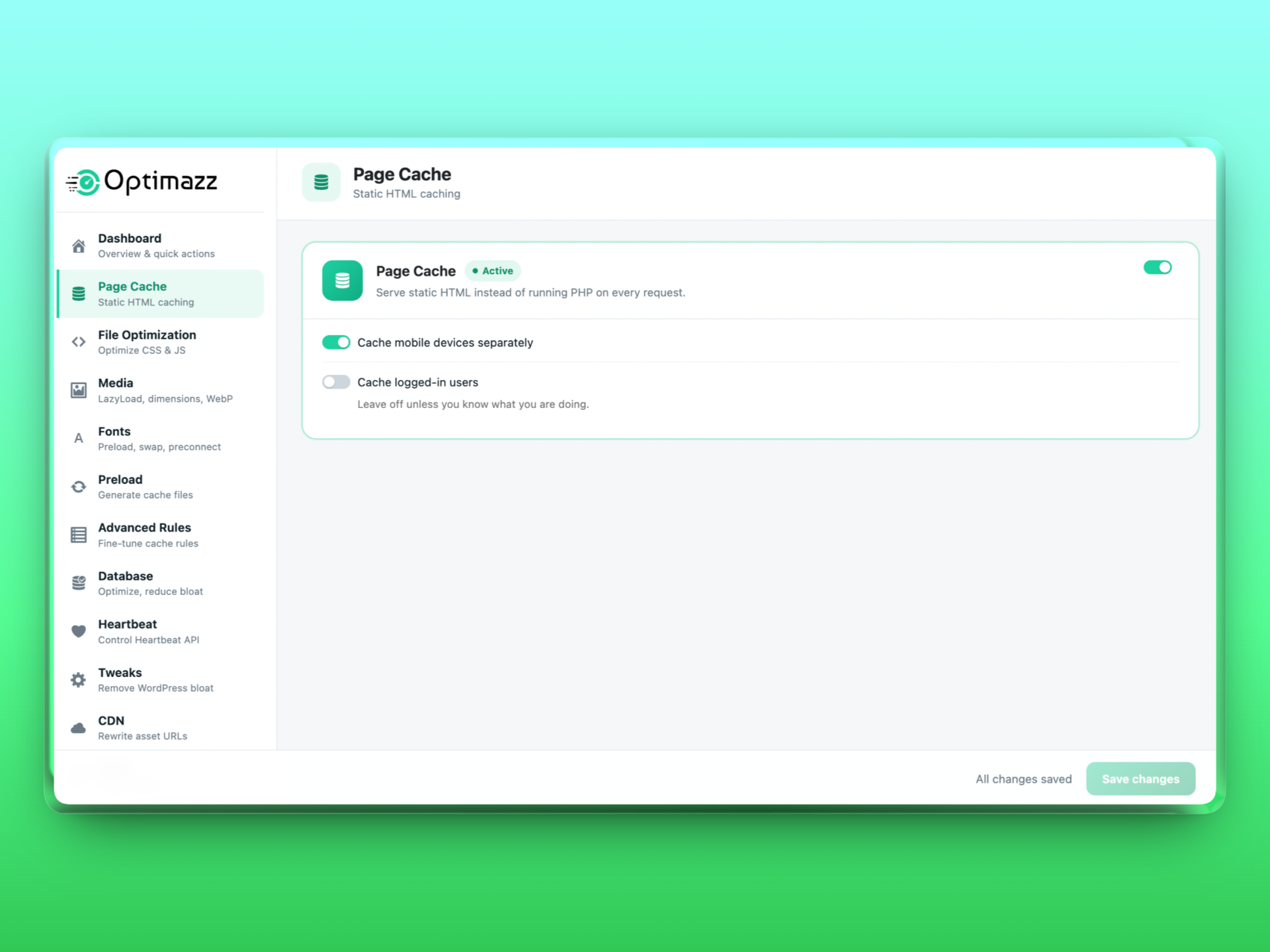
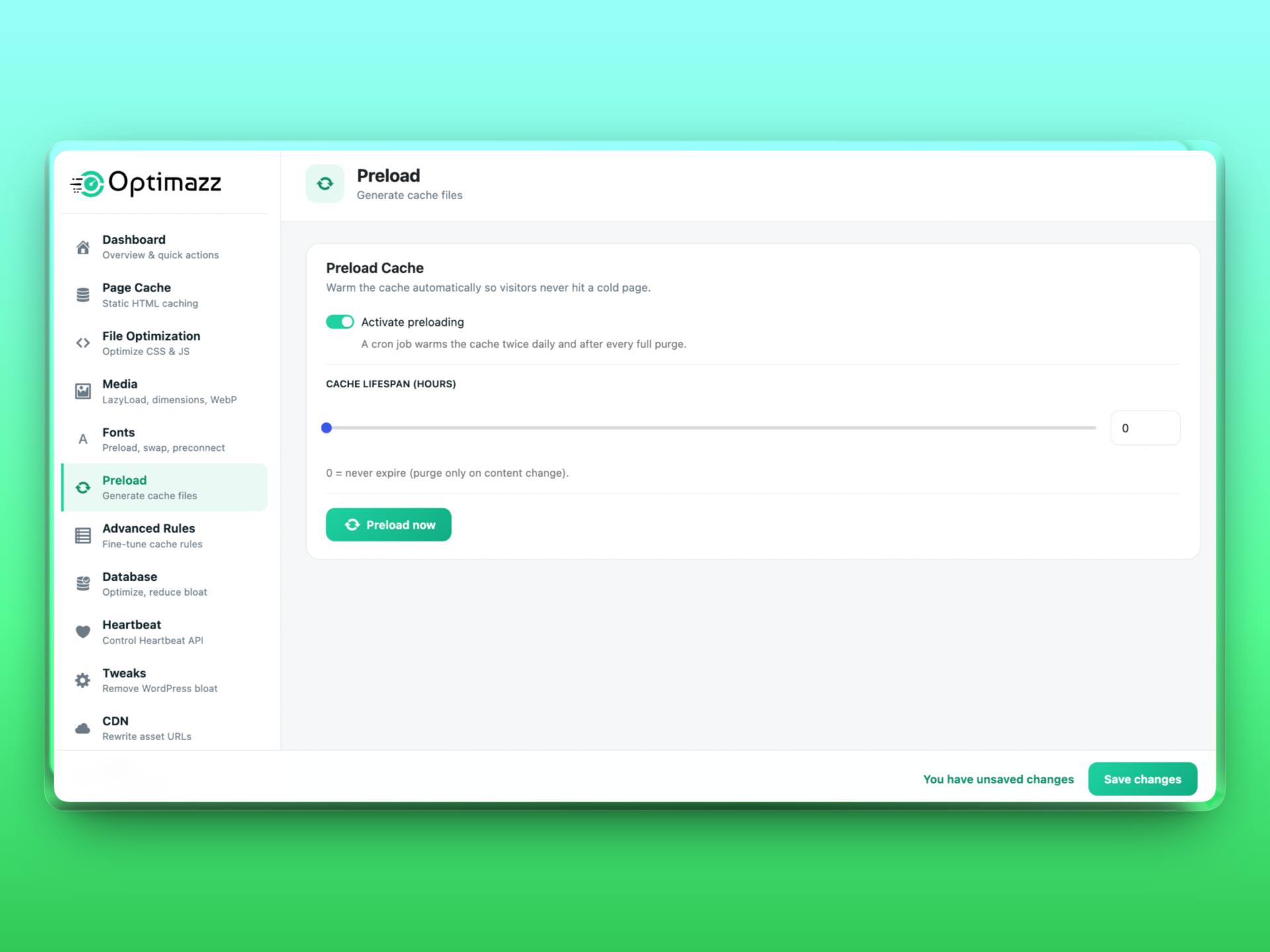
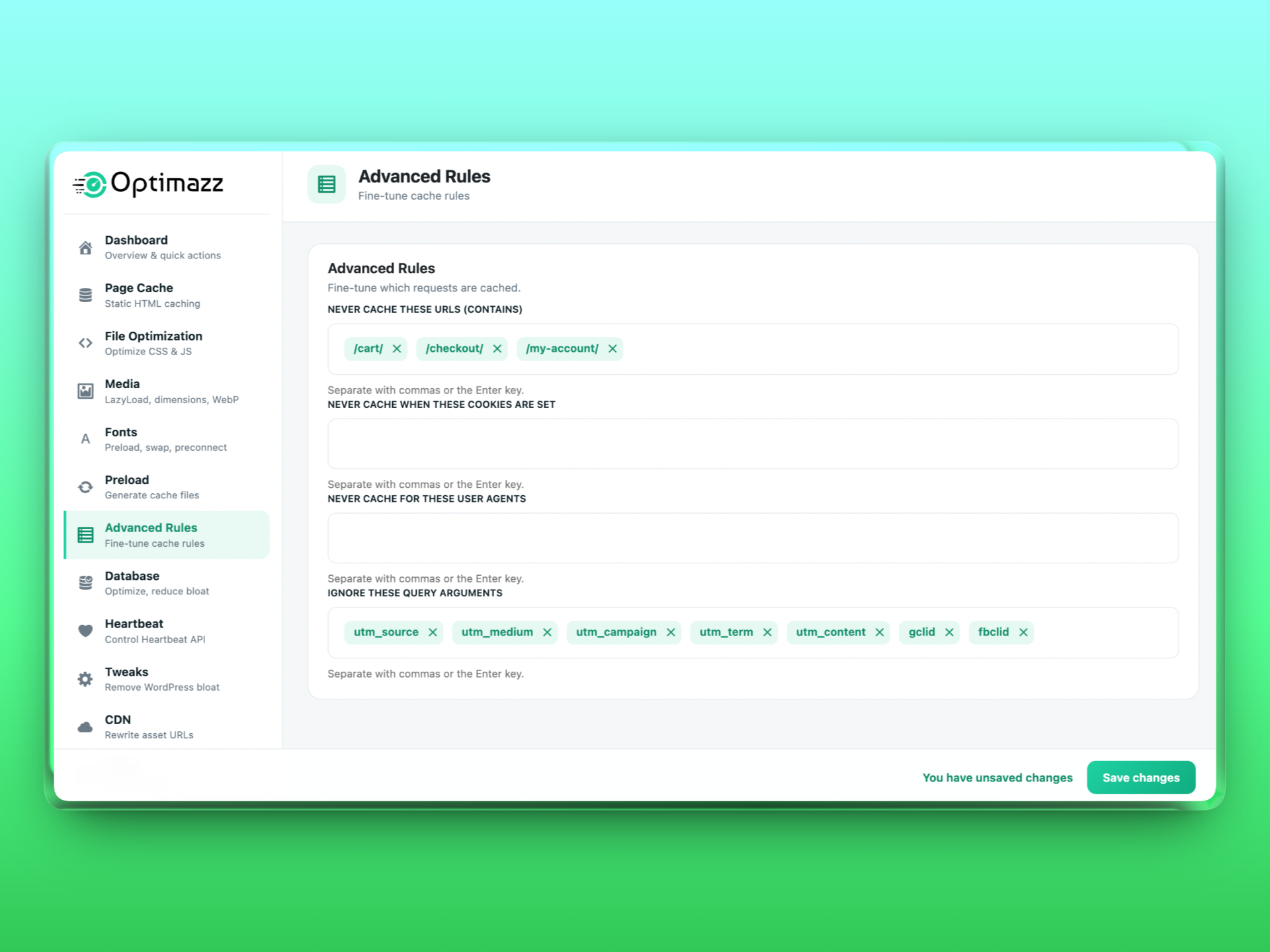
- Page Cache — serve static HTML instead of running PHP on every request, with smart exclusions (logged-in users, carts, query strings), automatic purging on content changes, and a cron-based cache preloader so visitors never hit a cold page.
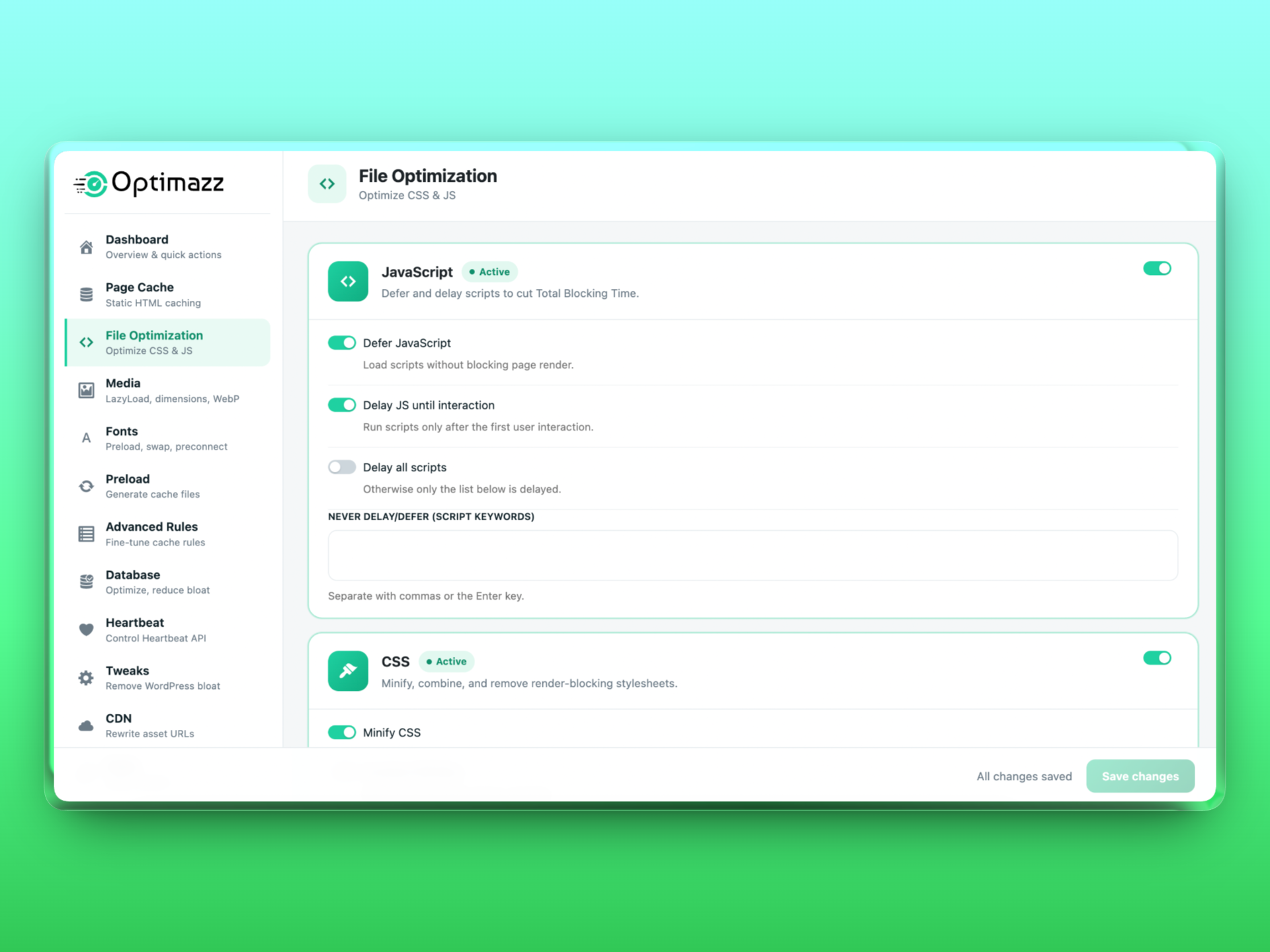
- JavaScript — defer scripts and delay them until the first user interaction to cut Total Blocking Time, with an exclusion list.
- CSS — minify, combine, and load CSS asynchronously to remove render-blocking stylesheets.
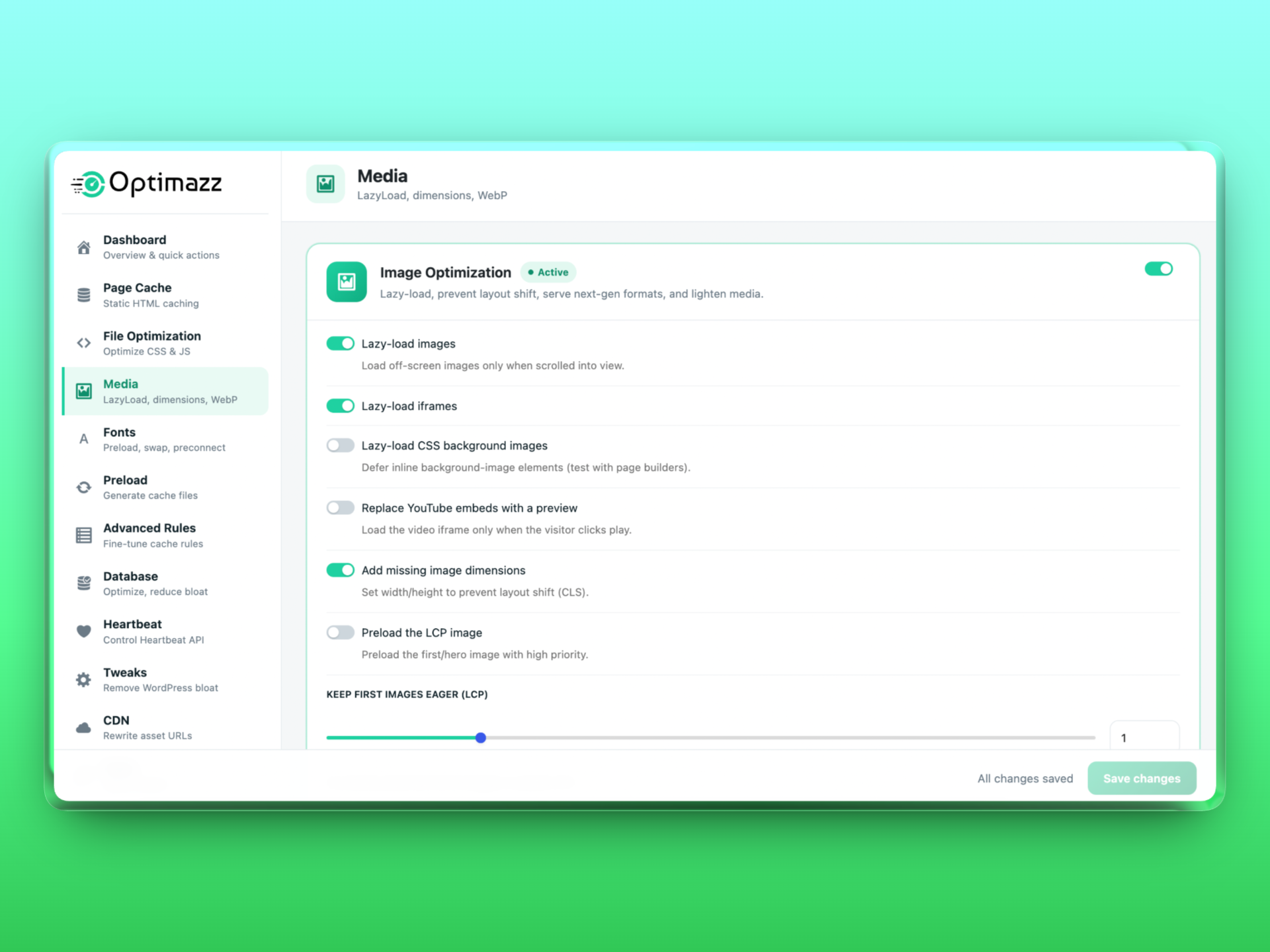
- Image Optimization — lazy-load images and iframes, add missing dimensions to prevent layout shift, generate and serve WebP/AVIF, bulk-compress your existing library, convert opaque PNGs to JPEG, and replace YouTube embeds with a click-to-load preview.
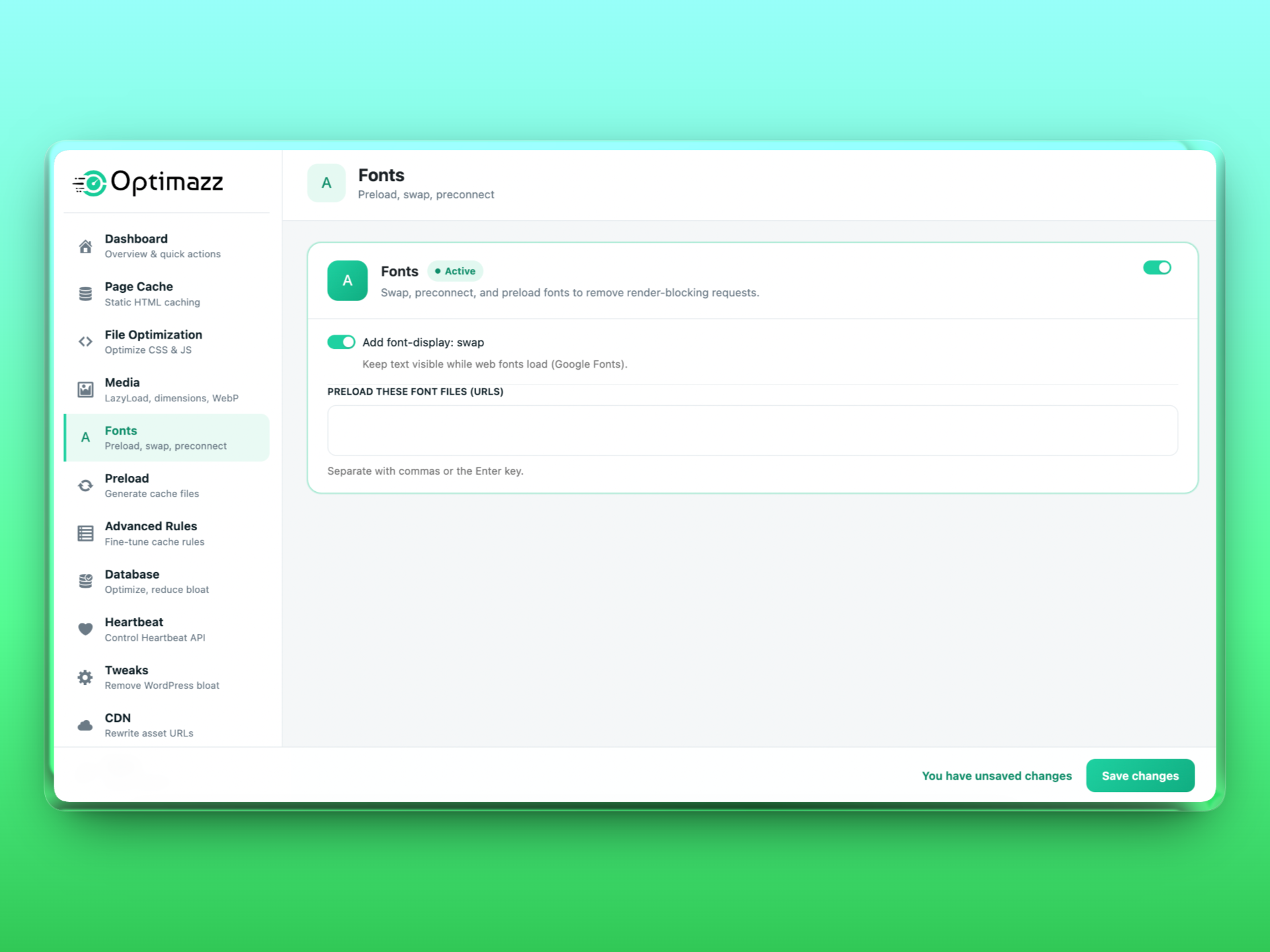
- Fonts — add
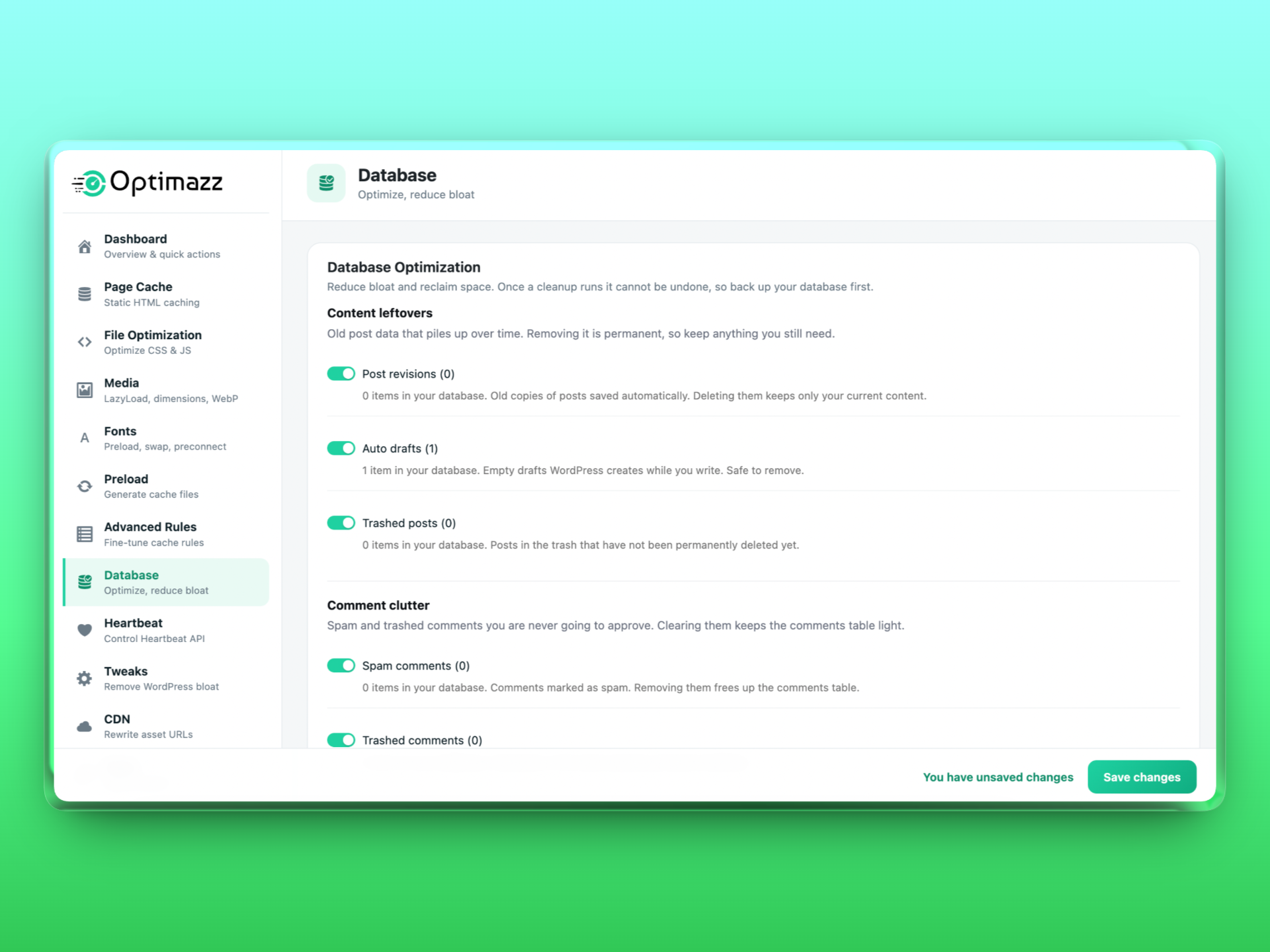
font-display: swap, preconnect to font hosts, and preload font files. - Database — clean revisions, auto-drafts, trashed posts, spam/trashed comments and expired transients, optimize tables, and schedule automatic cleanups.
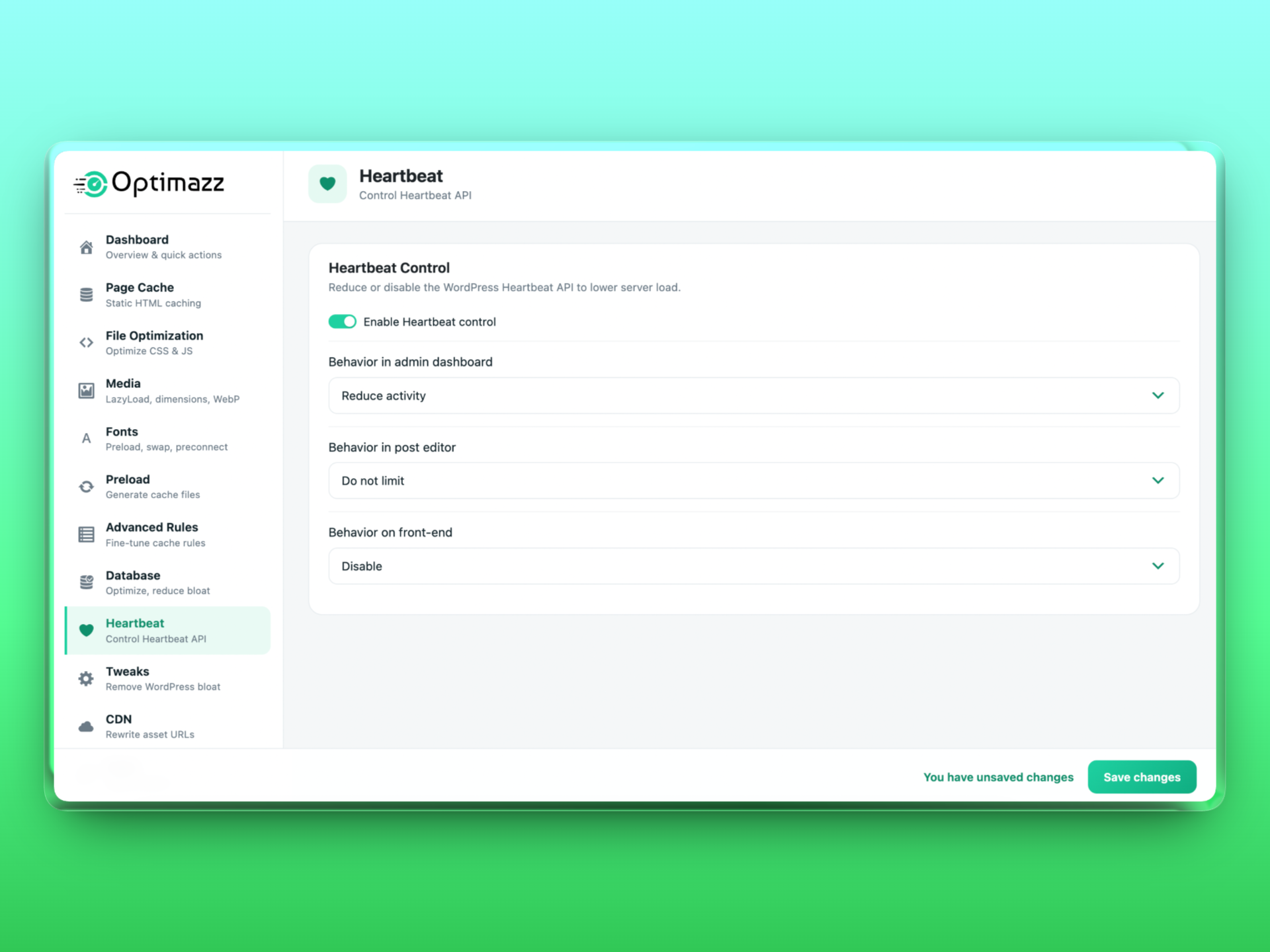
- Heartbeat — reduce or disable the WordPress Heartbeat API per context to lower server load.
- Tweaks — disable emojis, embeds, dashicons, query strings, XML-RPC and pingbacks, and add DNS-prefetch / preconnect hints.
- CDN — rewrite static asset URLs to your CDN hostname.
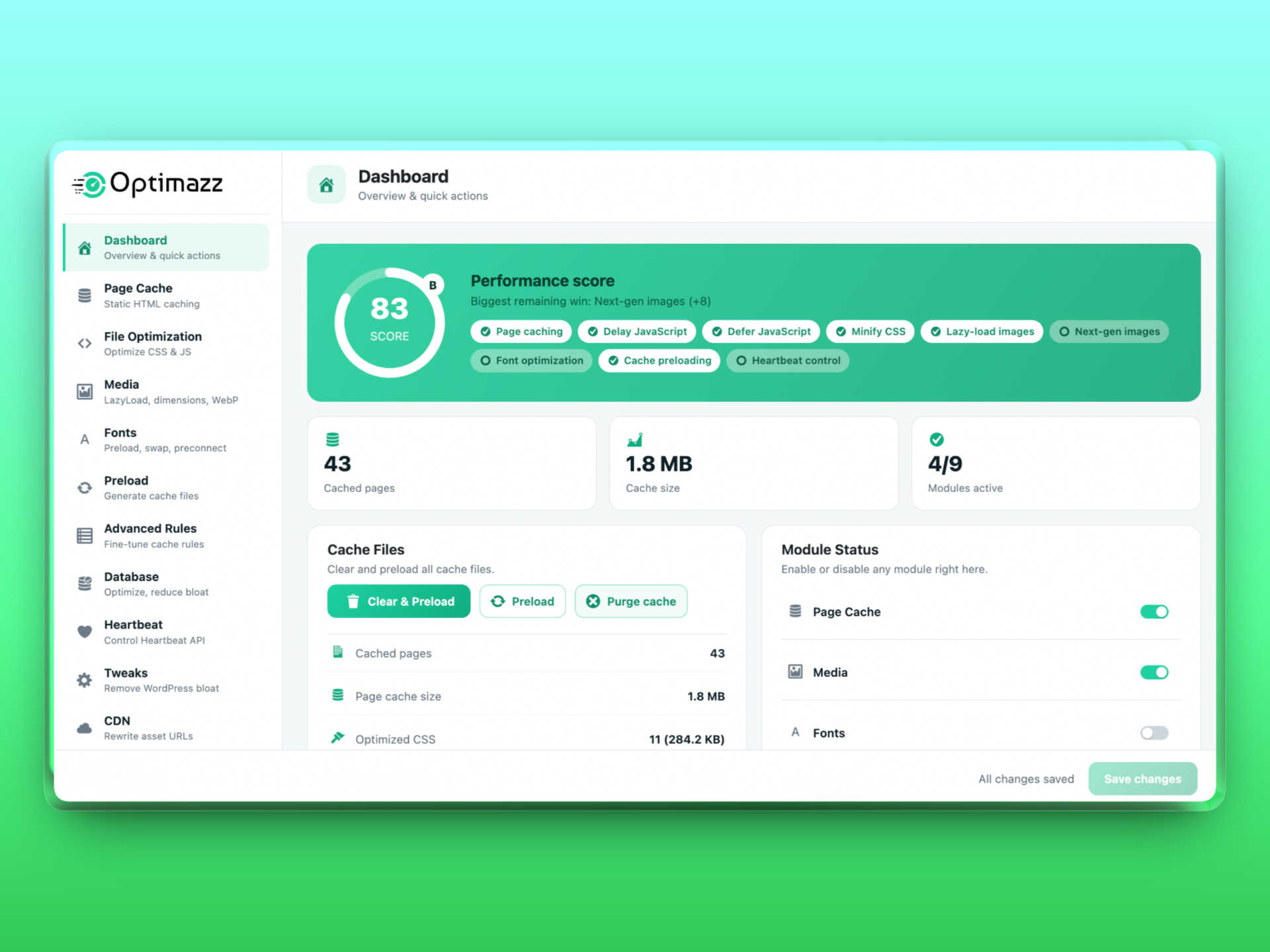
A live performance score on the dashboard shows which optimizations are active and your biggest remaining win.
Build process and source code
The admin interface is a React application. The human-readable source lives in the src/ directory shipped inside the plugin (src/index.js and src/index.scss), and the compiled, minified output lives in build/.
To regenerate the compiled files from source:
- Install dependencies:
npm install - Build:
npm run build
This uses the official @wordpress/scripts (webpack) toolchain — no custom or hidden build configuration. All source and build tooling are included in the plugin; nothing is obfuscated.
External services
Optimazz does not require any external service to function, and it works entirely on your own server by default. Two optional, admin-controlled features can reference third-party hosts:
-
Google Fonts optimization (Fonts module). If — and only if — your theme or another plugin already loads Google Fonts, and you enable the Fonts module, Optimazz adds
preconnectresource hints tofonts.googleapis.comandfonts.gstatic.comand can adddisplay=swapto the existing font URL. Optimazz does not add Google Fonts to a site that isn’t already using them, and it does not send any personal or site data — apreconnectis only a browser hint to open a connection earlier. The fonts themselves are requested by the visitor’s browser from Google, exactly as they were before the plugin, under Google’s terms: https://policies.google.com/terms and privacy policy: https://policies.google.com/privacy -
CDN rewriting (CDN module). If you enable the CDN module and enter a CDN hostname, Optimazz rewrites the URLs of your own static assets (CSS, JS, images) to that hostname so visitors’ browsers load them from your CDN. The CDN is a service you choose and configure; Optimazz sends no data to it itself and is not affiliated with any CDN provider. Consult your chosen CDN’s own terms and privacy policy.
Both features are off by default and take effect only after you explicitly enable them.
Installation
- Upload the
optimazzfolder to/wp-content/plugins/, or install it from the Plugins screen. - Activate the plugin through the Plugins menu in WordPress.
- Open Optimazz in the admin menu and enable the modules you want.
Frequently asked questions
Does Optimazz work alongside another caching plugin?
Optimazz will not overwrite another caching plugin’s advanced-cache.php drop-in. To use Optimazz page caching, deactivate any other page-caching plugin first. The other (non-caching) modules work alongside most plugins.
Will page caching work on my host?
Page caching needs WP_CACHE to be defined, which Optimazz adds to wp-config.php automatically. If wp-config.php is not writable, Optimazz shows a notice with the line to add manually.
Is it safe to delay JavaScript?
Delay-until-interaction is the biggest speed win but can affect scripts that must run before interaction. Start with “Delay” on and “Delay all” off, then add any problematic script keywords to the exclusion list.
Does converting PNG to JPEG lose my originals?
Only opaque PNGs are converted, the original is optionally backed up to uploads/optimazz-backup, and the conversion is rolled back if anything fails.
Does the plugin phone home or collect data?
No. Optimazz does not track users, register accounts, or send any of your site’s or visitors’ data to Optimazz servers. See the “External services” section for the only optional third-party hints the plugin can add.
Why does the plugin add inline and tags to my pages?
Those small inline fragments (the delay-JavaScript loader, critical/async CSS, the lazy-load helper and LCP preload hints) are the actual optimization output that Optimazz writes into your front-end HTML. They are the product of the plugin’s work, not the plugin’s own asset loading — a delay-until-interaction loader cannot be enqueued as an external file. The admin interface and all of the plugin’s own assets are loaded normally through the WordPress enqueue functions.
Changelog
Adds a Dashboard "Recommendations" panel that tells you exactly what to optimize next, with one-click fixes. Fully local — no external service. Recommended.
1.0.23
- Fixed: with WebP/AVIF serving on, some images (often the site logo) showed as broken on HTTPS sites whose content still used old http:// image addresses. Browsers upgrade a plain http:// image to https:// automatically, but block an http:// image inside a source — and never fall back. Next-gen image sources now always use https:// on HTTPS pages.
- Fixed: in responsive images, a size without a WebP/AVIF copy could be offered to the browser and show as broken; only sizes whose next-gen file exists are now listed.
- Fixed: tidier image markup — no attributes added after a self-closing slash, and no duplicate decoding/fetchpriority attributes.
- New: Google Fonts optimization (Fonts module). Page builders such as Elementor load every Google Font family as a separate request, each with every weight from 100 to 900 plus italics. Optimazz now merges them into a single request and loads only the weights and styles your pages actually use (weights 400 and 700 are always kept). On a typical Elementor site this turns three render-blocking requests into one and cuts the font CSS by more than half (measured: 170 KB down to 64 KB). Both options are on by default and can be switched off in the Fonts settings; requests that subset by text are never changed.
- Improved: the build tooling (
package.json) ships with the plugin again, so the admin interface can be rebuilt from the included source as described under “Build process and source code”. - Fixed: with the CDN module on, CSS minify/combine, WebP delivery and missing-image-dimension fixes were silently skipped, because the CDN rewrite ran before the other optimizations and they could no longer recognise your own files. The CDN rewrite now runs last, on the finished page.
- Improved: when the update safety check switches Safe Mode on to protect a site, it now keeps re-checking and switches Safe Mode back off by itself as soon as pages load correctly again, restoring full optimization (CSS combine, async CSS and JavaScript delay). Previously Safe Mode stayed on until someone turned it off manually, so a site could quietly run slower for a long time after a temporary problem. If pages break again within a day of being restored, Safe Mode stays on and the admin decides. Safe Mode that you switch on yourself is never changed automatically.
- Fixed: the update safety check now also recognises stylesheets served from your CDN hostname (when the CDN module is on), so a page that loads unstyled through the CDN is detected instead of being reported as healthy.
- Fixed: the “Optimazz Safe Mode is on” notice no longer lingers after Safe Mode was switched off via Undo last change, Reset or Import.
- Fixed: uninstalling Optimazz now removes all of its data, including the version marker, the safety-check state and its scheduled check, and the cached font-weight data.
1.0.22
- Fixed: on some hosts (certain LiteSpeed/WAF setups and managed hosts) pages loaded unstyled because the server does not serve — or routinely deletes — files under
wp-content/cache/, which is where Optimazz kept its generated CSS. Since the page HTML references those files by name, a page that could not load them rendered without styling. Optimazz now stores generated CSS underwp-content/uploads/optimazz/instead — the standard, always-served, persistent location page builders also use — so the stylesheets load reliably and are never wiped out from under a cached page. On update the page cache is refreshed automatically so pages pick up the new location with no manual step. - New: update safety guard. Shortly after the plugin updates, Optimazz quietly checks its own front page to confirm the optimized CSS actually loads. If it finds pages rendering unstyled — their generated stylesheets returning 404, usually because an external server or CDN cache is still serving old pages — it automatically switches on Safe Mode to keep the site working (pausing the risky CSS/JS transforms without changing your saved settings, so pages fall back to their original stylesheets) and shows an admin notice explaining what happened. After you clear your server/CDN cache and switch Safe Mode off from Tools, Optimazz re-checks and re-protects the site if anything is still broken — so an update can no longer leave a site visibly broken.
1.0.21
- Fixed: after updating, a site whose page cache was already populated could keep serving pages that loaded unstyled, until the cache was purged by hand. A plugin update never clears the page cache, so any HTML cached by an earlier version — still pointing at combined CSS/JS files that an older purge had removed — stayed in place and rendered without styling. Optimazz now clears the page cache automatically once, the first time it runs after an update, and re-aligns its caching drop-in; the generated CSS/JS assets are kept, so pages come back fully styled on the next visit with no manual purge needed. This completes the 1.0.20 fix for existing installs.
1.0.20
- Fixed: pages could intermittently load completely unstyled when CSS minify/combine was on together with page caching (or a server-level cache such as LiteSpeed). Optimazz names each generated CSS/JS file by a content hash and embeds those filenames in the cached HTML — but purging the page cache also deleted those generated files, so any HTML still held in a cache (Optimazz’s own, a CDN’s, or the server’s) pointed at stylesheets that had been removed, returning 404 and rendering the page without styling until they regenerated. Purging the page cache now preserves the hashed CSS/JS assets (they are self-invalidating — a source change produces a new filename), keeping the HTML and its stylesheets consistent.
1.0.19
- Fixed: page caching could silently stop working after a plugin update or a manual re-upload, making the whole site slow (every request fell back to full PHP). The advanced-cache.php drop-in embeds the path to the cache engine, and if the plugin folder was moved or recreated by the update, that path went stale — but Optimazz still recognised the drop-in as its own and never repaired it. Optimazz now detects a stale drop-in and rewrites it with the correct path automatically, and the drop-in itself falls back to the standard plugin location so caching keeps working immediately. If you were affected, the cache heals itself on the first page view after updating.
- Improved: the per-request cache readiness check no longer spins up the WordPress filesystem API just to read its own drop-in, removing needless overhead on every uncached request.
1.0.18
- New: Safe Mode (Tools screen). If a theme or page builder looks broken after you enable optimization, one toggle pauses just the riskiest transforms — combine CSS, async CSS, remove-block-CSS and JavaScript delay — while keeping page cache, minify, defer and lazy-load running. It changes nothing in your saved settings; those optimizations simply pause until you switch Safe Mode off, so recovery is instant and reversible. Filterable via
optimazz_safe_modeso a host can force it on during an incident. - New: Undo last change (Tools screen). Optimazz now keeps a one-step backup of your settings taken before every save, reset or Safe Mode toggle, so a single click restores the previous state — and undo is itself reversible (press it again to redo).
Screenshots
For developers
Is this your plugin? Show off the numbers.
Add a live badge to your site, docs or GitHub README. It updates on its own — no account needed.
Best Optimazz alternatives
All cache plugins →





FAQ
Optimazz: quick answers
Straight answers, pulled from live WordPress.org data.
Live data from WordPress.org · checked Sep 28, 2026
Is Optimazz free?
Yes. Optimazz is free to download and use from the official WordPress.org plugin directory.
Is Optimazz safe to use in 2026?
Optimazz is a solid plugin choice in 2026, with a few things worth checking first. It runs on 40+ sites, is rated 5/5 and was last updated 1 day ago, and scores 74/100 on our health check.
How many websites use Optimazz?
Optimazz is active on 40+ WordPress websites and has been downloaded 1,836 times since it launched in July 2026. It was downloaded 707 times in the last 30 days.
Does Optimazz work with WordPress 7.1?
Yes. The developer has tested Optimazz up to WordPress 7.1.2, the latest release. It requires WordPress 6.0 or newer.
What PHP version does Optimazz need?
Optimazz requires PHP 7.4 or higher. Most hosts run PHP 8.x today, so it works on any modern WordPress hosting.
When was Optimazz last updated?
The latest version, 1.0.23, was released on September 27, 2026 (1 day ago).
Who makes Optimazz?
Optimazz is developed and maintained by Shipon Karmakar.
What are the best alternatives to Optimazz?
The most popular alternatives to Optimazz are WP Super Cache (1M+ installs), WP Fastest Cache (1M+ installs) and WP-Optimize (1M+ installs).
Powered by PageForge
Want thousands of pages that rank like these? Build them in an afternoon.
This directory runs on the same engine as PageForge. Turn any spreadsheet, CSV or API into thousands of fast, SEO-ready WordPress pages — with schema, internal links and AI-written copy baked in.
- CSV, Google Sheets & API data sources
- AI content, schema & internal links per page
- Works with Elementor, Gutenberg, Yoast & Rank Math
- Free on WordPress.org — no credit card