



VizzEx
Be the trusted brand and expert that AI recommends. Turn disconnected pages into a GEOMesh that AI models can discover, trust, and cite.

Solid choice
VizzEx is a solid plugin choice in 2026, with a few things worth checking first. Is rated 5/5 and was last updated 2 weeks ago, and scores 71/100 on our health check.
- Actively developed — last update 2 weeks ago
- Tested with the latest WordPress (7.1)
- Small user base (<10 active installs)
- Very few reviews so far
How does it stack up?
Side-by-side on installs, updates, ratings & support


Daily downloads
Download spikes usually follow a new release — each site that auto-updates counts as a download.
Rankings
Where VizzEx stands todayWordPress.org search rankings
Live position in the plugin search, top 100| Keyword | Position |
|---|---|
| geo | >100 |
| geomesh | #1 |
| internal links | >100 |
| semantic seo | >100 |
| seo | >100 |
Rating breakdown
★★★★★★★★★★ 5 from 2 reviews
About VizzEx
From the official readme · v1.0.4Description
Most WordPress sites suffer from a silent structural problem: posts that exist as isolated “content islands,” categories with no clear hub, and internal links scattered randomly rather than strategically placed.
VizzEx is the first horizontal content analysis tool built specifically to create the GEOMesh (Generative Engine Ecosystem). Where traditional SEO tools analyze individual pages in depth, VizzEx analyzes your entire blog as a connected knowledge network — identifying what’s disconnected, what’s missing, what’s undermining your authority, and what needs to change.
Then it does something no other tool does: for every semantic relationship it identifies, it writes the linking text in your blog’s own tone, ready to paste. Not a keyword suggestion. A semantic relationship link — the explicit, reasoned connection between ideas that AI systems recognize as a signal of real, integrated expertise.
When ChatGPT, Perplexity, Google Gemini, Claude, or agentic RAG crawlers analyze your site, they do not evaluate pages in isolation. They map relationships. If your content exists in unstructured silos, it triggers extraction filters and reads as an expensive, low-confidence source. If your content is interconnected with clear semantic paths and a consistent heading hierarchy, it forms a highly cohesive GEOMesh (Generative Engine Ecosystem) — a machine-readable knowledge graph that proves topical authority and minimizes inference costs for AI crawler agents.
VizzEx builds that GEOMesh (Generative Engine Ecosystem). Starting with your most recent posts.
Why AI Citation Requires GEOMesh (Generative Engine Ecosystem) Architecture
AI retrieval agents operate under tight inference budgets. Parsing disconnected, bloated content costs real server money. When your site requires expensive calculations to determine how topics relate, your content gets deprioritized.
When your posts form a structured GEOMesh (Generative Engine Ecosystem) with clear internal link paths, consistent heading hierarchies, and unambiguous category ownership, the computation cost for an AI agent to parse, chunk, and cite your site drops dramatically. By organizing your WordPress site into a low-compute layout, VizzEx makes your content the most mathematically efficient, lowest-latency option on the web — and a far more attractive citation source than a competitor’s disjointed collection of pages.
VizzEx takes a database-wide approach: analyzing your posts horizontally as an interconnected system and delivering specific, non-destructive structural changes that reduce AI crawler compute tax and maximize citation probability.
What VizzEx BASIC (Free Version) Does
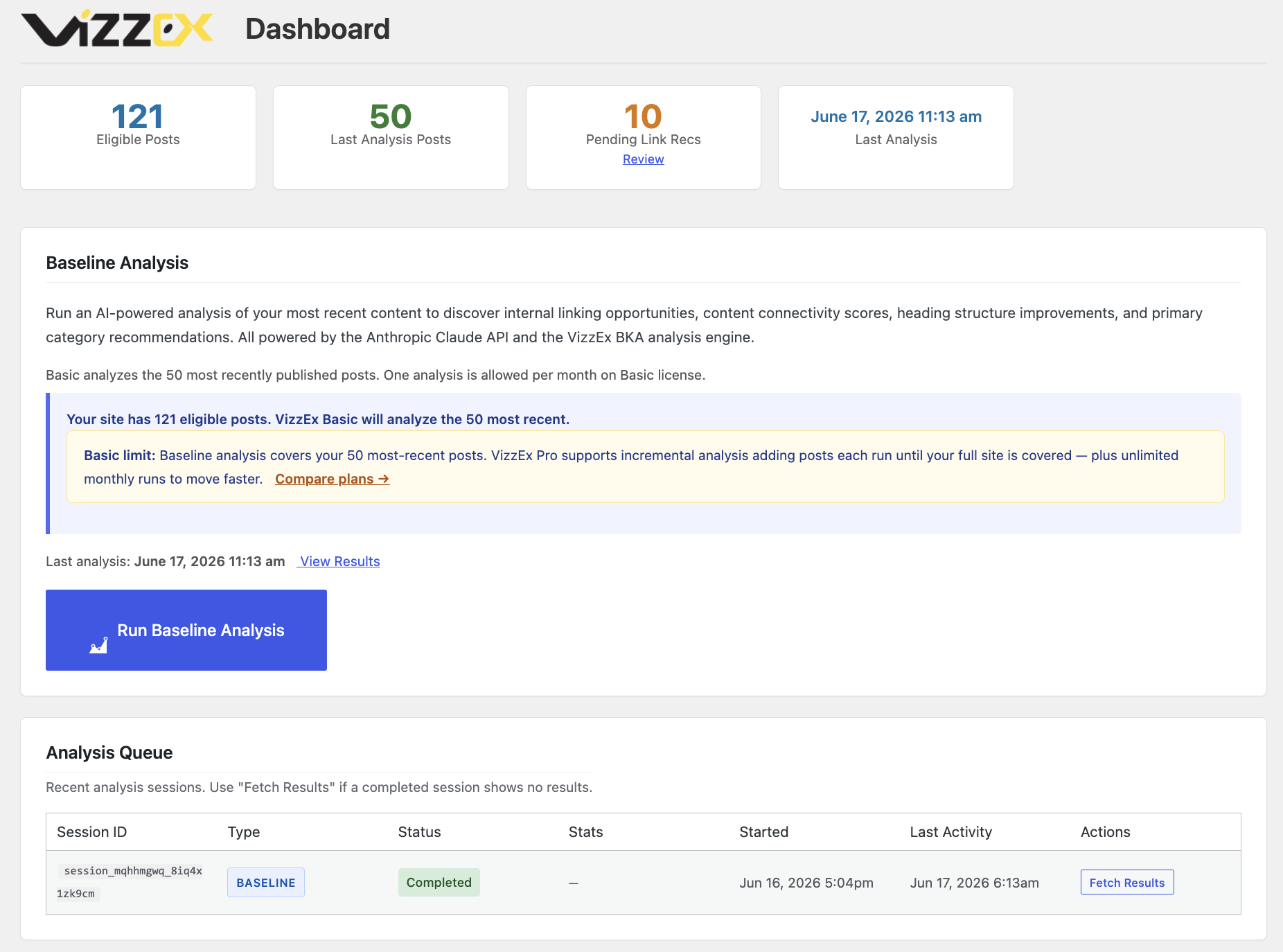
Baseline Analysis
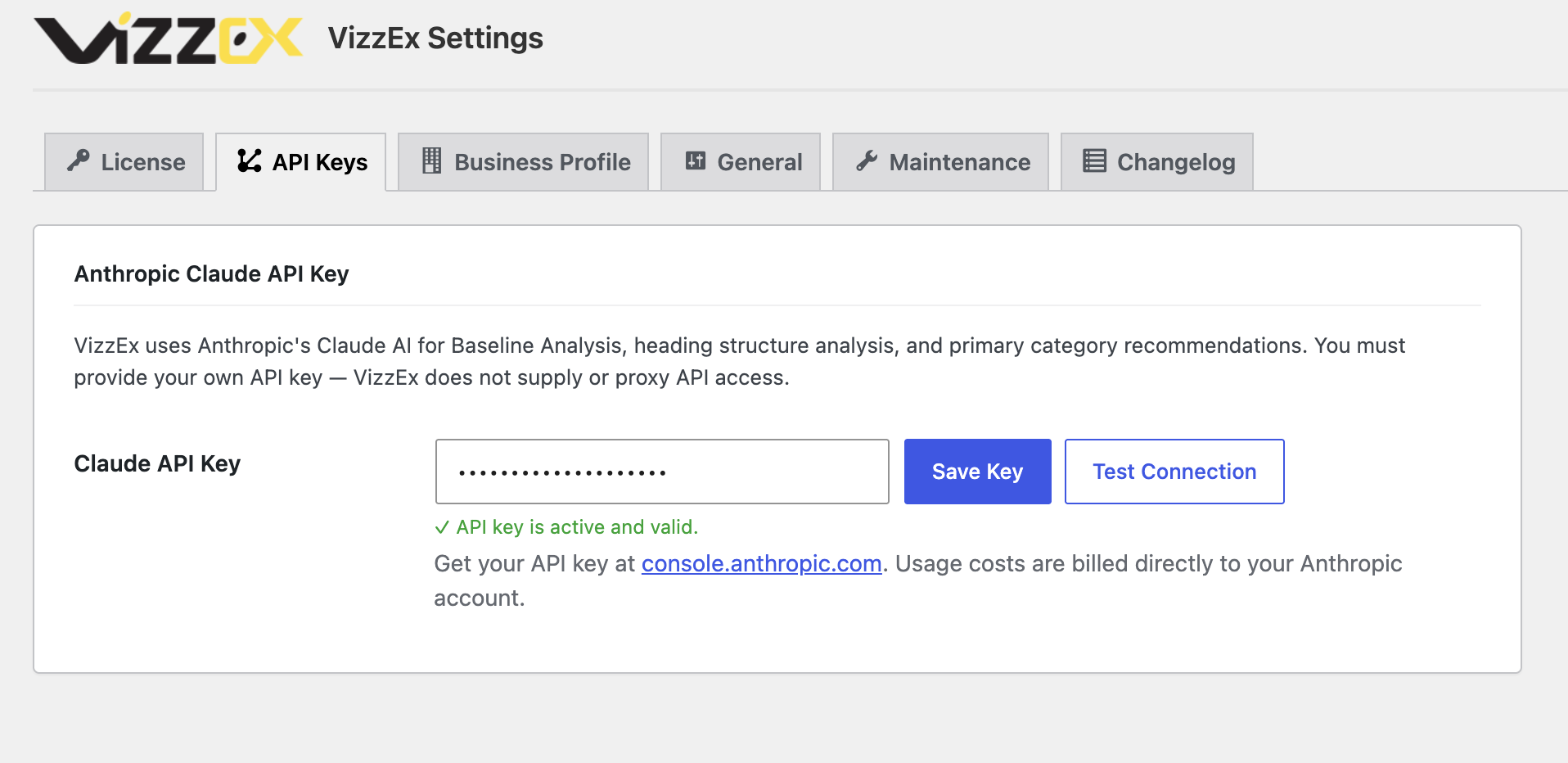
VizzEx uses your own Anthropic Claude API key to map semantic relationships between content nodes, identify topic clusters, score each post’s internal connectivity, and surface high-value content with strong AI citation potential.
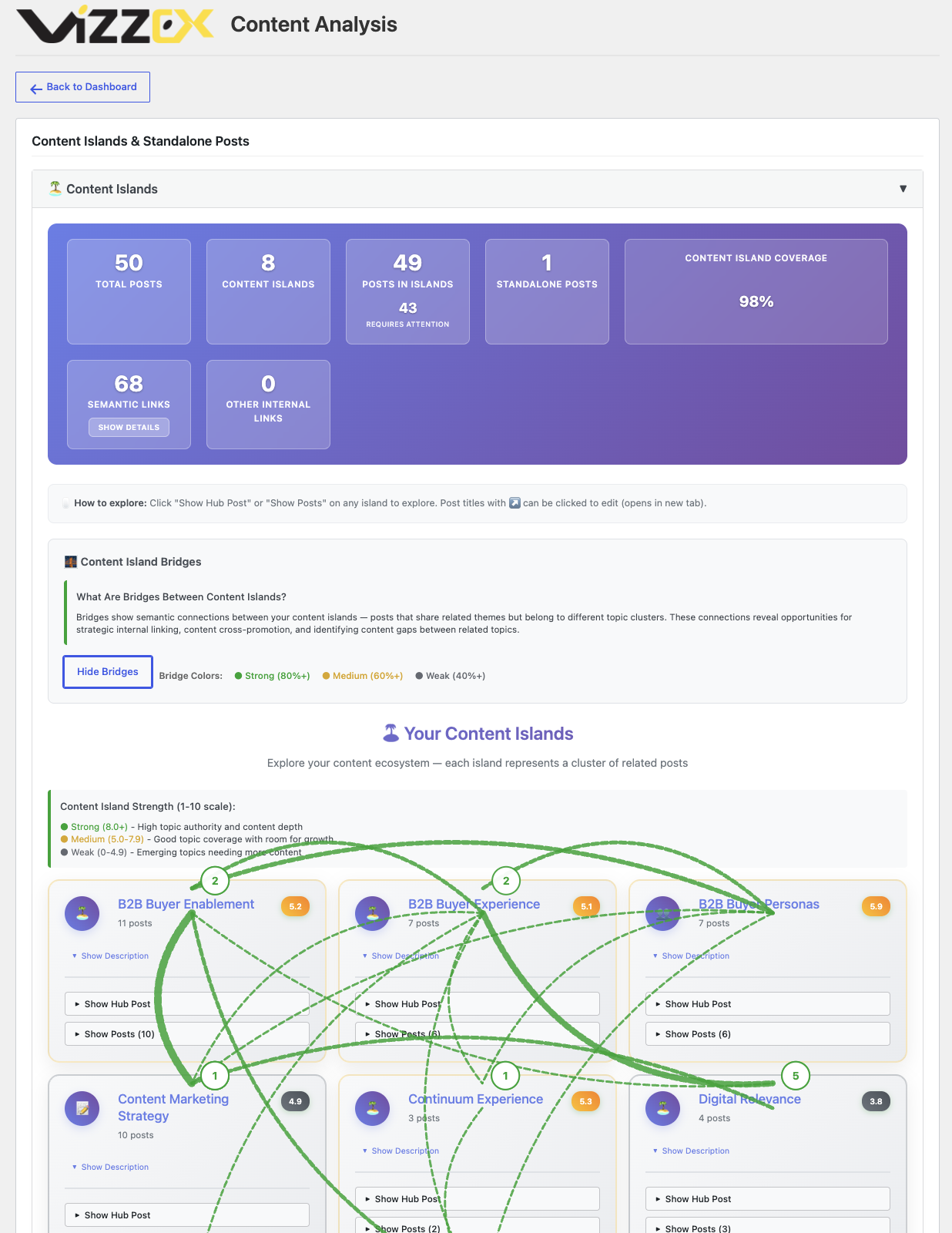
Content Analysis Dashboard
After your analysis, explore your results via an intuitive, action-oriented workspace:
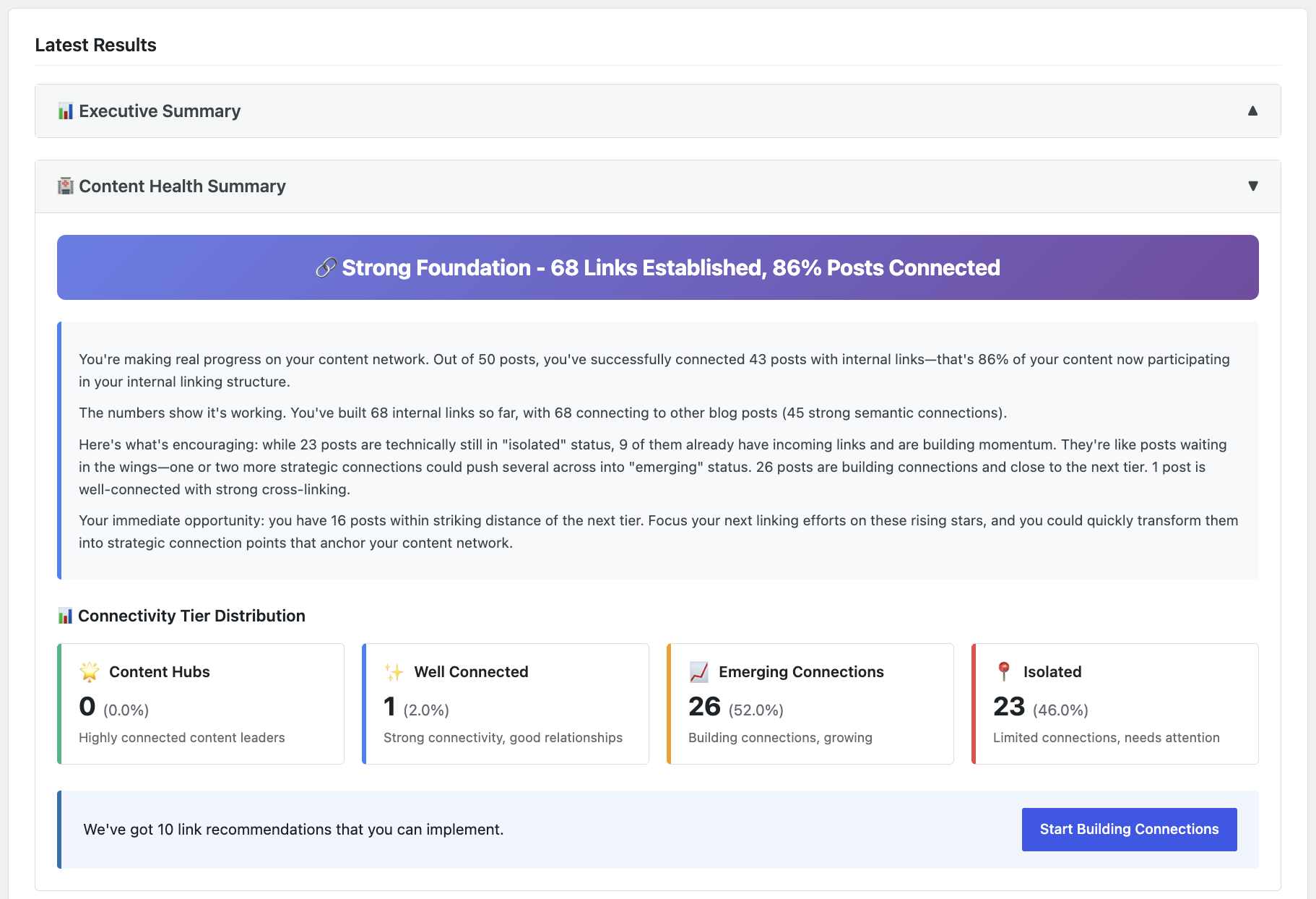
- Topic Clusters — groups of semantically-related posts with an authoritative hub page at the center.
- Connectivity Scores — a numeric metric showing how well each post is integrated into your site-wide GEOMesh (Generative Engine Ecosystem).
- Posts Needing Attention — content nodes with low connectivity scores or missing internal links.
- High-Value Content — posts displaying the strongest natural signals for AI citation potential and strategic link impact.
Link Recommendations
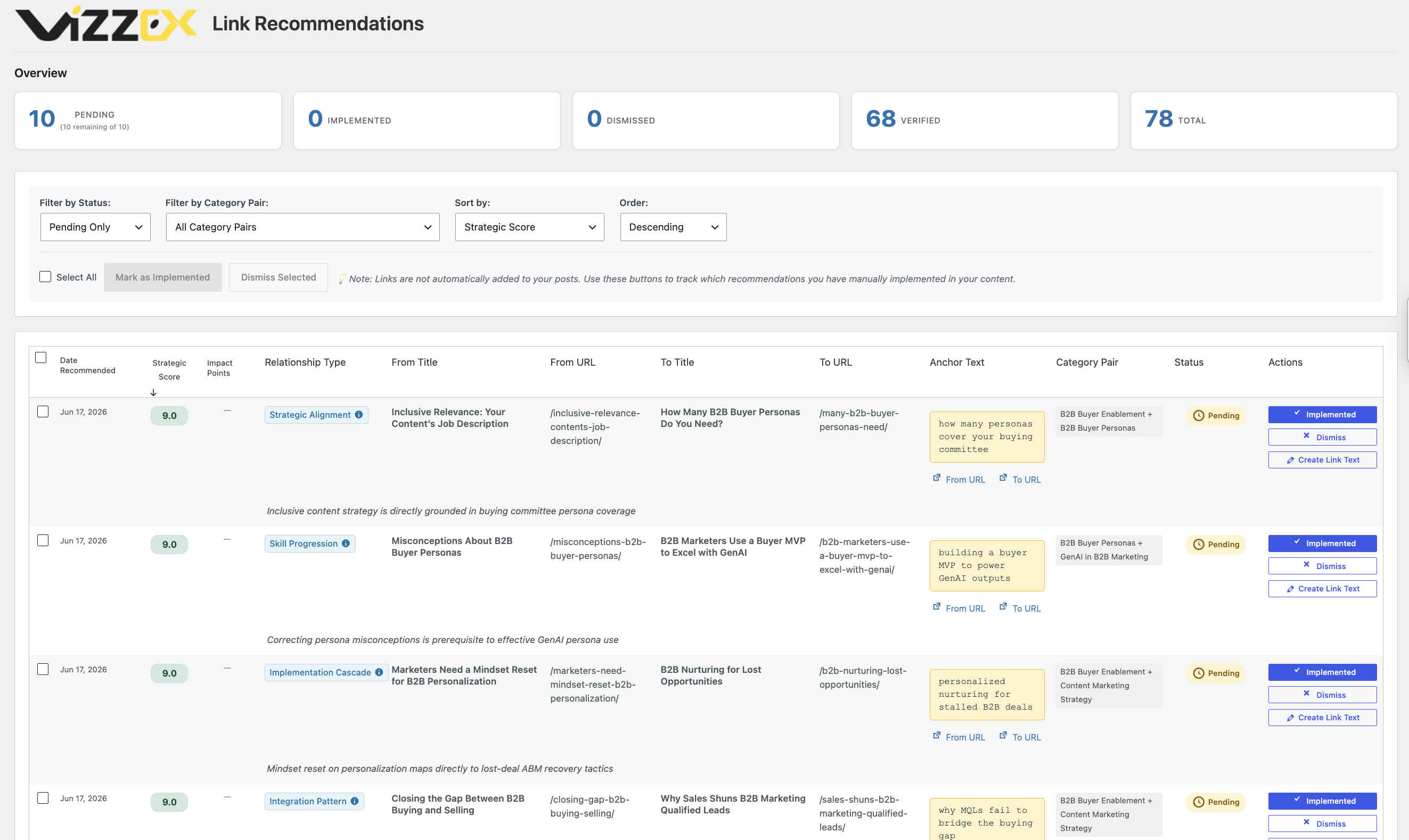
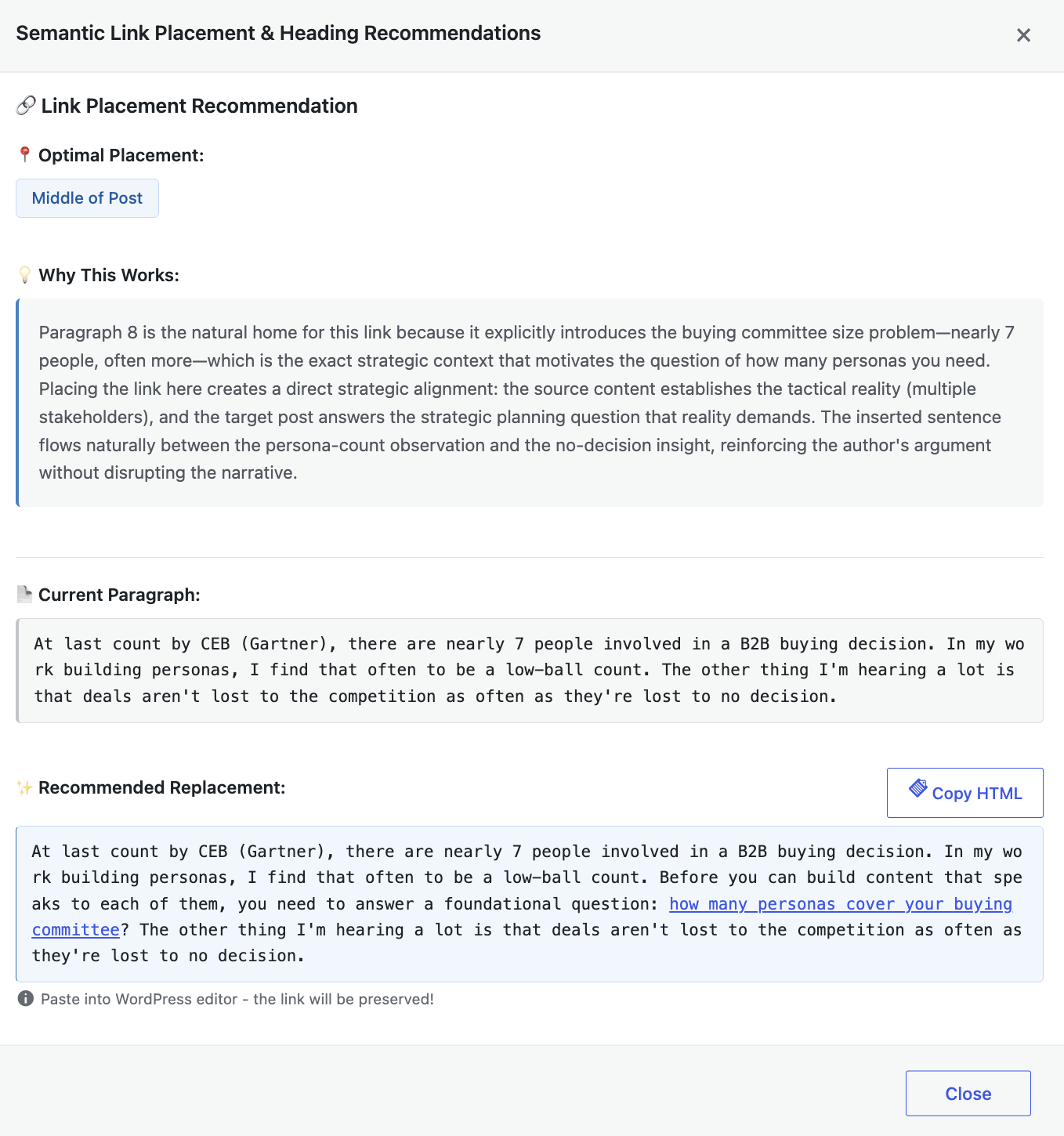
VizzEx delivers internal link recommendations per analysis run. No more writing your own connecting sentences. VizzEx uses Claude AI to read your source paragraph, generate the exact replacement paragraph with the link naturally embedded, and explain the placement rationale.
Heading Structure Analysis
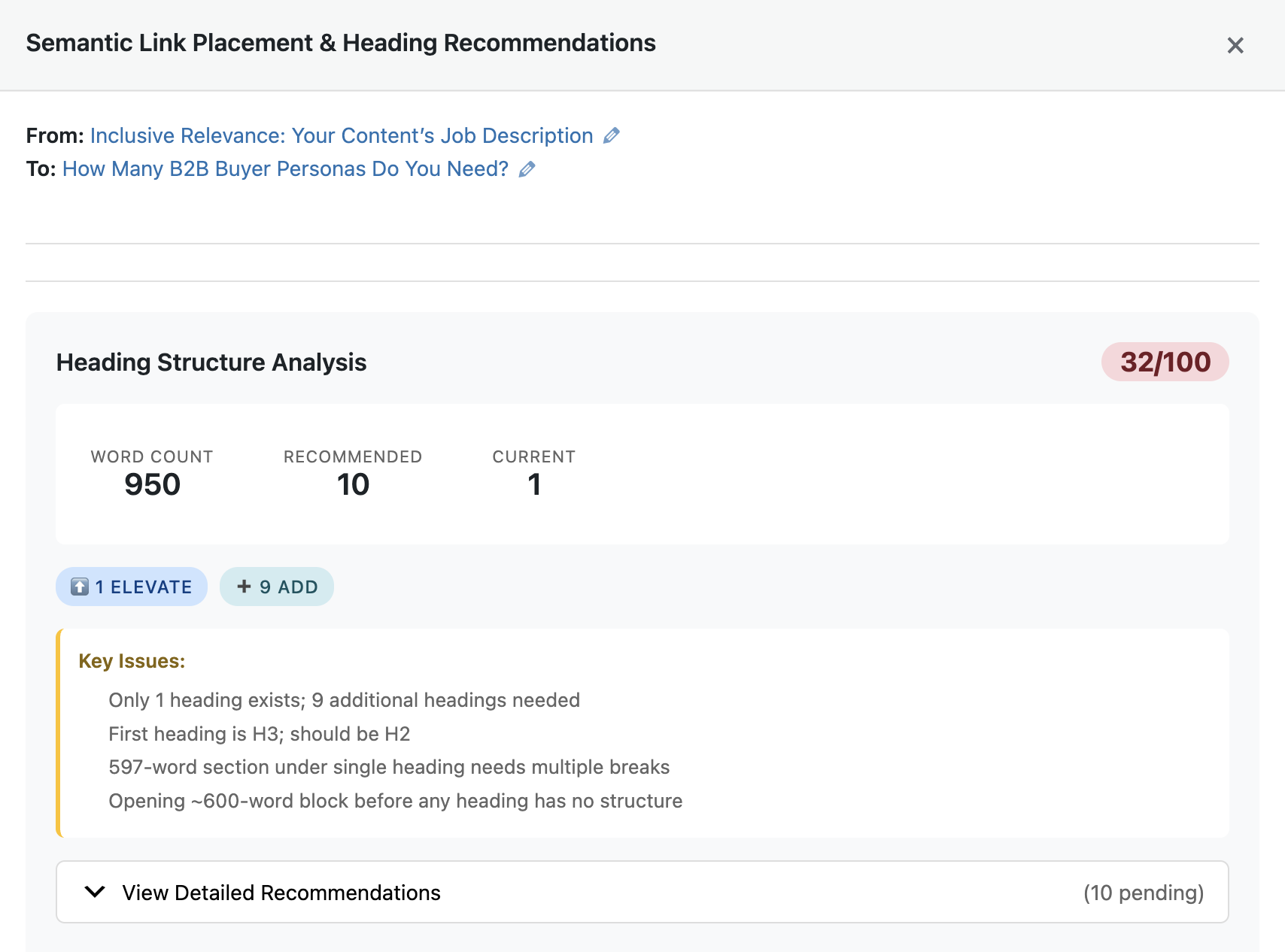
Clear, hierarchical headings provide explicit semantic boundaries between topics—reducing the compute tax for crawling agents. VizzEx reviews your heading (h2–h4) hierarchy to ensure your core facts reside in the premium extraction zone (The Knowledge Window).
Primary Category Recommendations
When a post belongs to multiple categories, VizzEx identifies the ideal primary category, sharpening your topical authority signals and eliminating the category ambiguity that causes AI models to assign lower confidence to your content.
Business Profile Integration
Set your industry and business model so VizzEx can apply industry-specific scoring and localized domain authority weighting in future analyses.
Requirements
To use VizzEx, you need:
- Your own Anthropic Claude API key — get one at console.anthropic.com. VizzEx does NOT provide, resell, or proxy Claude API access; you bring your own key to maintain absolute data sovereignty over your content database.
VizzEx PRO
VizzEx builds the structural foundation—the internal link architecture, heading hierarchy, and topical clustering that AI retrieval agents need to recognize your site as a coherent GEOMesh (Generative Engine Ecosystem). VizzEx PRO adds the next layers of signal on top of that foundation.
When the structural work from VizzEx aligns with PRO’s Signal Architecture and Dynamic Semantic Schema (JSON-LD), the combination creates an explicit, machine-readable signal stack: your entities are named, your relationships are defined, and your topical authority is verifiable—not just implied by link structure. That alignment is what makes it easy for AI systems to discover, trust, and cite your expertise with confidence.
VizzEx PRO, available at vizzex.ai, adds:
- Incremental Analysis Runs — Run analyses as often as you publish or update content. Only what’s changed gets uploaded, reducing the time per analysis.
- Signal Architect — explicit semantic schema and entity alignment that makes your topical authority machine-readable for AI recognition.
- Dynamic Semantic Schema (JSON-LD) — embed bespoke structured entity and relationship data behind your content as JSON-LD schema, giving AI retrieval agents a machine-readable map of your expert knowledge graph without inference guesswork.
- Semantic Schema Glossary — build the knowledge graph that defines your domain, your entities, and the relationships between them.
- Category-focused cluster analysis — strategic, iterative optimization by topic area.
- Expanded analysis capacity — ability to be more selective about what gets analyzed.
- Multisite network support.
When you activate VizzEx PRO, all your analysis data, link recommendations, and connectivity scores are fully preserved.
VizzEx Requirements
To use VizzEx you need:
- Your own Anthropic Claude API key — get one at console.anthropic.com.
External Services
VizzEx connects to four external services. The plugin will not work without the first three.
1. VizzEx Analysis Server (bka-api.vizzex.com)
What it does: Post titles and content are sent to the VizzEx Analysis Server to generate topic clusters, connectivity scores, link recommendations, and heading analysis.
What data is sent: Post titles, category, post content, and your site URL, sent when you initiate a Baseline Analysis.
Terms of Use | Privacy Policy
2. VizzEx Registration Server (vizzex.ai)
What it does: Registers the site with the VizzEx analysis service when you save your Claude API key during setup. Registration provisions your free service access credentials, including the key used to sign requests to the VizzEx News & Help Feed (service 4). The same registration request is repeated automatically, at most once a day, only when that feed key is missing (for example on sites registered before version 1.0.5) or has been replaced by VizzEx. No calls are made before you register.
What data is sent: Your site URL and a locally-generated anonymous site identifier (a random string created on your server). No personal information, no admin credentials, no tracking data.
Terms of Use | Privacy Policy
3. Anthropic Claude API (api.anthropic.com)
What it does: Powers the AI reasoning for semantic analysis, link text generation, and heading recommendations. You provide your own Anthropic API key — VizzEx does not proxy or resell API access.
What data is sent: Post content is sent to Anthropic’s API when you run an analysis or generate semantic link text, using your own account credentials.
Terms of Use | Privacy Policy
4. VizzEx News & Help Feed (feed.vizzex.ai)
What it does: Supplies the VizzEx news, announcements, offers and documentation shown in the “VizzEx AI Citation News” Dashboard widget, the VizzEx → Dashboard sidebar and VizzEx → Help. After your site is registered (service 2), the plugin refreshes this content automatically, at most once every 12 hours, in the background when an administrator views the WordPress Dashboard, VizzEx → Dashboard or VizzEx → Help. A documentation article is fetched when you open it in VizzEx → Help and cached for a day. Nothing is requested until the site is registered.
What data is sent: The plugin version, the product name (“basic”), a timestamp and a cryptographic signature made with your site’s feed key, plus the article ID when you open an article. No site URL, personal information, content or usage data is sent. Links in the feed open vizzex.ai with campaign parameters (utm_source, utm_medium, utm_campaign) so VizzEx can see which placements are useful.
Terms of Use | Privacy Policy
VizzEx does not collect personal visitor data. No analytics, tracking pixels, or visitor identifiers are used.
Installation
- Upload the
vizzexfolder to/wp-content/plugins/ - Activate VizzEx from the WordPress Plugins screen
- You will be taken to a Welcome screen — follow the two setup steps:
- Enter your Anthropic Claude API key
- Run your first Baseline Analysis
- After analysis completes, explore your results under VizzEx → Dashboard and start working through VizzEx → Link Recommendations
Changelog
Adds VizzEx → Help with the full documentation inside WordPress, and VizzEx news and announcements on the Dashboard.
1.0.5
- New: VizzEx → Help shows the VizzEx documentation inside WordPress, with search, topics and links between articles. A Help button is added to the top of every VizzEx screen.
- New: “VizzEx AI Citation News” widget on the WordPress Dashboard, and a news sidebar on VizzEx → Dashboard, with VizzEx announcements, offers and AI citation news.
- New: Announcements and offers are also shown at the top of VizzEx → Help, and can be hidden to read the documentation only.
- New: Settings and Help links on the Plugins screen, plus Documentation and Get Pro links.
- Improvement: Sites registered with earlier versions receive their feed key automatically; no action needed.
- Fix: Re-registering a site that was already registered is now treated as a success instead of an error.
1.0.4
- Fix: Shortened the plugin’s short description to fit the WordPress.org 150-character limit.
- Fix: Development test files are no longer included in the distributed plugin.
1.0.3
- Fix: Post list “Connectivity” column and its sort action queried a non-existent
score_tier/scorecolumn; now reads the realconnectivity_status/connectivity_scorecolumns. - Fix: Content Health metabox (post edit screen) queried non-existent columns/table causing database errors: connectivity score/tier, snapshot content hash, and primary category recommendation.
- Fix: Added the missing
vizzex_heading_recommendationsdatabase table (used by Heading Structure Analysis and Primary Category Recommendations) — auto-created on upgrade, no manual action needed. - Fix: Content-changed detection in the metabox now uses the same hashing method as the analysis pipeline, so it correctly reflects whether a post has changed since its last analysis.
- Improvement: Primary category recommendation in the metabox now hides itself once you’ve applied it.
- Fix: Saving the Settings page no longer clears the site’s VizzEx service credentials, which caused Baseline Analysis to fail with “Missing tenant information”.
- Fix: Service credentials are now re-provisioned automatically when missing — on saving Settings, on a successful Claude key test, or when starting a Baseline Analysis.
- Fix: Baseline Analysis now shows an accurate message when the site isn’t connected to the VizzEx analysis service, instead of incorrectly asking for a Claude API key.
- Fix: Applying a recommended heading now inserts it directly before the paragraph it belongs to, in both block-editor and classic-editor posts. Previously headings could be inserted inside the preceding heading, producing stacked or missing headings.
- Fix: Converting bold “Step” titles or list items into headings now removes the bold/list-item markup and splits the list cleanly (numbering preserved) instead of leaving empty nested lists.
- Improvement: If a heading’s target paragraph can’t be found exactly, or inserting it would stack headings with no text between them, the post is left unchanged and the reason is shown, so you can add the heading manually.
- Improvement: Heading recommendations are no longer applied automatically to posts built with page builders (Elementor, Divi, Beaver Builder, Bricks, Oxygen, Thrive Architect, Brizy, SiteOrigin, WPBakery, Avada). You’ll see a message to add the heading inside your builder, instead of a change that the builder would ignore or overwrite.
1.0.0
- Initial release of VizzEx.
- Baseline Analysis: analyzes your most recently published posts via the VizzEx Analysis Server.
- Content Analysis page: topic clusters, connectivity scores, posts needing attention, high-value content.
- Link Recommendations: pending recommendations per analysis with apply / dismiss / restore workflow.
- Semantic Link Text: AI-generated paragraph replacement with link placement rationale, per recommendation.
- Heading Structure Analysis: h2–h4 ratio analysis and recommendations per post.
- Primary Category Recommendations: identifies the best primary category for multi-category posts.
- Business Profile: industry and business model settings for improved analysis scoring.
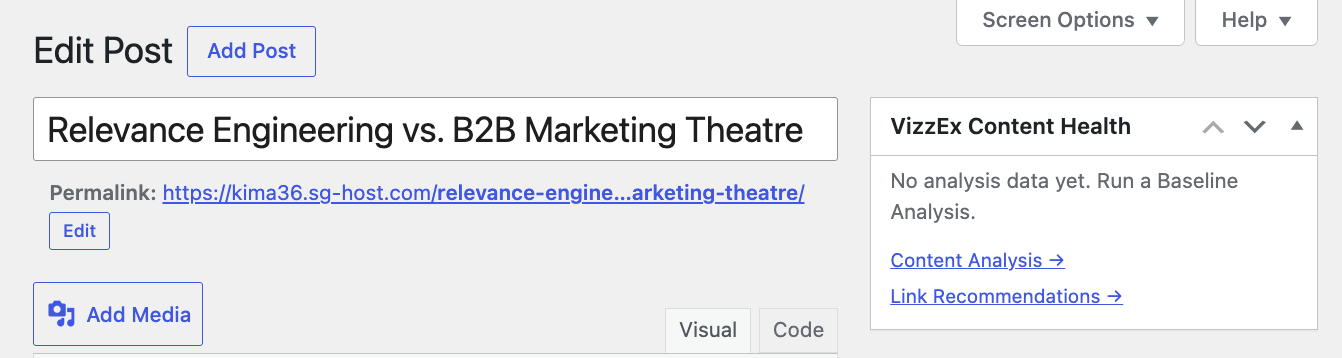
- Post Edit Metabox: connectivity score, hub designation, pending recommendations, and change-detection warning.
- Onboarding: two-step welcome screen guiding users through Claude API key setup and first analysis.
- Upgrade encouragement: friendly Pro upgrade callouts throughout — no gates, no blurs.
- Full GPLv2+ license compliance.
- Shared database table schemas with VizzEx Pro for seamless upgrade path.
Screenshots
For developers
Is this your plugin? Show off the numbers.
Add a live badge to your site, docs or GitHub README. It updates on its own — no account needed.
Best VizzEx alternatives
All geo plugins →





FAQ
VizzEx: quick answers
Straight answers, pulled from live WordPress.org data.
Live data from WordPress.org · checked Nov 18, 2026
Is VizzEx free?
Yes. VizzEx is free to download and use from the official WordPress.org plugin directory.
Is VizzEx safe to use in 2026?
VizzEx is a solid plugin choice in 2026, with a few things worth checking first. Is rated 5/5 and was last updated 2 weeks ago, and scores 71/100 on our health check.
How many websites use VizzEx?
VizzEx is active on <10 WordPress websites and has been downloaded 1,406 times since it launched in August 2026. It was downloaded 387 times in the last 30 days.
Does VizzEx work with WordPress 7.1?
Yes. The developer has tested VizzEx up to WordPress 7.1.4, the latest release. It requires WordPress 6.2 or newer.
What PHP version does VizzEx need?
VizzEx requires PHP 7.4 or higher. Most hosts run PHP 8.x today, so it works on any modern WordPress hosting.
When was VizzEx last updated?
The latest version, 1.0.4, was released on November 6, 2026 (2 weeks ago).
Who makes VizzEx?
VizzEx is developed and maintained by VizzEx.
What are the best alternatives to VizzEx?
The most popular alternatives to VizzEx are GEO Plugin by Squirrly SEO (30K+ installs), Geo Mashup (1K+ installs) and LovedByAI (1K+ installs).
Powered by PageForge
Want thousands of pages that rank like these? Build them in an afternoon.
This directory runs on the same engine as PageForge. Turn any spreadsheet, CSV or API into thousands of fast, SEO-ready WordPress pages — with schema, internal links and AI-written copy baked in.
- CSV, Google Sheets & API data sources
- AI content, schema & internal links per page
- Works with Elementor, Gutenberg, Yoast & Rank Math
- Free on WordPress.org — no credit card