



Deklera – E-Rechnung, XRechnung & KSeF for WooCommerce
Which WooCommerce orders would be rejected as e-invoices? Find out before you issue them. XRechnung, ZUGFeRD/Factur-X, KSeF.

Solid choice
Deklera is a solid plugin choice in 2026, with a few things worth checking first. Was last updated 2 weeks ago, and scores 64/100 on our health check.
- Actively developed — last update 2 weeks ago
- Tested with the latest WordPress (7.1)
- Small user base (<10 active installs)
- Very few reviews so far
- Needs PHP 8.2 or newer
How does it stack up?
Side-by-side on installs, updates, ratings & support


Daily downloads
Download spikes usually follow a new release — each site that auto-updates counts as a download.
Rankings
Where Deklera stands todayWordPress.org search rankings
Live position in the plugin search, top 100| Keyword | Position |
|---|---|
| e-rechnung | #9 |
| factur-x | #17 |
| ksef | #10 |
| woocommerce | >100 |
| xrechnung | #4 |
About Deklera
From the official readme · v0.3.11Description
Producing e-invoice XML is the easy part. The hard part is that WooCommerce
order data is rarely clean enough for it — and you find out weeks later, when
an invoice comes back rejected and you have to work out which of two hundred
business rules you broke.
Deklera starts at that problem, not at the XML.
Install it, open the report, and it tells you in plain language which of your
recent orders would be rejected and why. Then it produces the document your
country requires — XRechnung in Germany, Factur-X in France,
KSeF FA(3) in Poland — and, on the Pro plan, checks it against the
official EN 16931 rule set before it is issued.
Want to see what the official rule set says about an invoice before you install
anything? Paste one here, no sign-up, nothing stored:
https://ekremtekerek.github.io/deklera/check/
The pre-flight check
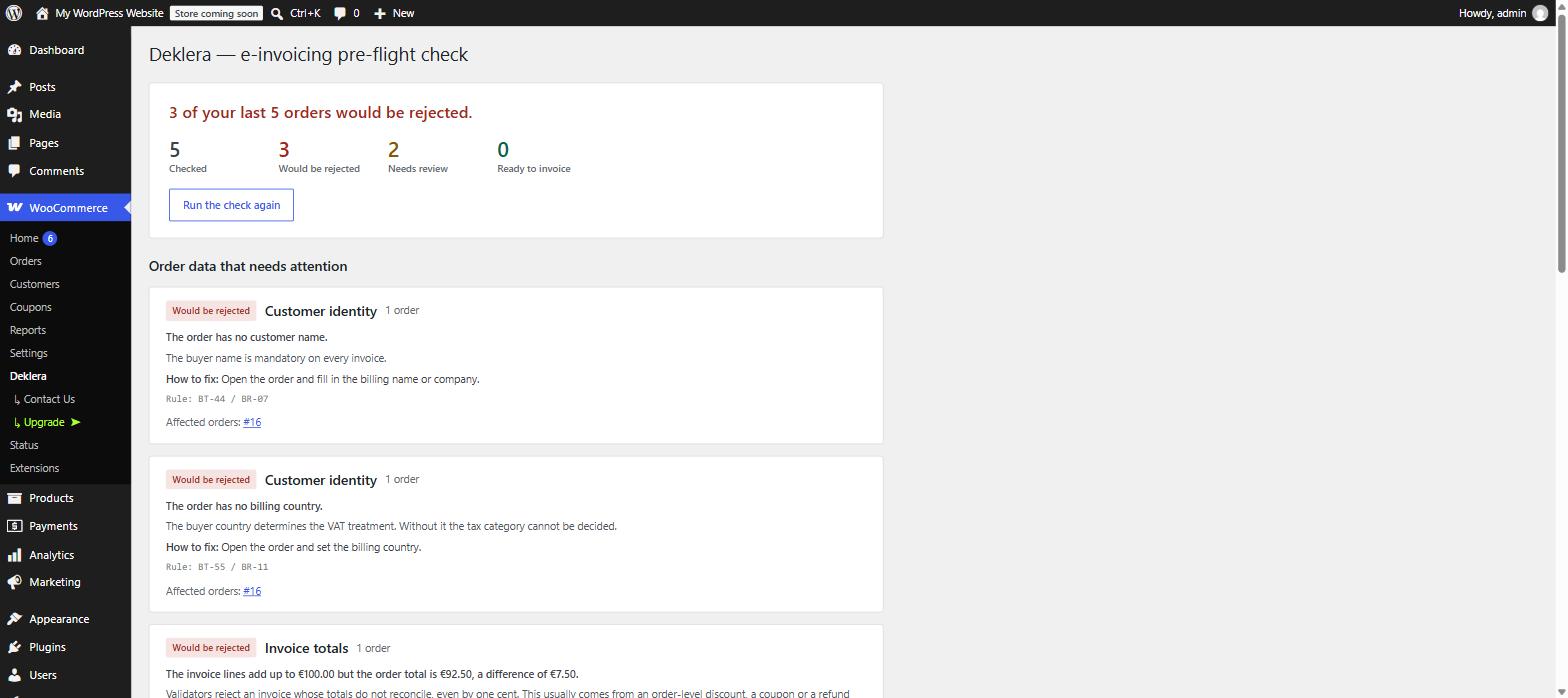
This is what the plugin is for. It scans your orders and reports, for each
problem: what happened, why it matters, the exact rule reference, and where to
fix it. No jargon, no “invalid order”.
Real examples from the report:
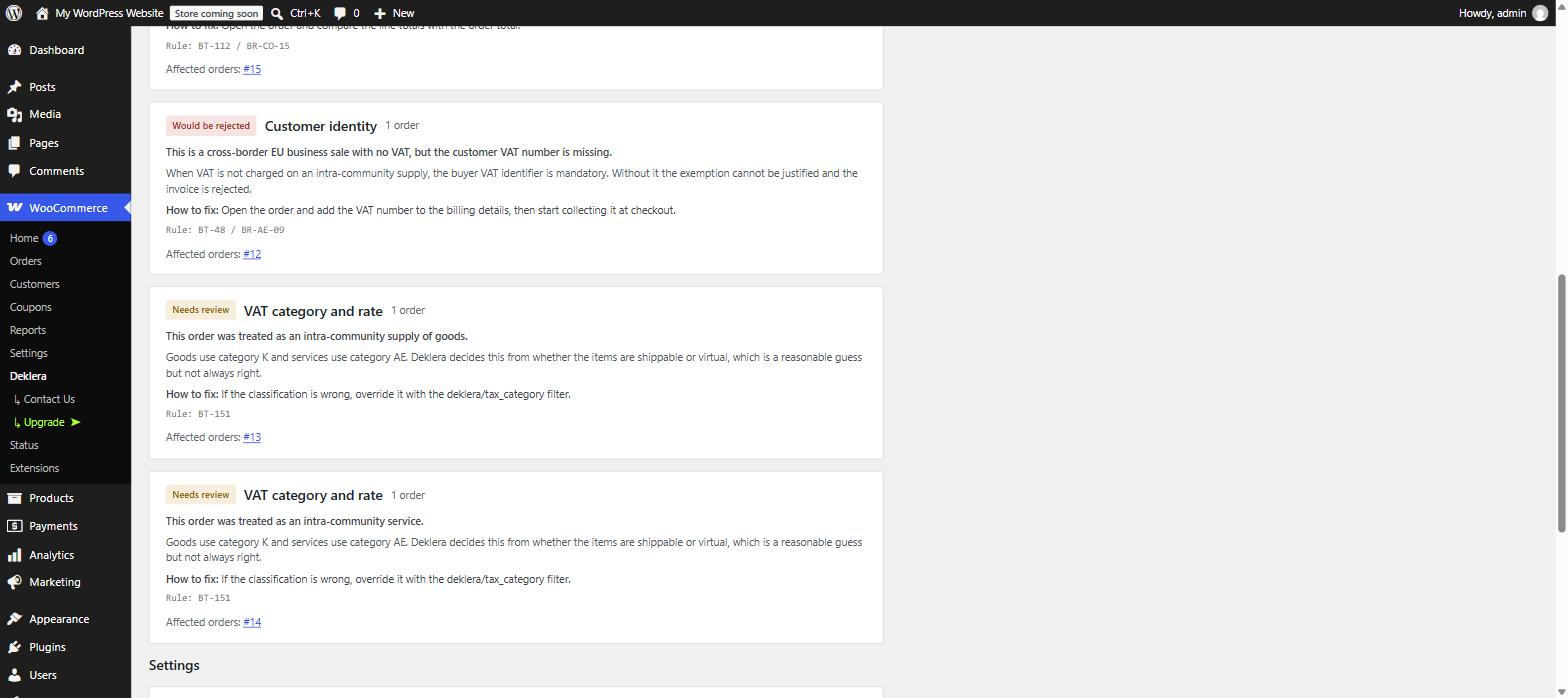
- “This is a cross-border EU business sale with no VAT, but the customer VAT
number is missing.” —BT-48 / BR-AE-09. Without it the exemption cannot be
justified and the invoice is rejected. - “The invoice lines add up to €120.00 but the order total is €112.50, a
difference of €7.50.” —BT-112 / BR-CO-15. Validators reject totals that
do not reconcile, even by one cent.
Findings are grouped by root cause, so a store-wide problem is reported once —
not repeated on every order.
Other things it catches:
- Sales to EU consumers where no VAT was charged at all
- Missing store VAT number, incomplete store address
- VAT categories that contradict the rate applied
- Orders with no customer name or no billing country
When Deklera has to make a judgement call — is this a service or goods? — it
says so and marks the order for review instead of guessing silently. You can
override it with a filter.
Generating documents
Deklera maps each order to the EN 16931 semantic model and produces the format
your country requires:
- France — Factur-X: a PDF/A-3 file with the XML embedded inside it. The
EN 16931 profile it uses is the same specification ZUGFeRD 2.x publishes
under its own name, so a German recipient that accepts ZUGFeRD accepts these
files - Germany — XRechnung 3.0, the pure-XML E-Rechnung the public sector and
a growing number of B2B recipients require - Poland — KSeF FA(3), the faktura ustrukturyzowana, submitted to the
national platform - Other countries — EN 16931 CII, the European baseline. Read the FAQ below before relying on it.
The tax category (standard, reverse charge, intra-community supply, export) is
derived from where the seller and buyer are, not guessed from the rate alone.
Where a decision is uncertain, Deklera says so instead of silently guessing.
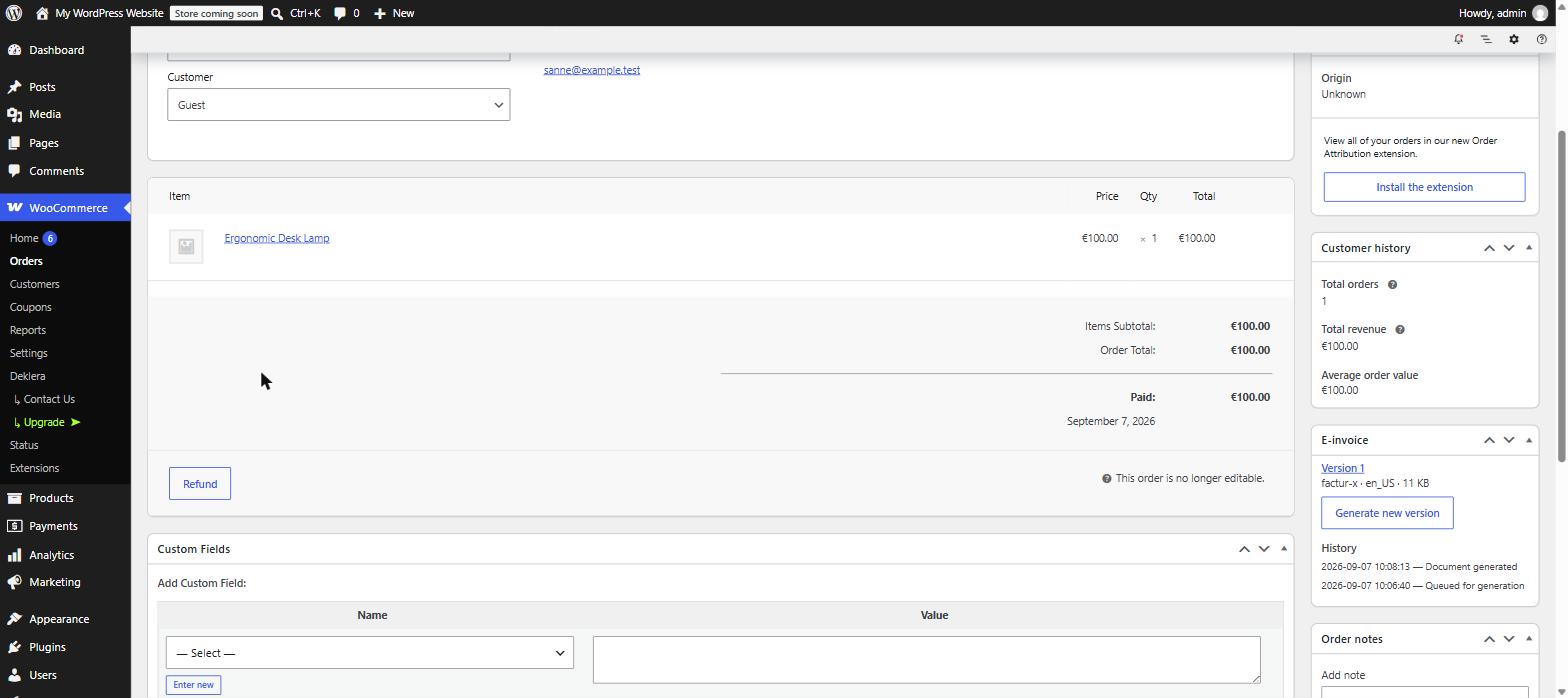
Documents are archived and never overwritten. Regenerating creates a new
version; the old one stays, because quietly replacing an issued invoice is not
something an audit will forgive.
What this plugin does not do
It does not transmit invoices, except to KSeF. Deklera produces the
document and checks it; delivery goes through your own accredited provider — a
PDP in France, a Peppol access point elsewhere. Poland is the exception,
because there an unsent file is not an invoice at all. If you are looking for a
plugin that sends invoices to a network, this is not it, and you should not buy
it expecting that.
It also does not guarantee legal compliance. No software can. Whether a
specific invoice is accepted depends on your registration, your provider and
rules that change over time. What Deklera can honestly promise is narrower and
more useful: it tells you when your data will fail the standard, and it checks
the finished document against the official rule set before you issue it.
Who this is for
Shops that already know they need e-invoicing and want to find out, now,
whether their order data is ready — rather than discovering it one rejection
at a time.
France requires e-invoicing from September 2026, small businesses from
September 2027. Poland’s KSeF already covers most VAT-registered businesses.
Germany accepts XRechnung and ZUGFeRD today, and under the
E-Rechnungspflicht every business there has had to be able to receive an
e-invoice since January 2025.
External services
Official validation service (Pro only, optional)
The Pro version can validate each document against the official EN 16931
Schematron rule set. This validation cannot run inside WordPress: the rule set
compiles to XSLT 2.0, and PHP’s XSL extension only supports XSLT 1.0.
When enabled, the invoice XML is sent over HTTPS to a validation service
operated by the plugin author. The XML contains your invoice data, including
seller and buyer names, addresses, VAT numbers and line items. It is processed
in memory to produce the validation report and is not stored.
This service is off by default and only runs on the Pro plan after you enter
an endpoint and licence key.
- Service: Deklera validation service
- Terms: https://github.com/ekremtekerek/deklera/blob/main/docs/TERMS.md
- Privacy: https://github.com/ekremtekerek/deklera/blob/main/docs/PRIVACY.md
KSeF (Poland only, required for Polish stores)
If your store is based in Poland, each generated FA(3) invoice is submitted to
the Polish Ministry of Finance’s National e-Invoice System (KSeF). This is not
optional for Polish stores: an FA(3) file has no legal standing until KSeF
accepts it and assigns a number.
The invoice is encrypted on your site before it leaves it, and sent over HTTPS.
It contains your invoice data: seller and buyer names, addresses, tax
identifiers and line items. You choose the environment; the test environment
has no legal effect.
- Service: KSeF (Krajowy System e-Faktur), Ministerstwo Finansów
- Test: https://api-test.ksef.mf.gov.pl
- Production: https://api.ksef.mf.gov.pl
- Terms: https://ksef.mf.gov.pl
Stores outside Poland never contact KSeF.
The free version performs no other external requests, apart from the language
pack downloads that WordPress itself makes.
Installation
- Install and activate WooCommerce.
- Install and activate Deklera.
- Go to WooCommerce → Deklera and enter your VAT number, with the country
prefix —FR40303265045, not40303265045. WooCommerce has no field for
this, so Deklera stores it. - Check that your store address is complete under WooCommerce → Settings →
General. Street, city, postcode and country are all mandatory on an
invoice; if one is missing, Deklera will refuse to produce documents and
tell you why. - Read the pre-flight report.
On the Pro plan there is nothing more to set up. Activating your licence
switches official validation on; the plugin authorises itself with that
licence, so there is no second key to paste.
The full guide — what the findings mean, when documents are produced and
where they are stored, credit notes, the Polish KSeF flow, and the available
filters — is at
https://github.com/ekremtekerek/deklera/blob/main/docs/GUIDE.md
Frequently asked questions
Does it work without a PDF invoice plugin?
Yes. Deklera includes a plain fallback template. If you already use a PDF invoice plugin such as WooCommerce PDF Invoices & Packing Slips, Deklera embeds the XML into that plugin’s PDF instead, so your own design and branding are kept. The built-in template embeds its own font, so it writes any European alphabet and the finished Factur-X passes PDF/A-3 validation, which France requires. When another plugin produces the PDF, PDF/A conformance is up to that plugin.
Will my invoices be accepted?
Deklera produces documents that conform to EN 16931 and, on the Pro plan, verifies them against the official rule set before they leave your site. Whether a specific tax authority accepts a specific invoice also depends on your registration, your provider and rules that change over time. No plugin can promise that, and any that does is not being honest with you. What can be shown is the measurement. I ran my own output through KoSIT’s official validator configuration before release; the first run failed six rules, every one of them a field EN 16931 leaves optional and Germany makes mandatory…
Does it send my invoices anywhere?
If your store is in Poland, yes: FA(3) invoices are submitted to KSeF, because there an invoice does not legally exist until KSeF has accepted it. That is the whole point of the Polish system. Everywhere else, no. On Pro, the document is sent to the validation service described under External services, and only if you enable it.
How is this different from the other invoice plugins?
Most WooCommerce invoice plugins already produce the file, and several produce it for nothing. So does Deklera: the entire free version is the format work — pre-flight report, Factur-X, XRechnung, credit notes, versioned archive — and nothing in it is switched off. That is the entry ticket, not the product. Producing a file is easy. Knowing whether the data behind it will survive the rules is not, and that is the part that costs you weeks when it goes wrong. So Deklera does the part nobody else checks. The report tells you which orders would be rejected before you issue them. Pro runs the…
Which countries are supported?
France (Factur-X, facture électronique), Germany (XRechnung, E-Rechnung) and Poland (KSeF FA(3)) are fully supported, and each one is measured against that country’s own official validator before a release goes out. Other EU countries receive EN 16931 CII output, the common semantic standard behind all of them. Read that as the European baseline, not as your national profile. Several member states run their own mandatory format and their own platform — Italy’s FatturaPA through the SdI is the clearest example — and Deklera does not produce those. If your country runs its own system, confirm…
Is the free version actually usable?
Yes, and not in the “crippled demo” sense. The free version does everything the plugin itself is capable of: it scans your orders, reports every problem it finds, generates real Factur-X and XRechnung documents, produces credit notes for refunds, archives every version with a hash, and generates a document automatically when an order completes. Nothing in the code is switched off by a licence. Pro adds one thing, because it is the one thing the plugin cannot do on its own: validation against the official EN 16931 rule set before a document is issued. That rule set compiles to XSLT 2.0 and…
Changelog
Pro no longer needs a separate validation key: your licence now authorises official validation on its own. If you had pasted a key, it keeps working. The order screen also names the rule when a document is refused.
0.3.11
- The pre-flight screen no longer contradicts itself. On a fresh install with
no VAT number — that is, when every invoice would be rejected — the summary
said in green that all recent orders would be accepted, while the same
screen listed two store-level problems as “Would be rejected” three lines
below. It now leads with the store-level blockers, and “Ready to invoice”
reads zero, because nothing is. - The plugins list now links straight to the pre-flight report. Until now the
only way in was a submenu at the bottom of the WooCommerce menu, and
activating the plugin left no sign it was there at all.
0.3.10
- Packaging only, no functional change. A command-line tool that came with a
bundled library is no longer included, and the Factur-X metadata schema is
now shipped as an .xml file. French invoices are produced exactly as
before.
0.3.9
- Packaging only, no functional change. The download no longer carries build
and continuous-integration files from the bundled libraries — Schematron,
XSLT and CI configuration that nothing in the plugin reads. The WordPress.org
review asked for this, and the download is a good deal smaller for it.
0.3.8
- When the official rule set refuses a document, the order screen now names
the rule and quotes what it said. Before, it said only “Invalid” and the
reason sat in the database where nobody could see it — which is unhelpful
exactly when it matters most. - Pro no longer needs a separate validation key. The plugin authorises itself
with the licence you already activated, so there is nothing extra to paste,
and a cancelled or lapsed subscription now stops validation on its own. - An existing validation key still works and still wins, for shops running
their own copy of the validation service. - Two settings — the invoice contact name and telephone number — were left
behind when the plugin was uninstalled with “delete my settings” turned on.
They are removed now. Invoices, archived documents and the key that verifies
them are kept, as before.
0.3.7
- Packaging only, no functional change. The free download no longer carries
compiled translation files: they were never read, because the translation
loader only runs in the premium build, and on WordPress.org translations
come from translate.wordpress.org anyway. The download is smaller for it. - The upgrade notice for 0.3.0 was longer than the 300 characters the plugin
directory allows, so it was shortened.
0.3.6
- Clearer about what is and is not covered. France, Germany and Poland are
measured against each country’s own official validator before a release
goes out; everywhere else you get EN 16931 CII, which is the European
baseline and not a national profile. Some member states mandate their own
format and their own platform — Italy’s FatturaPA through the SdI is the
clearest example — and Deklera does not produce those. Better to know that
before you buy than after.
Screenshots
For developers
Is this your plugin? Show off the numbers.
Add a live badge to your site, docs or GitHub README. It updates on its own — no account needed.
Best Deklera alternatives
All e-rechnung plugins →FAQ
Deklera: quick answers
Straight answers, pulled from live WordPress.org data.
Live data from WordPress.org · checked Sep 30, 2026
Is Deklera free?
Yes. Deklera is free to download and use from the official WordPress.org plugin directory.
Is Deklera safe to use in 2026?
Deklera is a solid plugin choice in 2026, with a few things worth checking first. Was last updated 2 weeks ago, and scores 64/100 on our health check.
How many websites use Deklera?
Deklera is active on <10 WordPress websites and has been downloaded 135 times since it launched in September 2026. It was downloaded 139 times in the last 30 days.
Does Deklera work with WordPress 7.1?
Yes. The developer has tested Deklera up to WordPress 7.1.2, the latest release. It requires WordPress 6.5 or newer.
What PHP version does Deklera need?
Deklera requires PHP 8.2 or higher. Most hosts run PHP 8.x today, so it works on any modern WordPress hosting.
When was Deklera last updated?
The latest version, 0.3.11, was released on September 18, 2026 (2 weeks ago).
Who makes Deklera?
Deklera is developed and maintained by ekremtekerek.
What are the best alternatives to Deklera?
The most popular alternatives to Deklera are Jojobry E-Rechnung for WooC… (<10 installs), Komplyo E-Invoicing (<10 installs) and Rechnova (<10 installs).
Powered by PageForge
Want thousands of pages that rank like these? Build them in an afternoon.
This directory runs on the same engine as PageForge. Turn any spreadsheet, CSV or API into thousands of fast, SEO-ready WordPress pages — with schema, internal links and AI-written copy baked in.
- CSV, Google Sheets & API data sources
- AI content, schema & internal links per page
- Works with Elementor, Gutenberg, Yoast & Rank Math
- Free on WordPress.org — no credit card