


CSS Page Ancestors
Please, keep in mind that THIS IS IN BETA. I’m relying to your feedback, positive or with suggestions, to release it out of beta

Consider an alternative
CSS Page Ancestors shows warning signs in 2026 — compare the alternatives below before installing. Was last updated 9 years ago, and scores 21/100 on our health check.
- Small user base (<10 active installs)
- Very few reviews so far
- No update in 8 years
- Only tested up to WordPress 4.8 (latest is 7.1)
How does it stack up?
Side-by-side on installs, updates, ratings & supportDaily downloads
Download spikes usually follow a new release — each site that auto-updates counts as a download.
Rankings
Where CSS Page Ancestors stands todayWordPress.org search rankings
Live position in the plugin search, top 100| Keyword | Position |
|---|---|
| ancestor | >100 |
| ancestors | >100 |
| css | >100 |
| father | #17 |
About CSS Page Ancestors
From the official readme · v0.95Description
Please, keep in mind that THIS IS IN BETA. I’m relying to your feedback, positive or with suggestions, to release it out of beta
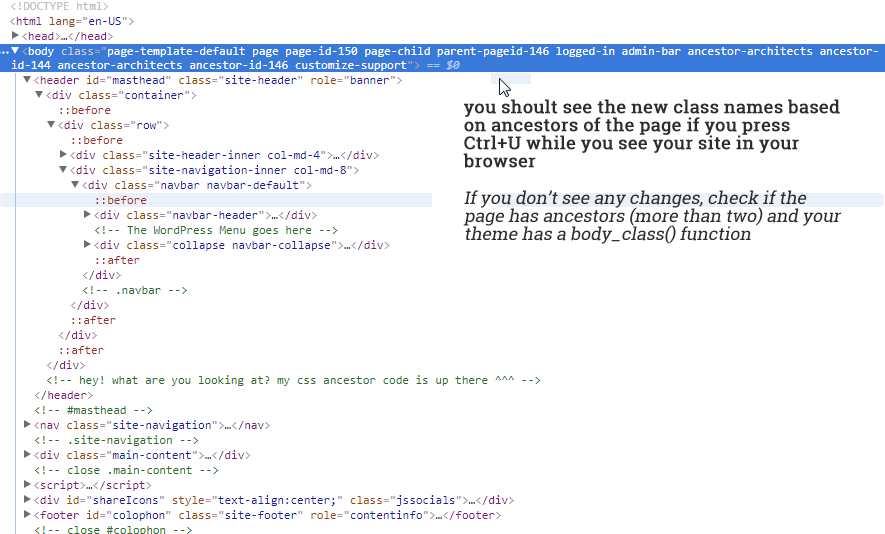
This plugin will give you the extra class you need in your tag of ALL (and not just one) of the anchestors of a page in WordPress.
This way you will be able to color a certain section of a site, based on the root’s ancestor – no matter how deep is the page (WordPress does this only for the direct father of a page)
Also, the printed class names are ancestor-[slug] and ancestor-id-[id]. This way, you can use it with your page slug (very conviniate if you move sites between instalations where id can change) and id (useful if you use a non-latin site, and slug can’t be used in css)
–
So, let’s imagine you have this tree of pages on your site:
- Home
- Clients
- Web
- EShops
- Portfolio
- Web
- Contact
Let’s see this scenario: You want all the pages under ‘Clients’ to have a red background. Now, it’s easy to do that – but only for the ‘Web’, and ‘Print’ pages because WordPress gives you only the fathers in the body classes – in this case, the id of ‘Clients’. ‘Eshops’ and ‘Portfolio’ can also have a red background, but you will have to add a new class in your css with the id of ‘Web’ at your css. And, if you add pages under ‘Eshops’, same thing, you will have to add a new class in your css file with the id of ‘Eshops’ page. So, all this is easy if you do it yourself – but if you handle the site to an editor, that knows only to create content – you will have to add the class in the CSS every time someone adds a level to all this.
With this plugin all the ancestors of a page, no matter the depth will be in your body as class names – as a slug, and as an id. And you want all the pages under ‘Clients’ to have a red background you just add to your css .achestor-clients {background:red;} in your css, and you are done – no matter the level the final page is under.
Finaly, the order is with top ancestor first (in our example, Portfolio page will have “ancestor-clients ancestor-web”) – this way, it’s simpler in CSS to overwrite the -clients class with the -web attributes.
There is no writing on the database, or other change on the site, so, even if something goes wrong, just de-activate the plugin, and you’ll be fine.
Installation
-
Upload the plugin files to the ‘/wp-content/plugins/plugin-name’ directory, or install the plugin through the WordPress plugins screen directly.
-
Activate the plugin through the ‘Plugins’ screen in WordPress
-
The new classes will be automatically added to your body (IF your theme is provided with the body_class() function)
Changelog
0.95
Removed the manual installation of the plugin, and converted it to a filter, so the users won’t touch their theme. (Thanks WordPress Plugin Directory Team for the tip!)
0.9
Beta release.
0.8
Added the anchestor-id-[id] css class, for non-latin page slugs
0.1
Hey, i have an idea! What if… 🙂
Screenshots
For developers
Is this your plugin? Show off the numbers.
Add a live badge to your site, docs or GitHub README. It updates on its own — no account needed.
Best CSS Page Ancestors alternatives
All ancestor plugins →| Rank | Plugin | Active installs |
|---|---|---|
| 1 |
 Menu-item-ancestor
Adds a menu-item-ancestor class to every menu item that has descendants.
Menu-item-ancestor
Adds a menu-item-ancestor class to every menu item that has descendants.
|
10+ |
FAQ
CSS Page Ancestors: quick answers
Straight answers, pulled from live WordPress.org data.
Live data from WordPress.org · checked Oct 11, 2026
Is CSS Page Ancestors free?
Yes. CSS Page Ancestors is free to download and use from the official WordPress.org plugin directory.
Is CSS Page Ancestors safe to use in 2026?
CSS Page Ancestors shows warning signs in 2026 — compare the alternatives below before installing. Was last updated 9 years ago, and scores 21/100 on our health check.
How many websites use CSS Page Ancestors?
CSS Page Ancestors is active on <10 WordPress websites and has been downloaded 1,536 times since it launched in November 2017. It was downloaded 59 times in the last 30 days.
Does CSS Page Ancestors work with WordPress 7.1?
CSS Page Ancestors is officially tested up to WordPress 4.8.33, while the latest release is 7.1.3. It may still work, but try it on a staging site first.
What PHP version does CSS Page Ancestors need?
CSS Page Ancestors requires PHP 5.6 or higher. Most hosts run PHP 8.x today, so it works on any modern WordPress hosting.
When was CSS Page Ancestors last updated?
The latest version, 0.95, was released on November 19, 2017 (9 years ago).
Who makes CSS Page Ancestors?
CSS Page Ancestors is developed and maintained by giannisg.
What are the best alternatives to CSS Page Ancestors?
The most popular alternatives to CSS Page Ancestors are Menu-item-ancestor (10+ installs).
Powered by PageForge
Want thousands of pages that rank like these? Build them in an afternoon.
This directory runs on the same engine as PageForge. Turn any spreadsheet, CSV or API into thousands of fast, SEO-ready WordPress pages — with schema, internal links and AI-written copy baked in.
- CSV, Google Sheets & API data sources
- AI content, schema & internal links per page
- Works with Elementor, Gutenberg, Yoast & Rank Math
- Free on WordPress.org — no credit card