


Glossary
Given a collection of glossary definition pages, automatically creates links in your page and post content for the words in your glossary.
 By
By Consider an alternative
Glossary shows warning signs in 2026 — compare the alternatives below before installing. It runs on 10+ sites and was last updated 18 years ago, and scores 31/100 on our health check.
- Small user base (10+ active installs)
- Very few reviews so far
- No update in 17 years
How does it stack up?
Side-by-side on installs, updates, ratings & support


Daily downloads
Download spikes usually follow a new release — each site that auto-updates counts as a download.
Rankings
Where Glossary stands todayWordPress.org search rankings
Live position in the plugin search, top 100| Keyword | Position |
|---|---|
| definitions | >100 |
| glossary | >100 |
| pages | >100 |
| posts | >100 |
Version adoption
Share of active sites per release.
About Glossary
From the official readme · v0.9Description
Given a collection of glossary definition pages, automatically creates links in your page and post content for the words in your glossary.
Is smart enough not to create illegal nested links.
Works with php 4 and 5 (check out the FAQ for more info on using it with php 4).
Only tested on WordPress version 2.7.1 (although will most likely work on other versions).
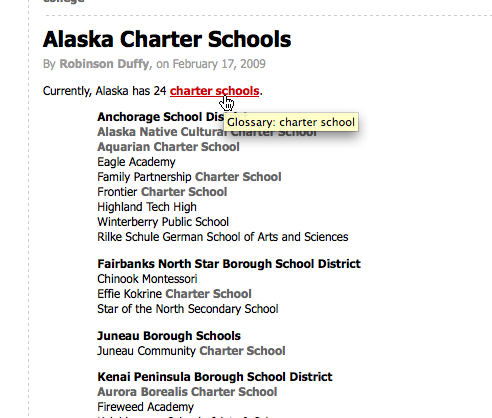
A good example of the glossary in action is at this page. All of the “charter school” links were added dynamically by the glossary plugin.
Installation
- Upload
glossary.phpto the/wp-content/plugins/directory - Activate the plugin through the ‘Plugins’ menu in WordPress
- Create a main glossary page (example “Glossary”) with no body content
- In the plugin’s dashboard preferences, enter the main glossary page’s id#
- Create child pages of the main glossary page for each term you wish to define. The title of the page should be the term. The body content should be the definition.
- There are a handful of optional preferences available in the dashboard
- If you are using php 4, be sure to read teh FAQ.
Screenshots
For developers
Is this your plugin? Show off the numbers.
Add a live badge to your site, docs or GitHub README. It updates on its own — no account needed.
Best Glossary alternatives
All definitions plugins →


FAQ
Glossary: quick answers
Straight answers, pulled from live WordPress.org data.
Live data from WordPress.org · checked Sep 30, 2026
Is Glossary free?
Yes. Glossary is free to download and use from the official WordPress.org plugin directory.
Is Glossary safe to use in 2026?
Glossary shows warning signs in 2026 — compare the alternatives below before installing. It runs on 10+ sites and was last updated 18 years ago, and scores 31/100 on our health check.
How many websites use Glossary?
Glossary is active on 10+ WordPress websites and has been downloaded 8,888 times since it launched in March 2009. It was downloaded 76 times in the last 30 days.
When was Glossary last updated?
The latest version, 0.9, was released on March 4, 2009 (18 years ago).
What are the best alternatives to Glossary?
The most popular alternatives to Glossary are TooltipGlossary (30+ installs), Dexonline Searchbox (10+ installs) and mowsterGlossary (10+ installs).
Powered by PageForge
Want thousands of pages that rank like these? Build them in an afternoon.
This directory runs on the same engine as PageForge. Turn any spreadsheet, CSV or API into thousands of fast, SEO-ready WordPress pages — with schema, internal links and AI-written copy baked in.
- CSV, Google Sheets & API data sources
- AI content, schema & internal links per page
- Works with Elementor, Gutenberg, Yoast & Rank Math
- Free on WordPress.org — no credit card