


Field Forge – Custom Fields, Relational Fields & Builder
Custom fields for WordPress: visual builder, 31 field types incl. relational, unlimited groups, REST API and Local JSON. Own table, not postmeta.

Solide Wahl
Field Forge is a solid plugin choice in 2026, with a few things worth checking first. It runs on 10+ sites and was last updated 3 weeks ago, and scores 66/100 on our health check.
- Aktiv entwickelt – letztes Update vor 3 Wochen
- Getestet mit dem neuesten WordPress (7.1)
- Kleine Benutzerbasis (10+ aktive Installationen)
- Bisher sehr wenige Bewertungen
Wie stapelt es sich?
Side-by-side bei Installationen, Updates, Bewertungen und Support



Tägliche Downloads
Download-Spitzen folgen normalerweise einer neuen Version - jede Website, die automatisch aktualisiert wird, gilt als Download.
Ranglisten
Where Field Forge stands todayWordPress.org Ranglisten suchen
Live-Position in der Plugin-Suche, Top 100| Stichwort | Position |
|---|---|
| builder | >100 |
| custom fields | >100 |
| custom table | >100 |
| meta fields | >100 |
| relational fields | #8 |
Versionsübernahme
Anteil aktiver Sites pro Release.
About Field Forge
From the official readme · v1.4.0Beschreibung
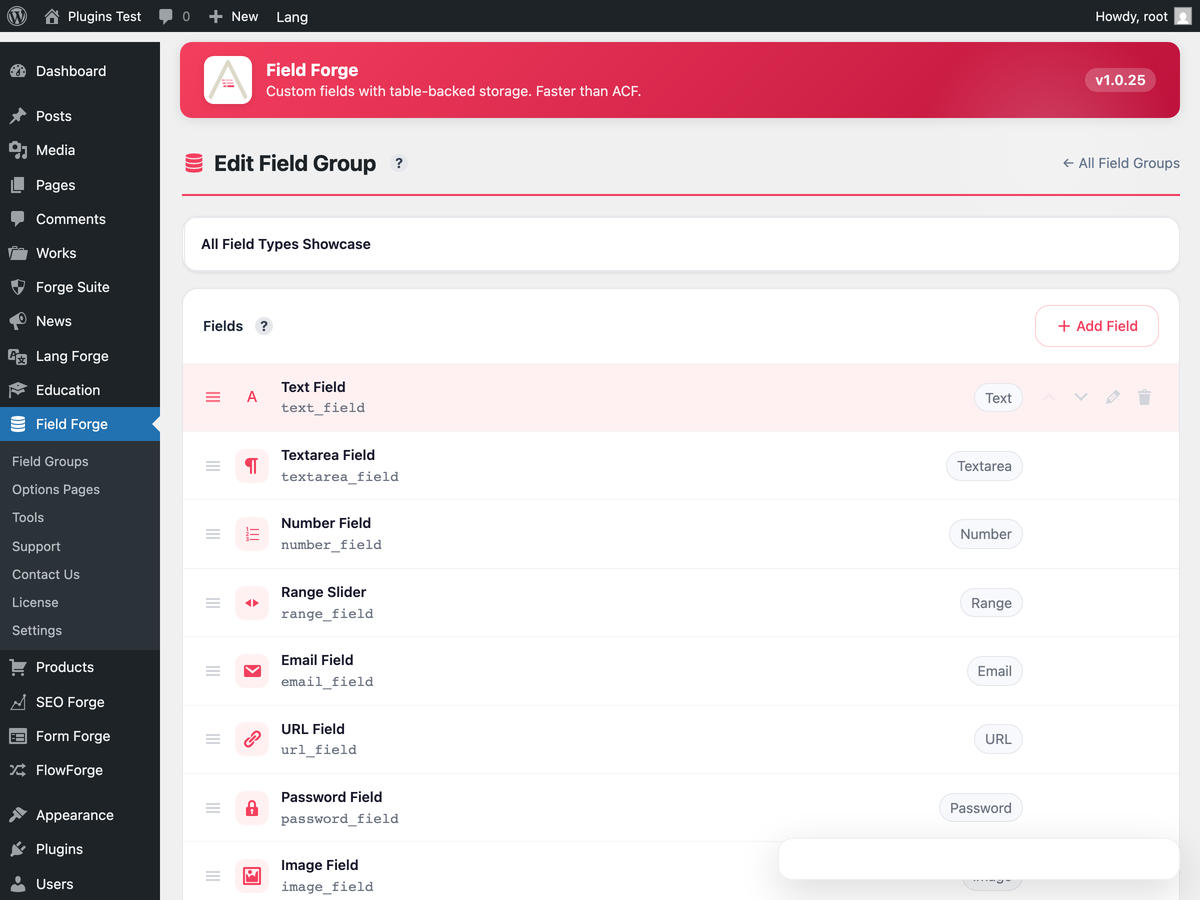
Field Forge adds custom fields to posts, pages, custom post types, taxonomies and users. Build a field group in a visual editor, pick where it appears, and read the values in PHP or over the REST API. The number of field groups is not limited.
Field values are kept in their own table, wp_fieldforge_values, instead of wp_postmeta, so a post with dozens of fields does not fill the core meta table. There are 31 field types: text, textarea, number, select, image, file, WYSIWYG, oEmbed, gallery, calculation, date, time and colour pickers, Google Map and link, plus the relational set: Relationship, Post Object, Page Link, Taxonomy and User.
Location rules decide where a group is shown: by post type, taxonomy, page template or user role. Field groups are written to disk as Local JSON files in wp-content/uploads/fieldforge-json, and a folder you add with the fieldforge/local_json/load_paths filter, for example one kept in your theme under version control, is read too. Every group keeps a schema version and a revision history. Values of options pages can be read and written with get_field() and update_field().
Coming from ACF
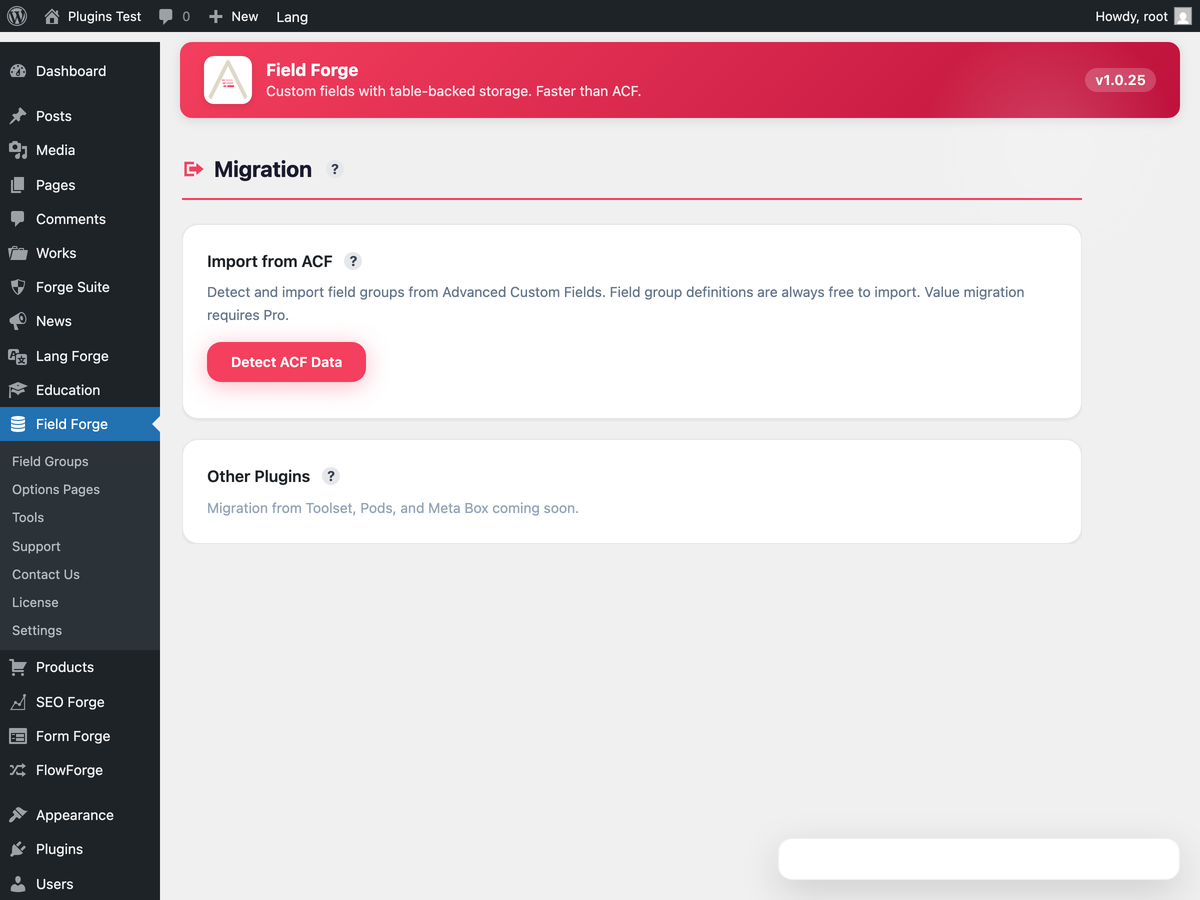
Field Forge → Migration detects your existing ACF field groups and values and imports them into its own tables. A compatibility layer defines the common ACF template functions, including get_field(), the_field(), get_field_object(), get_fields() and have_rows(), so theme code that calls them keeps working while you migrate. acf_register_block_type() is defined too, but it registers a block only when the Pro add-on’s PHP Blocks are active. Check your theme after the switch.
Kostenlos
- Unlimited field groups
- 31 field types, including Relationship, Post Object, Page Link, Taxonomy and User
- Location rules by post type, taxonomy, template and user role
- Visual field group builder
- Storage in a custom table, not
wp_postmeta - Import of ACF field groups and values, and an ACF compatibility layer
- Local JSON sync
- Options-page values through
get_field()andupdate_field() - REST API exposure of field values
- Schema versioning and revision history for field groups
Pro add-on (separate plugin, not part of this download)
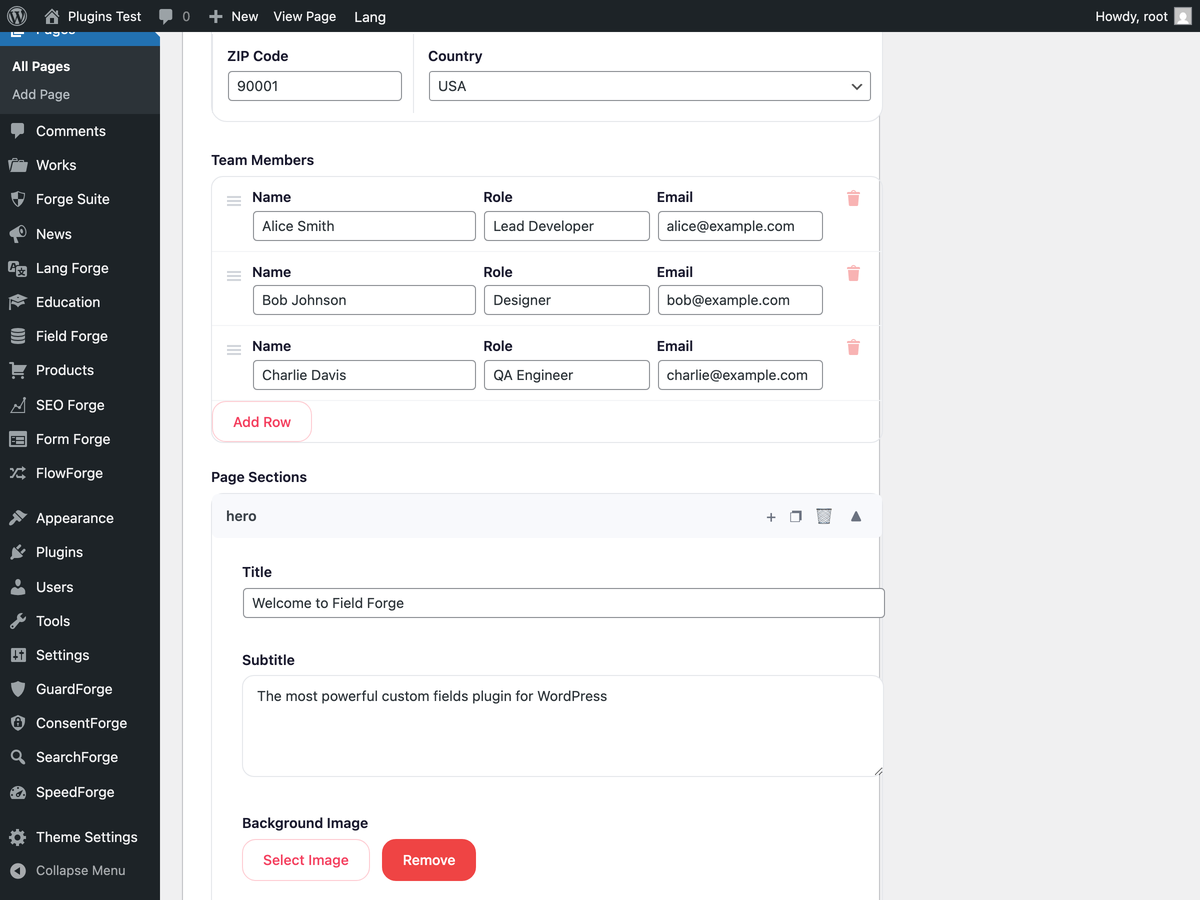
- Compound field types: Repeater, Group, Flexible Content and Clone
- Options pages management screen
- PHP Blocks: register Gutenberg blocks from field groups
- AI schema generator: describe your data and get a field group
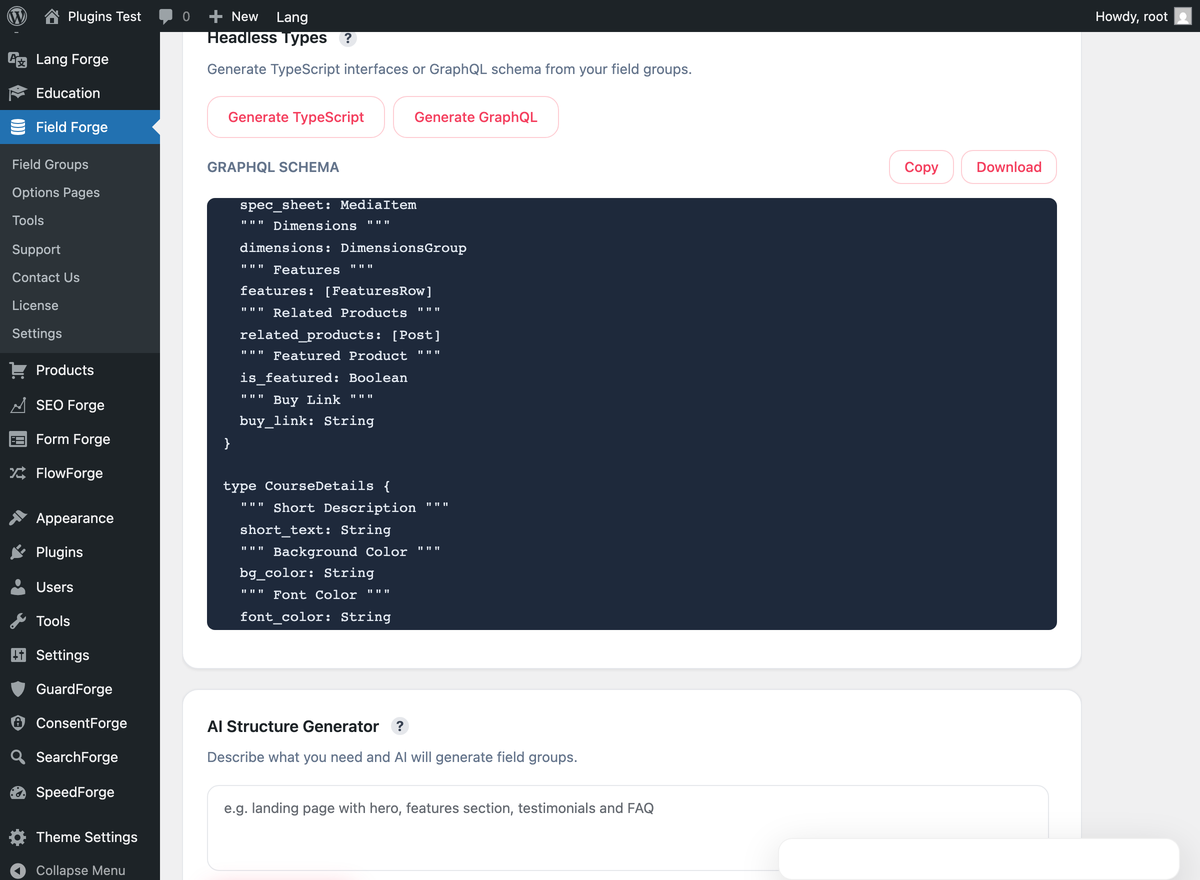
- Native WPGraphQL schema and resolvers
- TypeScript and JSON export of field groups
- Bulk JSON export and import
The only request the free plugin can make is the one WordPress makes for an oEmbed field, to the provider of the URL an editor enters. It has no analytics, no telemetry and no licensing calls.
Documentation: https://fieldforgewp.com/docs/
Guide to moving from ACF: https://fieldforgewp.com/acf-migration-guide/
Comparison with other field plugins: https://fieldforgewp.com/compare/
Externe Dienste
Every outbound request this plugin makes is listed below. Activating it, and opening its screens, contacts nobody.
- oEmbed field. An oEmbed field asks WordPress to fetch the embed from the provider of the URL an editor enters, exactly as the block editor does: when the field’s value is shown, in the preview under the field in the editor and wherever a theme or a plugin reads the field through the ACF-compatible
get_field(), WordPress asks that provider’s oEmbed address about the URL. The provider receives the URL and sees the network address of your server. Which provider that is depends on the URL; its terms and its privacy policy are its own. A site that uses no oEmbed field makes no such request.
Apart from that this plugin contacts no external service of its own: field groups, values, Local JSON, the ACF importer and REST exposure all run on your site, and there are no analytics, no telemetry and no licensing calls. AI features belong to the separate Field Forge Pro add-on, which describes the services it uses in its own documentation.
Installation
- Upload
fieldforgeto/wp-content/plugins/, or install via Plugins → Add New. - Aktivieren Sie das Plugin.
- Go to Field Forge → Field Groups → New Field Group.
- Read values in PHP:
$value = get_field('my_field', $post_id); - Or via REST:
GET /wp-json/wp/v2/posts/123/fieldforge - With the separate Field Forge Pro add-on, also via GraphQL:
posts { nodes { fieldforge { myField } } }
Änderungsprotokoll
If you run the add-on, keep Field Forge Pro 1.1.5 or newer installed, as before. Update Field Forge Pro to 1.5.0 as well: a repeated AI field generation after a dropped connection then does not use your credits twice.
1.4.0
- AI field generation (with Field Forge Pro): when the connection drops before the answer arrives, the editor says so in plain words, and trying again with the same description does not use your credits a second time. While the first try is still running, you are asked to wait. With an older Field Forge Pro, generation works as before.
- AI field generation: an answer that arrives but cannot be read is reported as such instead of a confusing error.
- Uninstall removes the temporary records Field Forge keeps for AI requests, whether or not “Delete Field Forge data on uninstall” is selected.
1.3.1
- Background jobs: on a site where WP-Cron is switched off (DISABLE_WP_CRON), queuing a job no longer sends the request that wakes WP-Cron. The site’s own cron runner starts the job, as you set it up.
1.3.0
- Uninstall keeps field groups, saved values, settings and migration maps unless “Delete Field Forge data on uninstall” is selected. Older Pro add-ons follow the same choice.
- Removed unused Freemius integration code.
1.2.0
- A site whose Field Forge Pro licence has ended keeps working. Repeater, Group, Flexible Content and Clone values and Options Page values that were saved before are still read and shown, and get_field() returns them as before. Adding, removing or changing those fields and Options Pages is closed until you renew; the other fields of the same group still save, and the editor says which fields are closed. With Field Forge Pro 1.2.0 the same holds for PHP blocks, GraphQL fields, export and code generation.
- Saved values are safer. A post can no longer hold two stored values for the same field: after the update the database is upgraded, duplicates that already exist are collapsed in the background (the one the site shows is kept, the rest are set aside in a separate table) and a unique key is added once that is safe. A value that already sits under a field’s new name when you rename the field is set aside the same way, with a count after the save. Swapping or shifting field names in one save keeps every value, and a save that is refused or breaks off half way keeps them all.
- Field names that are the same apart from capital letters or accents are refused, and the message names both fields, because they would overwrite each other’s values. A field name over 191 characters is refused with a plain message in the editor, the REST API and the ACF import.
- A refused database write while saving a Repeater, Group or Flexible Content field now stops the save instead of wiping the stored values of the post.
- Local JSON Sync now applies a file that differs from the field group it is linked to, compares a file the way it would be written (a file that only reorders choices or layouts is applied), and judges a group of this site by its content, not by the hash line in the file.
- A field group made from a Local JSON file of another site remembers that file, so Sync does not make another copy every time; the Sync screen names the groups a file was linked to and the groups it refused. Groups are announced and caches cleared only after the whole batch is saved, and deleting the plugin removes the links.
- ACF value import: Clone fields now bring their values (Seamless and Group, with and without prefixed names); a Message field keeps its text, new lines and escaping setting; a Textarea without a New Lines setting stays as it was; a stored object or a cut-off serialised value is skipped instead of saved. The result says how many field groups were created, updated and not imported, and which were created as new instead of updating an existing one. The Migration screen lists the importers that are active. Export All shows the server’s message under the button when it is refused.
- ACF functions: get_field(), update_field() and delete_field() accept the key of a field. A user_N or term_N context keeps its own values in user and term meta instead of record 0, and a context that names no record reads and writes nothing. update_field() on a Repeater, Group or Flexible Content saves the rows the way the post screen does. get_field() and have_rows() read Repeater, Flexible Content and Group values saved under ACF’s old meta keys (up to 1000 rows per field, nested levels included) and rows kept as one JSON text. A Relationship saved as comma text is read as a list, and a zero in a Group is a value.
- Option values read for another language (an ACF-style options_xx id) use the language’s own value first and the default language when it has none. acf_register_block_type() and acf_register_block() are declared before acf/init fires.
- Calculation fields read a minus sign in front of a value as the sign of it, in the saved result and in the live preview on the post screen.
- Conditional logic rules that use the operators < and <= are kept when a field group is saved.
- A Password sub-field in a Repeater row is a password box. A stored choice that is no longer in the list is still shown as picked. The value of a Relationship or Post Object field has the shape of its type and Multiple setting, not of the number of saved ids.
- Saving a field group over the REST API is checked: a missing title, a field without a name, fields that are not a list, a group over 1 MB, and Sub Fields or Layouts that are not lists at any depth are refused with a 400 that names the place. A stored value that is not a list reads as empty on the public read paths.
- Reading a list of posts with get_field() in a loop loads their field values in one query per batch of posts instead of one per post.
- The Settings screen has a “Keep my data when Field Forge is deleted” switch. Without it, deleting Field Forge or the Pro add-on from the Plugins screen removes field groups, values, Options Pages and settings, including the new set-aside values table. The Settings form saves without the Pro add-on.
- New messages are translated into the 15 languages the plugin ships with.
- Developers: FIELDFORGE_Field_Groups::begin_batch() and end_batch() let an add-on save several field groups in one transaction, and report_refused_move() lets it report a refused move of stored values.
1.1.8
- Security: Related fields in the public REST API no longer expose private user data, unpublished posts or the content of password-protected posts. With Field Forge Pro 1.1.16 the same holds for GraphQL.
- Security: Field values of password-protected posts in the REST API are no longer shown to visitors who have not entered the password, and totals leave out password-protected posts unless you may edit others’ posts of that type. With Field Forge Pro 1.1.16 the same holds for GraphQL.
- Security: Field values are no longer returned by the Field Forge REST endpoint to logged-in users who cannot edit the post, unless allowed with the fieldforge/rest/public_field_allowed filter.
- Developers: FIELDFORGE_Performance::instance()->flush_all() now also clears the values cache.
1.1.7
- When AI credits run out, the message no longer promises a monthly reset and links to the page where you buy credits.
- The logo in the admin screens is the new mark.
Screenshots
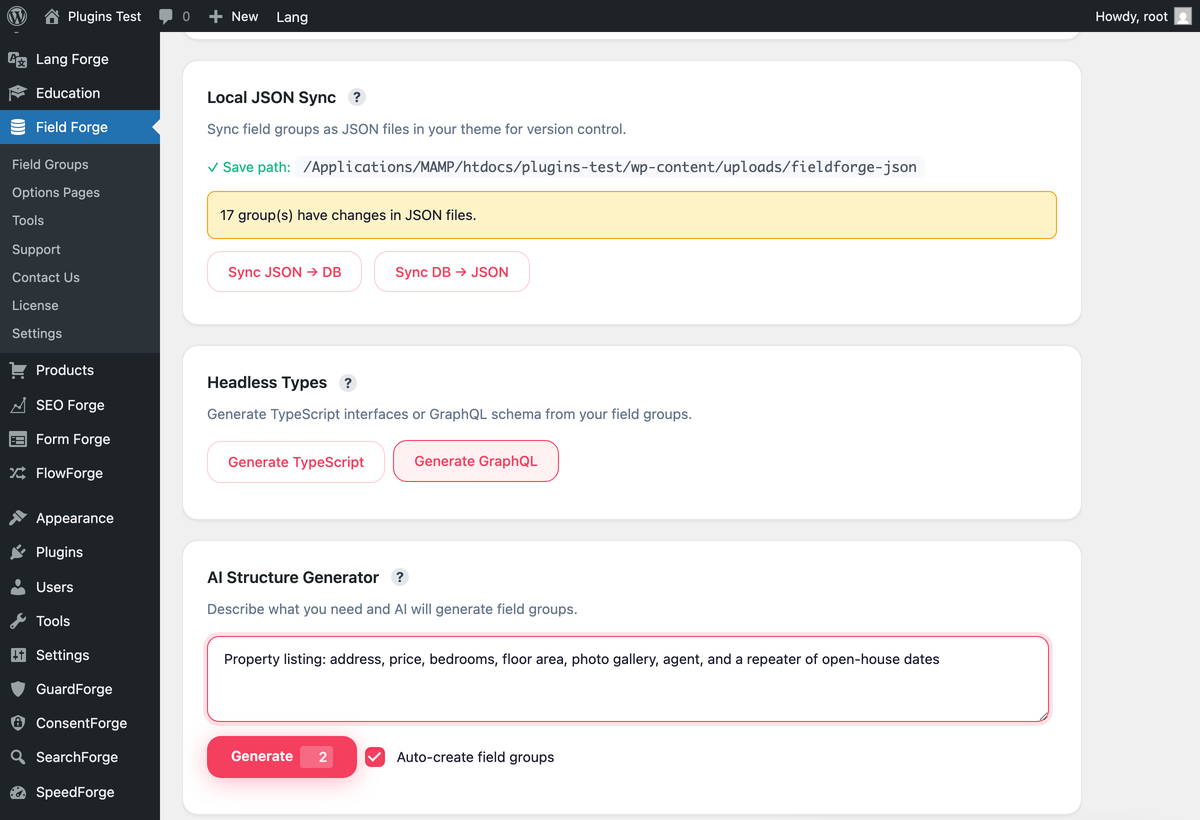
Für Entwickler
Ist das dein Plugin? Zeigen Sie die Zahlen.
Fügen Sie Ihrer Website, Docs oder GitHub Readme ein Live-Badge hinzu. Es wird von selbst aktualisiert - kein Konto erforderlich.
Best Field Forge alternatives
All builder plugins →





Fragen und Antworten
Field Forge: quick answers
Gerade Antworten, gezogen von Live WordPress.org Daten.
Quelle: WordPress.org
Is Field Forge free?
Yes. Field Forge is free to download and use from the official WordPress.org plugin directory.
Is Field Forge safe to use in 2026?
Field Forge is a solid plugin choice in 2026, with a few things worth checking first. It runs on 10+ sites and was last updated 3 weeks ago, and scores 66/100 on our health check.
How many websites use Field Forge?
Field Forge is active on 10+ WordPress websites and has been downloaded 1,536 times since it launched in August 2026. It was downloaded 293 times in the last 30 days.
Does Field Forge work with WordPress 7.1?
Yes. The developer has tested Field Forge up to WordPress 7.1.5, the latest release. It requires WordPress 6.5 or newer.
What PHP version does Field Forge need?
Field Forge requires PHP 7.4 or higher. Most hosts run PHP 8.x today, so it works on any modern WordPress hosting.
When was Field Forge last updated?
The latest version, 1.4.0, was released on November 9, 2026 (3 weeks ago).
Who makes Field Forge?
Field Forge is developed and maintained by avakodeforge.
What are the best alternatives to Field Forge?
The most popular alternatives to Field Forge are Mesmerize Companion (50K+ installs), PixTypes (9K+ installs) and Gantry 5 Framework (7K+ installs).
Angetrieben von PageForge
Eine Vorlage und eine Tabelle. Eine echte Seite für jede Suche.
PageForge Verwandelt jede Zeile eines CSV in eine WordPress-Seite mit eigenem Titel, URL, SEO Felder und Schema entworfen. Kostenlos auf WordPress.org.
- CSV und XLSX, plus Google Sheets auf Beruf und Unternehmen
- seinen eigenen Titel, URL, SEO Felder und Schema für jede Seite
- Arbeitet mit dem Blockeditor, Elementor, Divi und Avada
- Kostenlos auf WordPress.org, keine Kreditkarte