


WPGraphQL
WPGraphQL adds a flexible and powerful GraphQL API to WordPress, enabling efficient querying and interaction with your site's data.

Sichere Auswahl
Yes — WPGraphQL is a safe, well-maintained plugin to use in 2026. It runs on 30K+ sites, is rated 4.9/5 and was last updated 1 week ago, and scores 86/100 on our health check.
- Bewährt auf 30.000 aktiven Standorten
- Loved by users — 4.9/5 from 48 reviews
- Aktiv entwickelt — letztes Update vor 1 Woche
- Momentum — downloads up 26.6% vs the previous 30 days
Wie stapelt es sich?
Side-by-side bei Installationen, Updates, Bewertungen und Support



Tägliche Downloads
Download-Spitzen folgen normalerweise einer neuen Version - jede Website, die automatisch aktualisiert wird, gilt als Download.
Ranglisten
Where WPGraphQL stands todayWordPress.org Ranglisten suchen
Live-Position in der Plugin-Suche, Top 100| Stichwort | Position |
|---|---|
| decoupled | #1 |
| GraphQL | #1 |
| headless | #10 |
| react | #4 |
| rest-api | #49 |
Versionsübernahme
Anteil aktiver Sites pro Release.
Bewertungsaufschlüsselung
★★★★★★★★★★ 4.9 from 48 reviews
About WPGraphQL
From the official readme · v2.29.0Beschreibung
WPGraphQL is a free, open-source WordPress plugin that provides an extendable GraphQL schema and API for any WordPress site.
Get Started
- Install WPGraphQL:
wp plugin install wp-graphql --activate - Try it out: Live Demo
- Read the Quick Start Guide.
- Join the Community on Discord and Star the Repo!
Hauptmerkmale
- Flexible API: Query posts, pages, custom post types, taxonomies, users, and more.
- Extendable Schema: Easily add functionality with WPGraphQL’s API, enabling custom integrations.
- Compatible with Modern Frameworks: Works seamlessly with Next.js, Astro, SvelteKit, and more.
- Optimized Performance: Fetch exactly the data you need in a single query. Boost performance with WPGraphQL Smart Cache.
WPGraphQL is becoming a Canonical Plugin on WordPress.org, ensuring long-term support and a growing community of users and contributors.
Upgrading
It is recommended that anytime you want to update WPGraphQL that you get familiar with what’s changed in the release.
WPGraphQL publishes release notes on Github.
WPGraphQL has been following Semver practices for a few years. We will continue to follow Semver and let version numbers communicate meaning. The summary of Semver versioning is as follows:
- MAJOR version when you make incompatible API changes,
- MINOR version when you add functionality in a backwards compatible manner, and
- PATCH version when you make backwards compatible bug fixes.
You can read more about the details of Semver at semver.org
Datenschutzerklärung
WPGraphQL uses Appsero SDK to collect some telemetry data upon user’s confirmation. This helps us to troubleshoot problems faster and make product improvements.
Appsero SDK does not gather any data by default. The SDK starts gathering basic telemetry data only when a user allows it via the admin notice.
You can stop sharing at any time by unchecking Share usage data with the WPGraphQL team next to WPGraphQL under GraphQL → Settings → Data Sharing. Opting out stops all further check-ins, including the copies sent to https://telemetry.wpgraphql.com. When you opt out, one final request records the opt-out with Appsero (and its copy at https://telemetry.wpgraphql.com). It includes a hashed identifier for your site, but no site details.
When you opt in, each telemetry request is sent to Appsero and a duplicate is sent in a non-blocking request to WPGraphQL-operated infrastructure at https://telemetry.wpgraphql.com (the same categories of data as described for Appsero below, except this site’s admin email address and an administrator’s name, which the copy leaves out). If you deactivate the plugin from the Plugins screen while opted in, a feedback form may ask why; submitting it sends that reason with the same categories of site details as a regular check-in. If you have not opted in, deactivation skips the form and sends nothing.
Sharing usage data doesn’t sign anyone up for email, even though the usage data sent to Appsero includes this site’s admin email address and an administrator’s name.
Email updates about security releases and breaking changes, along with occasional product news, are a separate choice, also under GraphQL → Settings → Data Sharing. Checking Email me about security releases, breaking changes and occasional product news in WPGraphQL and saving sends the address you enter, this site’s URL and the WPGraphQL version to https://telemetry.wpgraphql.com, which emails a confirmation link to that address unless it’s already subscribed. Nothing is subscribed until the link is clicked. The site keeps a record of the address and when the confirmation was requested until you uncheck the box. Unchecking it doesn’t unsubscribe the address; use the unsubscribe link in any of the emails.
Learn more about how Appsero collects and uses this data.
Änderungsprotokoll
Share Usage Data moved to GraphQL → Settings → Data Sharing. Your choice carries over, and the same data is shared, except that the copy sent to https://telemetry.wpgraphql.com no longer includes this site's admin email address or an administrator's name. updateMediaItem no longer resets fields left out of the input. Updating a media item without a description used to erase it, and updating it without a status reset the status to inherit, so a private media item stopped being private. Fields that are left out or null now keep their stored values. An empty string now clears caption, description and altText, where it used to be ignored, so check any client that sends empty strings for fields it doesn't mean to change. Post and term mutations now save empty values. An empty string for a post's title, content, excerpt or password, a 0 for menuOrder or parentId, and an empty description on term mutations are now saved, where they used to be ignored. This makes it possible to clear these fields, remove a post's password and move a page back to the top level. A title or content of "0" is also saved now. Fields that are left out or null still keep their stored values, so check any client that sends empty strings or zeros for fields it doesn't mean to change.
2.29.0
New Features
- add a Data Sharing settings tab for usage data opt-ins (#4697)
- add email updates to the Data Sharing tab and its opt-in notice (#4708)
- add TypeRegistry::has_registered_field() to check a field name before a type is built (#4728)
- deps: bump the npm-prod-minor-patch group across 1 directory with 6 updates (#4715)
- leave the admin email and an administrator’s name out of the usage data copy sent to telemetry.wpgraphql.com (#4707)
Bug Fixes
- deps-dev: bump @wordpress/babel-preset-default from 8.56.0 to 9.0.0 (#4689)
- deps-dev: bump phpstan/phpstan from 2.3.4 to 2.3.5 in /plugins/wp-graphql in the wp-graphql-composer-dev-minor-patch group (#4718)
- deps-dev: bump the npm-dev-minor-patch group across 1 directory with 8 updates (#4714)
- deps-dev: bump the wp-graphql-composer-dev-minor-patch group in /plugins/wp-graphql with 2 updates (#4684)
- mutations: handle failed and disabled password reset emails (#4680)
- mutations: save empty values in post and term mutations (#4679)
- mutations: stop updateMediaItem erasing fields left out of the input (#4678)
- say that email updates include occasional product news (#4733)
- stop calling descriptions that name a PHP function (#4717)
- stop escaping quotes in settings section descriptions (#4699)
- translate the Extensions page descriptions and Smart Cache setting labels (#4730)
2.28.0
New Features
- give resolvers the right current post, term or user, and restore global state afterward (#4575)
2.27.1
Bug Fixes
- require edit_others_posts to read other users’ posts in any non-public status (#4702)
2.27.0
New Features
- add hasPublishedContent user connection arg and deprecate hasPublishedPosts (#4612)
- mutations: add graphql_term_object_mutation_update_additional_data action (#4623)
- preview the post format from the preview context (#4617)
Bug Fixes
- mutations: pass updateComment as the mutation name when updating a comment (#4625)
- only show deactivation feedback when usage tracking is opted in (#4655)
2.26.2
Bug Fixes
- return no results for malformed connection cursors (#4613)
2.26.1
Bug Fixes
- deps-dev: bump the wp-graphql-composer-dev-minor-patch group in /plugins/wp-graphql with 2 updates (#4630)
- deps: bump webonyx/graphql-php from 15.38.1 to 15.39.0 in /plugins/wp-graphql (#4633)
- limit comment connection filters and counts to comments the requester can see (#4642)
- require manage_options to read settings exposed only through the REST API (#4641)
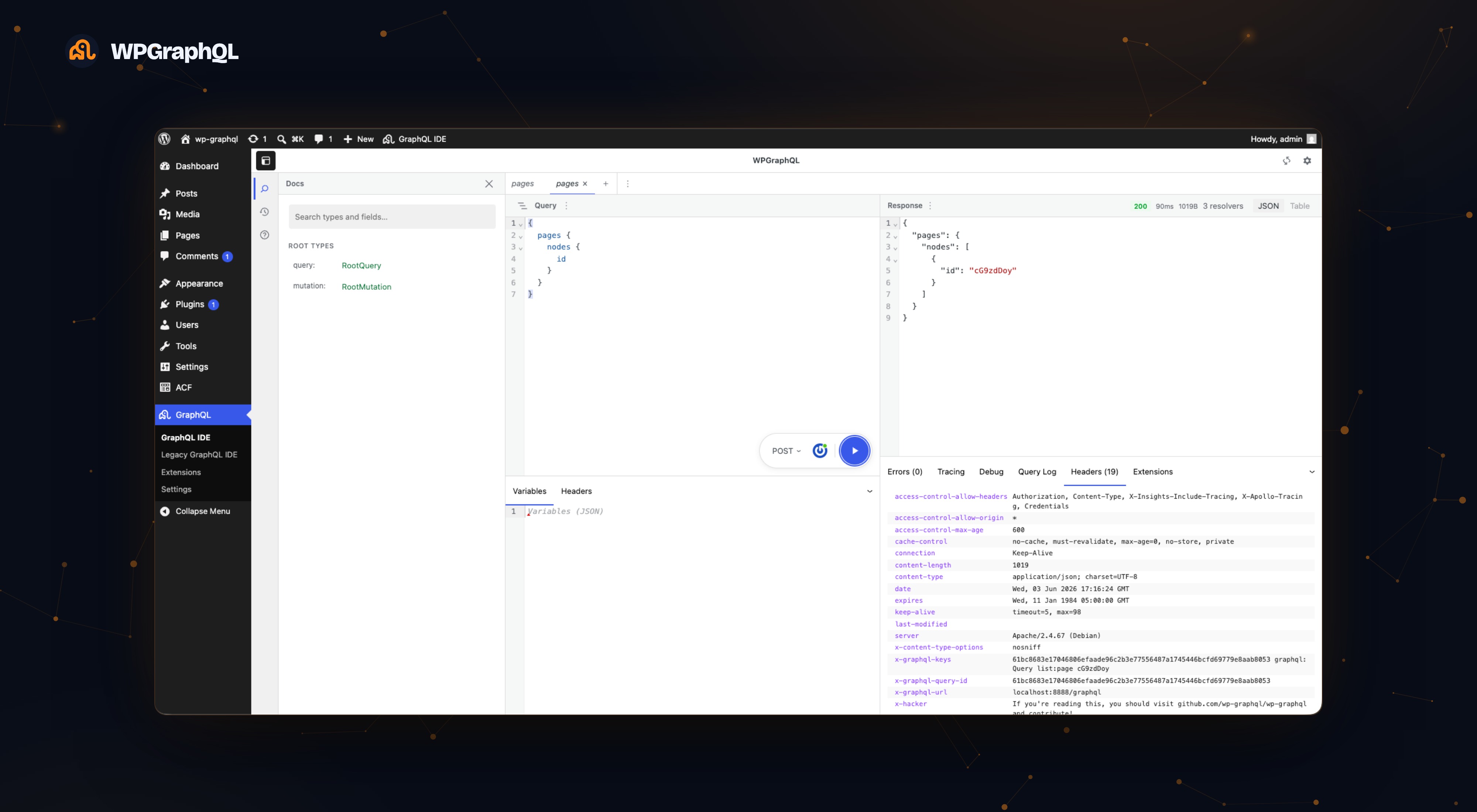
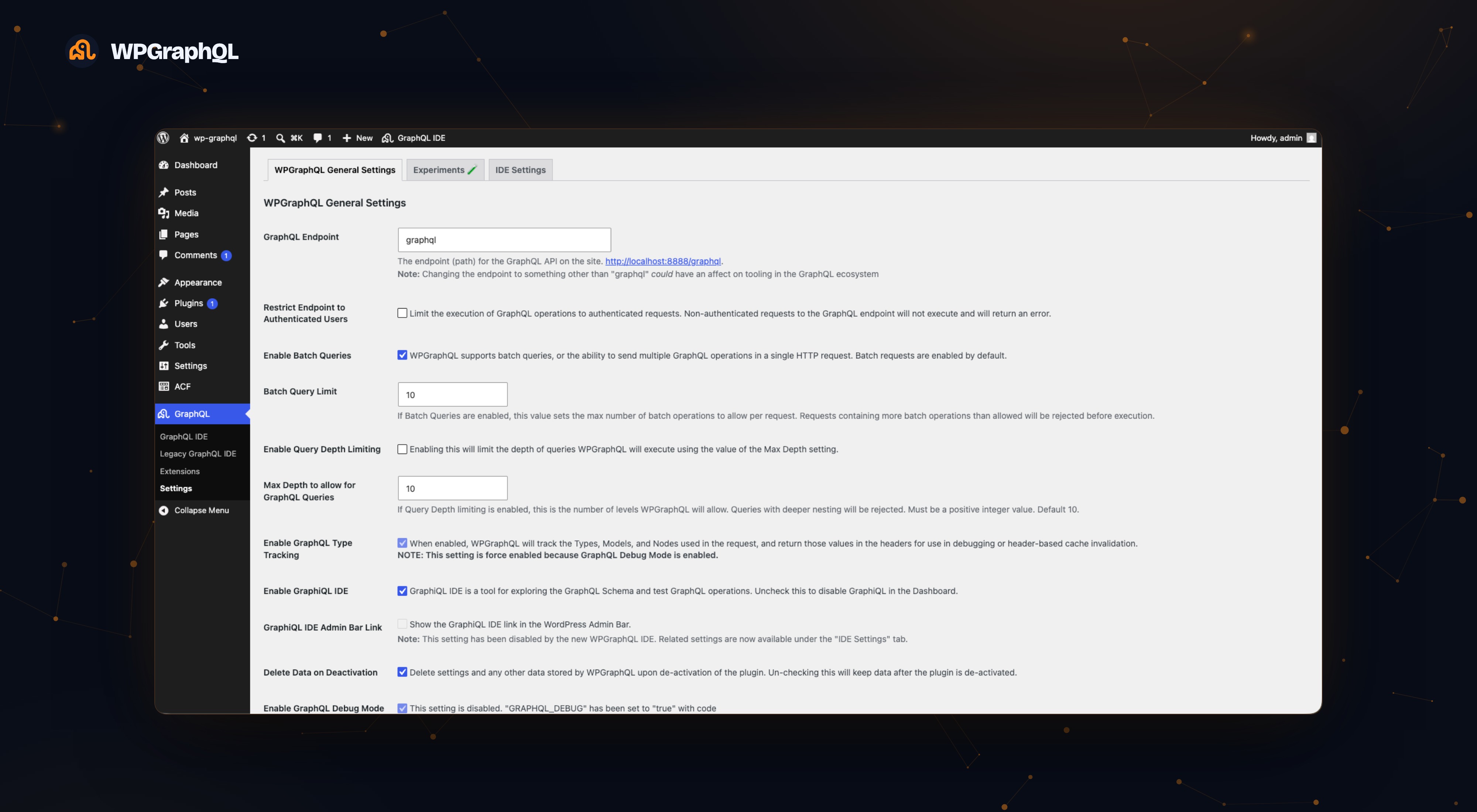
Screenshots
Für Entwickler
Ist das dein Plugin? Zeigen Sie die Zahlen.
Fügen Sie Ihrer Website, Docs oder GitHub Readme ein Live-Badge hinzu. Es wird von selbst aktualisiert - kein Konto erforderlich.
Best WPGraphQL alternatives
All decoupled plugins →





Fragen und Antworten
WPGraphQL: quick answers
Gerade Antworten, gezogen von Live WordPress.org Daten.
Quelle: WordPress.org
Is WPGraphQL free?
Yes. WPGraphQL is free to download and use from the official WordPress.org plugin directory.
Is WPGraphQL safe to use in 2026?
Yes — WPGraphQL is a safe, well-maintained plugin to use in 2026. It runs on 30K+ sites, is rated 4.9/5 and was last updated 1 week ago, and scores 86/100 on our health check.
How many websites use WPGraphQL?
WPGraphQL is active on 30K+ WordPress websites and has been downloaded 1,830,047 times since it launched in November 2020. It was downloaded 74,833 times in the last 30 days.
Does WPGraphQL work with WordPress 7.1?
WPGraphQL is officially tested up to WordPress 7.0.9, while the latest release is 7.1.5. It may still work, but try it on a staging site first.
What PHP version does WPGraphQL need?
WPGraphQL requires PHP 7.4 or higher. Most hosts run PHP 8.x today, so it works on any modern WordPress hosting.
When was WPGraphQL last updated?
The latest version, 2.29.0, was released on November 20, 2026 (1 week ago).
Who makes WPGraphQL?
WPGraphQL is developed and maintained by Jason Bahl.
What are the best alternatives to WPGraphQL?
The most popular alternatives to WPGraphQL are WPGraphQL IDE (1K+ installs), Faust.js (1K+ installs) and CoCart (900+ installs).
Angetrieben von PageForge
Eine Vorlage und eine Tabelle. Eine echte Seite für jede Suche.
PageForge Verwandelt jede Zeile eines CSV in eine WordPress-Seite mit eigenem Titel, URL, SEO Felder und Schema entworfen. Kostenlos auf WordPress.org.
- CSV und XLSX, plus Google Sheets auf Beruf und Unternehmen
- seinen eigenen Titel, URL, SEO Felder und Schema für jede Seite
- Arbeitet mit dem Blockeditor, Elementor, Divi und Avada
- Kostenlos auf WordPress.org, keine Kreditkarte