


Bootstrap for Contact Form 7
Bootstrap for Contact Form 7 modifies all the output of the popular Contact Form 7 plugin to be fully compatible with the current version 3 of the popular CSS framework Bootstrap. What this means to you as a Bootstrap…

Utiliser avec prudence
Bootstrap for Contact Form 7 works, but test it on a staging site before relying on it in 2026. It runs on 10K+ sites, is rated 4.8/5 and was last updated 8 years ago, and scores 46/100 on our health check.
- Prouvé à grande échelle sur plus de 10 000 sites actifs
- Loved by users — 4.8/5 from 26 reviews
- Momentum — downloads up 39% vs the previous 30 days
- No update in 8 years
- Only tested up to WordPress 4.9 (latest is 7.1)
Comment s'accumule-t-il ?
Côte à côte sur les installations, les mises à jour, les évaluations et le support


Téléchargements quotidiens
Les pics de téléchargement suivent généralement une nouvelle version - chaque site qui met à jour automatiquement compte comme un téléchargement.
Classements
Where Bootstrap for Contact Form 7 stands todayWordPress.org Classements de recherche
Position en direct dans la recherche de plugins, Top 100| Mot-clé | Position |
|---|---|
| bootstrap | >100 |
| bootstrap 3 | >100 |
| bootstrap framework | >100 |
| contact form 7 | >100 |
| wpcf7 | #43 |
Adoption de version
Part de sites actifs par version.
Répartition des notes
★★★★★★★★★★ 4.8 from 26 reviews
About Bootstrap for Contact Form 7
From the official readme · v1.4.8Description
Bootstrap for Contact Form 7 modifies all the output of the popular Contact Form 7 plugin to be fully compatible with the current version 3 of the popular CSS framework Bootstrap. What this means to you as a Bootstrap user: No additional CSS rules necessary – from now on, Contact Form 7 integrates seamlessly with the overall Bootstrap design. It is even possible to use different form layouts via Contact Form 7’s “Additional Settings” tab.
This plugin is an addon to Contact Form 7.
The plugin requires Contact Form 7 to be activated, otherwise it won’t change anything. Furthermore you should be using it in conjunction with a Bootstrap-based WordPress theme, otherwise the forms might look weird (and there would be no point in using this addon anyway).
Usage
Bootstrap for Contact Form 7 does not provide additional options itself, so you can continue using Contact Form 7 (almost) the same way you did before.
The plugin will not break your form’s appearance, however it is recommended to adjust the contact form shortcodes to achieve perfect results: Generally, you should not be using HTML tags any longer to wrap the field shortcodes. They already include the complete Bootstrap-ready markup, including displaying labels. Read the Setup Guide for a quick introduction.
Advanced Features
The plugin brings some additional useful features to enhance your forms even more:
- the form layout can be changed to a horizontal or inline one
- the form’s input size can be globally changed
- checkbox and radio groups can be displayed either one per line, inline or as Bootstrap buttons
- text inputs and textareas support Bootstrap’s input group feature to add content before or after them
- text inputs and textareas can show a character count (the [count] shortcode from Contact Form 7) inline
- the captcha input field can show the captcha image inline
- by using GET parameters in a URL to a contact form, field values can be predefined
The above features are explained in detail on the Other Notes page.
Basic Idea behind the Plugin
Lots of WordPress Themes are based on Bootstrap – and while it is the general approach to use CSS rules to style your HTML content, it is also possible the other way around – with many benefits.
When using a well-known framework which provides general styles for all the important components of a website, it can be time-consuming to apply the same styles to third-party plugins which (obviously) have not been written with a framework in mind. This is perfectly fine, but if you’re using Bootstrap for your WordPress theme, you will certainly love the fact that you do not need to write CSS rules for the Contact Form 7 plugin any longer. It will all look like Bootstrap from the beginning so that it fits into your website design. If you’re not using Bootstrap, this plugin is useless for you – but maybe you’re just having an idea how you can adjust another popular WordPress plugin to integrate with another well-written CSS framework.
Advanced Features
Additional Settings
Here you find additional settings which are part of the Bootstrap for Contact Form 7 plugin. If you want to learn more about the additional settings of the original Contact Form 7 plugin, please visit this page.
You can adjust several form properties (properties that affect an entire form, not just a single field of it) to give your forms the appearance you want. Here is a list of the properties, what they do and their possible values:
layout– adjusts the form’s layout (note that in most cases the inline form will need additional styling to look good); valid values: ‘default’, ‘inline’, ‘horizontal’; default value: ‘default’size– adjusts the size of all input fields; valid values: ‘default’, ‘small’, ‘large’; default value: ‘default’group_layout– adjusts the layout of checkbox and radio groups; valid values: ‘default’, ‘inline’, ‘buttons’; default value: ‘default’group_type– adjusts the color of checkbox and radio groups with buttons layout; valid values: ‘default’, ‘primary’, ‘success’, ‘info’, ‘warning’, ‘danger’; default value: ‘default’submit_size– adjusts the size of the submit button; valid values: ‘default’, ‘small’, ‘large’ or an empty string to force it to have the size defined in thesizeform property; default value is an empty stringsubmit_type– adjusts the color of the submit button; valid values: ‘default’, ‘primary’, ‘success’, ‘info’, ‘warning’, ‘danger’; default value: ‘primary’required_html– adjusts the HTML output to append to required fields’ labels; valid values: any HTML output; default value:<span class="required">*</span>grid_columns– allows you to override the total grid column count of Bootstrap (you might only need to adjust this if you’re using a custom version of Bootstrap); valid values: any integer greater than 1; default value: 12label_width– adjusts the form’s label width (applies only to horizontal layout); valid values: any integer between 1 and the value ofgrid_columnsminus 1; default value: 3breakpoint– adjusts the responsive breakpoint (applies only to horizontal layout); valid values: ‘xs’, ‘sm’, ‘md’, ‘lg’; default value: ‘sm’
There are four methods to adjust the above properties: The easiest one is to use the “Additional Settings” tab when editing a form in Contact Form 7 and insert any property and its desired value there, one per line. For example:
layout:horizontal
size:large
group_layout:inline
Alternatively you can use the filter cf7bs_form_{{FORM_ID}}_properties where {{FORM_ID}} must be replaced by the ID of the form you would like to modify (you find that number in the overall form’s shortcode). An array of all the properties and their values is passed to that function so that you can easily adjust them. Example (in this case we would adjust the contact form with the ID 3):
function my_custom_form_properties( $properties ) {
    $properties['layout'] = 'horizontal';
    $properties['size'] = 'large';
    $properties['group_layout'] = 'inline';
    return $properties;
}
add_filter( 'cf7bs_form_3_properties', 'my_custom_form_properties' );
The third way does something slightly different from the other two since it does not change a specific form’s properties, but the default properties for all forms. To do that, you should use the filter cf7bs_default_form_properties which works exactly like the other filter mentioned above.
The fourth method is different from the others as it allows to override the form settings on a per-field basis. You can add any of the setting names plus its intended value as a shortcode attribute for any field to make this field behave differently from the form’s setting. This can be especially helpful if you need to create advanced form layouts like when you need multiple fields on the same line. For example, you could do the following to display two fields in one row, even though the form’s layout is set to ‘default’:
<div class="form-group row">
    <div class="col-md-6"><label for="user-first-name">First Name</label>[text user_first_name id:user-first-name layout:none][/text]</div>
    <div class="col-md-6"><label for="user-last-name">Last Name</label>[text user_last_name id:user-last-name layout:none][/text]</div>
</div>
Note that the custom form filter takes precedence over the properties defined in the admin, while the default filter is just used as fallback.
Input Groups
All textual input fields support the input group feature that Bootstrap provides. To use it, add a shortcode-like construct (almost, but it has to use curly braces instead) into the content of any text / email / url / tel input shortcode. Example:
[text twitter-username]{input_before}@{/input_before}Your Twitter Handle[/text]
Note that the input_before and input_after can also be added to textareas. In this case, the content will be displayed directly above or below the textarea respectively.
Submit Button Alignment
The submit button can be aligned left, center or right to fit your form’s desired appearance. Simply provide an align option with either ‘left’, ‘center’ or ‘right’ as value. Example:
[submit align:right "Send"]
Inline Character Count
Contact Form 7 provides a [count] shortcode that renders a number indicating how many characters have been entered or how many characters are remaining in a specific input field. Using it on its own looks kind of ugly though. But guess what, you can adjust that too by adding an option include_count to any text / email / url / tel / textarea input. You can optionally specify a value for that option as well which can consist of the positioning (‘before’ or ‘after’) and the count direction (‘up’ or ‘down’) of the counter. Just as a reminder, when choosing ‘down’, make sure you give the input element a maximum length, otherwise there is no point in having that counter. Example:
[text your-text maxlength:80 include_count:after:down]Your Text[/text]
By the way, have you read the information about input groups above? You can combine those with the character count (because just seeing a number without any additional information might confuse your site’s visitors). The following example will show a message like ‘433 characters left’ after the field:
[textarea your-text maxlength:500 include_count:after:down input_after:characters---left]Your Text[/textarea]
Inline Captcha Image
If you’ve been using Contact Form 7 together with the Really Simple CAPTCHA plugin, you are probably aware of the [captchar] (captcha input field) and [captchac] (captcha image) shortcodes it provides. You can still use them independently, but it probably looks nicer to have the captcha image show up inline, right beside its input field. To accomplish this, remove the [captchac] shortcode completely and instead add a new option include_captchac to the [captchar] shortcode. You can optionally give this option a value (either ‘before’ or ‘after’) to mark the location where the image should show up. Example:
[captchar your-captcha include_captchac:before]Captcha[/captchar]
Custom Form URLs
You can add GET parameters to populate your forms with custom initial values by simply using the field name as parameter’s key and the desired value as the parameter’s value. This works with checkboxes, date fields, number fields, select fields, all text fields and textareas. The easiest way to create such a URL is to use the plugin’s function cf7bs_add_get_parameter() where you provide parameters similarly to the WordPress Core function add_query_arg. Example:
$my_custom_url = cf7bs_add_get_parameter( array(
    'your-name'     => 'John Doe',
    'your-email'    => 'johndoe@example.com',
    'your-subject'  => 'Support Request',
), 'http://www.example.com/my-custom-form/' );
Filter Field Arguments
As of version 1.2.3, field arguments for every single field can be filtered, which allows you to basically modify anything you like. The filters you need to hook your function into have the following structure cf7bs_form_{{FORM_ID}}_field_{{FIELD_BASETYPE}}_{{FIELD_NAME}}_properties. Yep, it’s a long filter name, but it is necessary so that you can filter in the most detailed way possible. When using one of the filters, replace {{FORM_ID}} with the ID of the form, {{FIELD_BASETYPE}} with the type of the field you need to adjust (be sure to not include the asterisks here!) and {{FIELD_NAME}} with the name of the field. The function should accept one argument, an array of parameters. For an overview about the available parameters, please check the plugin’s source code.
Unsupported functionality
While the plugin tries to support as many features as possible from the original Contact Form 7 (in combination with adding new ones!), not everything is and can be supported.
There are two things in particular which are explicitly not supported:
- the
sizeoption on all input fields (Bootstrap form elements scale automatically, so we do not need a custom size for those) - the
label_firstoption on checkbox and radio fields (Bootstrap natively only supports checkboxes and radio buttons where the label is displayed after them)
If you discover any other Contact Form 7 feature than the above two which is not supported by Bootstrap for Contact Form 7, you can raise an issue or submit a support request.
Installation
Download and Activation
- Either download the plugin from within your WordPress site, or download it manually and then upload the entire
bootstrap-for-contact-form-7folder to the/wp-content/plugins/directory. - Activate the plugin through the ‘Plugins’ menu in WordPress.
Setup Guide
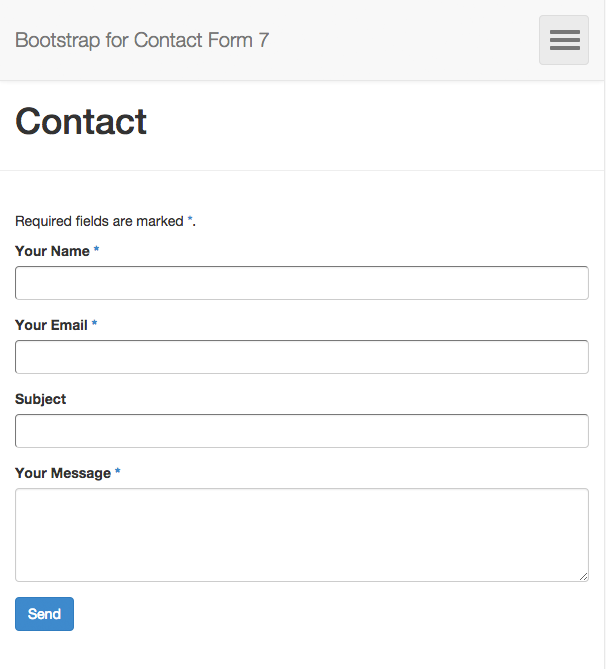
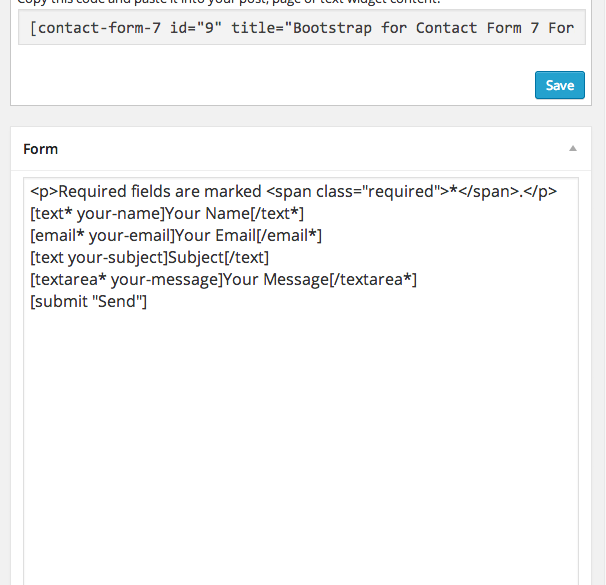
While the shortcodes generally work the same like in the original plugin, there are a few things to consider. If you like to get started quickly, just copy/paste the content below and adjust it to get the form you like (the code below recreates the default form from Contact Form 7).
[text* your-name]Your Name[/text*]
[email* your-email]Your Email[/email*]
[text your-subject]Subject[/text]
[textarea your-message]Your Message[/textarea]
[submit "Send"]
The following are the most important things that are different in Bootstrap for Contact Form 7:
- Field labels are now integrated in the field shortcodes, so you don’t need to wrap them in paragraphs when editing the form. Instead, make the field shortcode enclosing and put the label text between the opening and closing tag. Example:
[text* your-name]Your Name[/text*] - You don’t need to use HTML tags any longer to give your form a layout. The field shortcodes handle this manually, so you should remove all HTML tags from the form editor. Of course you can still use HTML code to separate parts of your form, for example using the
<fieldset>tag.
It is recommended to adjust the shortcodes to be conform with the explainations above to ensure perfect results with the plugin and Boostrap themes.
For details on everything else that you can do to enhance your forms even further, feel free to check out the Other Notes section.
Journal de modifications
1.4.8
- Added: support for input groups for number tags
- Added: support for conditional loading of styles and scripts
- Enhanced: Labels now allow basic inline HTML markup
- Fixed: Acceptance validation not showing message
1.4.7
- Fixed: plugin compatibility with Contact Form 7 version 5.0 acceptance checkbox triggering submit button
1.4.6
- Fixed: plugin compatibility with Contact Form 7 version 5.0 acceptance checkbox triggering submit button
- Fixed: plugin compatibility with Contact Form 7 after refactor removing jQuery.fn.wpcf7ClearResponseOutput() function
1.4.5
- Fixed: plugin compatibility with Contact Form 7 version 4.9 input type radio default required
1.4.4
- Fixed: critical bug with REALLY SIMPLE CAPTCHA not showing image
1.4.3
- Fixed: plugin compatibility fatal errors with Contact Form 7 version 4.8 related to form validation and REALLY SIMPLE CAPTCHA
- Fixed: Contact Form 7 version 4.7 features are now being used
- Fixed: correct styles for latest Contact Form 7 versions are now being printed
Captures d'écran
Pour les développeurs
Est-ce votre plugin ? Montrez les chiffres.
Ajoutez un badge en direct à votre site, docs ou github readme. Il se met à jour par lui-même - aucun compte n'est nécessaire.
Best Bootstrap for Contact Form 7 alternatives
All bootstrap plugins →




FAQ
Bootstrap for Contact Form 7: quick answers
Réponses directes, extraites des données en direct WordPress.org.
Source : WordPress.org
Is Bootstrap for Contact Form 7 free?
Yes. Bootstrap for Contact Form 7 is free to download and use from the official WordPress.org plugin directory.
Is Bootstrap for Contact Form 7 safe to use in 2026?
Bootstrap for Contact Form 7 works, but test it on a staging site before relying on it in 2026. It runs on 10K+ sites, is rated 4.8/5 and was last updated 8 years ago, and scores 46/100 on our health check.
How many websites use Bootstrap for Contact Form 7?
Bootstrap for Contact Form 7 is active on 10K+ WordPress websites and has been downloaded 320,796 times since it launched in November 2014. It was downloaded 959 times in the last 30 days.
Does Bootstrap for Contact Form 7 work with WordPress 7.1?
Bootstrap for Contact Form 7 is officially tested up to WordPress 4.9.36, while the latest release is 7.1.5. It may still work, but try it on a staging site first.
When was Bootstrap for Contact Form 7 last updated?
The latest version, 1.4.8, was released on May 24, 2018 (8 years ago).
Who makes Bootstrap for Contact Form 7?
Bootstrap for Contact Form 7 is developed and maintained by Felix Arntz.
What are the best alternatives to Bootstrap for Contact Form 7?
The most popular alternatives to Bootstrap for Contact Form 7 are Bootstrap Blocks (10K+ installs), Contact Form Clean and Simp… (7K+ installs) and Easy Bootstrap Shortcode (6K+ installs).
Propulsé par PageForge
Un modèle et une feuille de calcul. Une vraie page pour chaque recherche.
PageForge transforme chaque ligne d'un CSV en une page WordPress avec son propre titre, URL, SEO et schéma, construit sur la mise en page que vous Déjà conçu. Gratuit sur WordPress.org.
- CSV et XLSX, plus Google Sheets sur les professionnels et les entreprises
- Son propre titre, URL, SEO champs et schéma pour chaque page
- Fonctionne avec l'éditeur de blocs, Elementor, Divi et Avada
- Gratuit sur WordPress.org, pas de carte de crédit