


SiteFort Security – Firewall, Malware Scanner & Hardening
Free WordPress security with dynamic bot detection, network threat intelligence, cloud-assisted malware scans, login security and exploit protection.

Safe pick
Yes — SiteFort Security is a safe, well-maintained plugin to use in 2026. It runs on 100+ sites, is rated 5/5 and was last updated 4 days ago, and scores 80/100 on our health check.
- Actively developed — last update 4 days ago
- Tested with the latest WordPress (7.1)
- Momentum — downloads up 62.8% vs the previous 30 days
- Small user base (100+ active installs)
How does it stack up?
Side-by-side on installs, updates, ratings & support



Daily downloads
Download spikes usually follow a new release — each site that auto-updates counts as a download.
Rankings
Where SiteFort Security stands todayWordPress.org search rankings
Live position in the plugin search, top 100| Keyword | Position |
|---|---|
| 2FA | #84 |
| firewall | #31 |
| malware scanner | #23 |
| security | >100 |
| vulnerability | >100 |
Version adoption
Share of active sites per release.
Rating breakdown
★★★★★★★★★★ 5 from 5 reviews
About SiteFort Security
From the official readme · v2.1.5Description
SiteFort is a free WordPress security plugin with a layered firewall that combines dynamic bot detection, exploit protection, rate limiting, and shared threat intelligence to block malicious requests and abusive traffic. Supported firewall rules can also sync with Cloudflare to stop repeat offenders before they reach your server.
SiteFort strengthens WordPress security with site hardening, login protection, and two-factor authentication (2FA). Its malware and security scanner checks for malware, vulnerabilities, hidden administrator accounts, and other security risks, offloading resource-intensive file analysis to the cloud to reduce server load and help scans complete reliably, even on resource-limited hosting.
Try the Live Demo | Features | Try Online Scanner
Core WordPress Security Features
- Firewall & Bot Protection: Blocks known exploit attempts, malicious scanners, abusive bots, and repeat offenders. Includes network threat intelligence, rate limiting, configurable firewall rules, and optional Cloudflare edge protection.
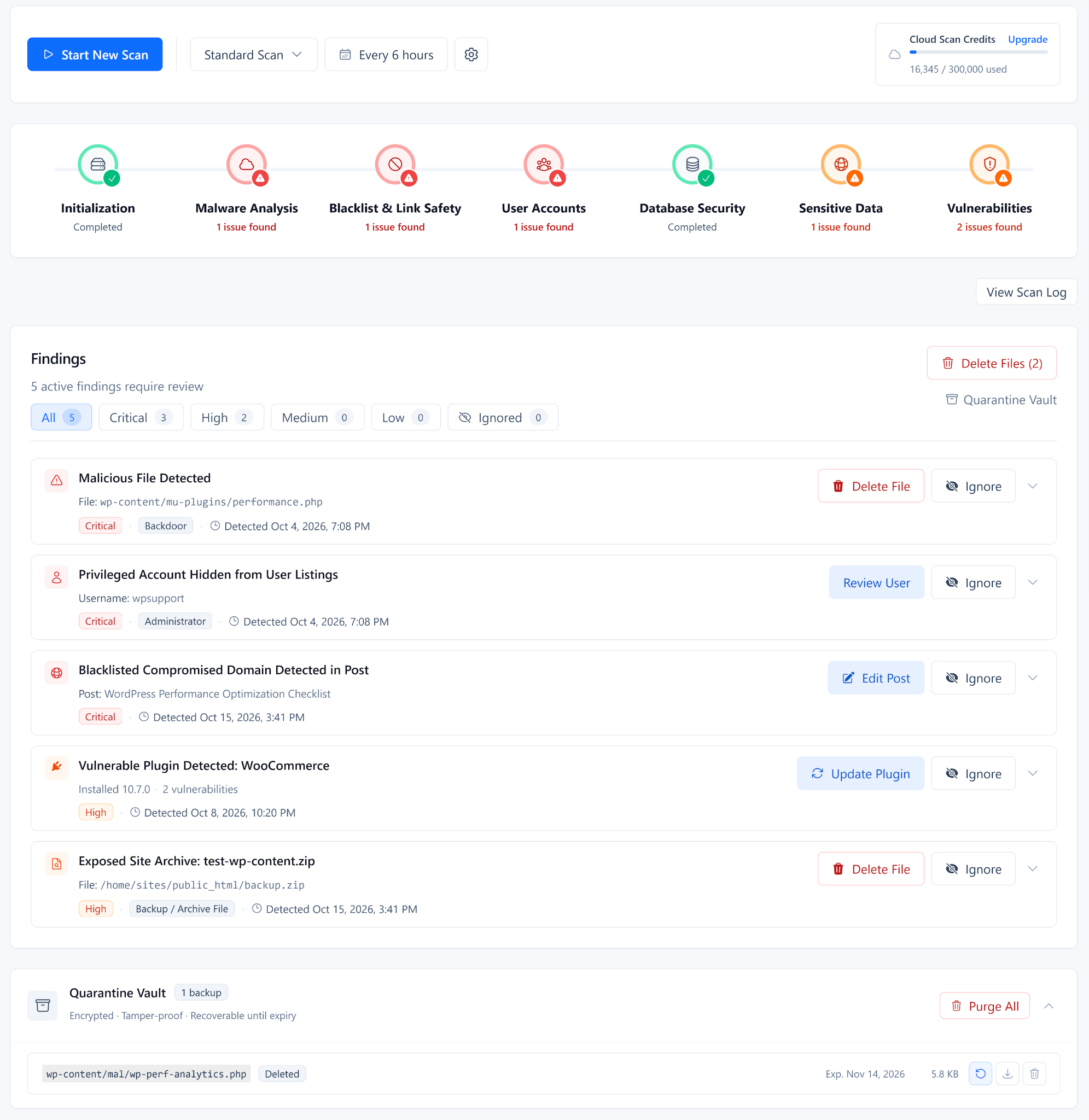
- Cloud-Assisted Malware Scanner: Detects backdoors, web shells, injected code, malicious redirects, SEO spam, and suspicious file changes, with deep threat analysis in the cloud to reduce server load.
- Login Security & 2FA: Protects WordPress login, WooCommerce customer accounts, and membership account access with two-factor authentication, CAPTCHA, brute-force lockouts, a custom login URL, breached-password checks, and password policies.
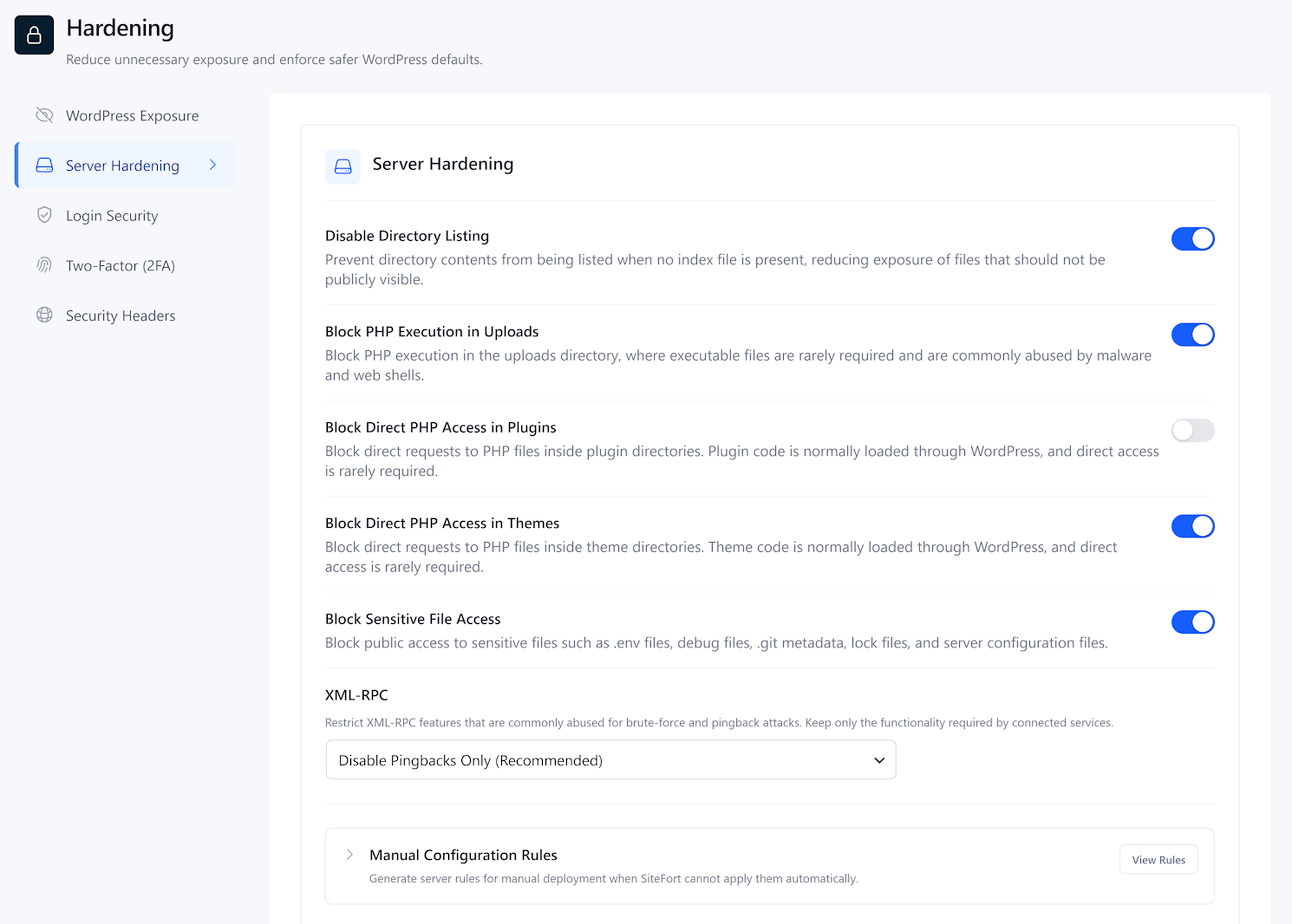
- WordPress Security Hardening: Reduces common exposure through XML-RPC, user enumeration, sensitive files, direct PHP execution, REST access, security headers, and other WordPress security controls.
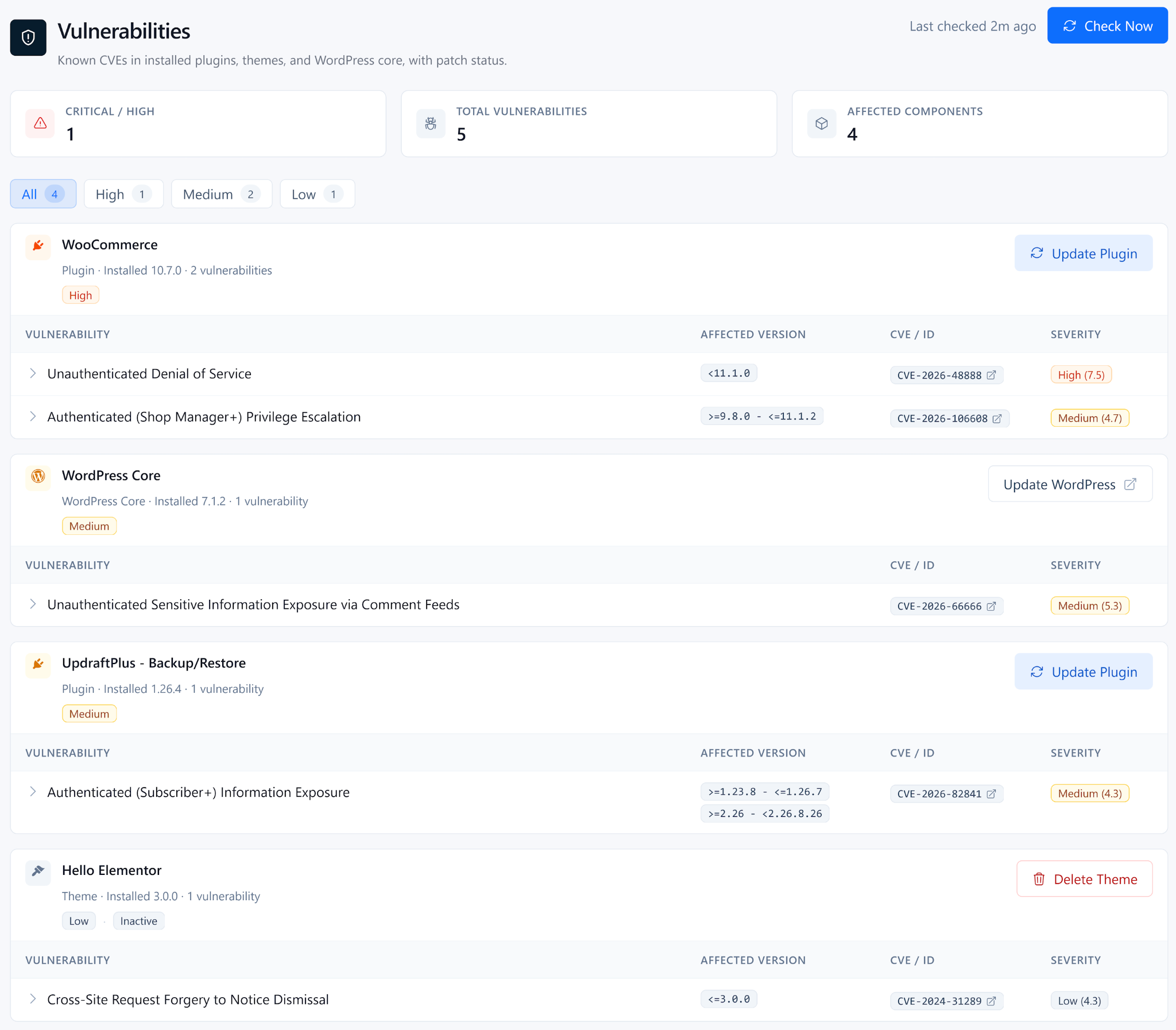
- Vulnerability Scanner: Checks WordPress core, plugins, and themes for known vulnerabilities, affected versions, severity, CVE references where available, and remediation guidance.
- Compromise & Reputation Checks: Detects suspicious administrator accounts, injected content, unsafe URLs, exposed sensitive files, malicious redirects, and domain or server reputation issues.
WordPress Firewall
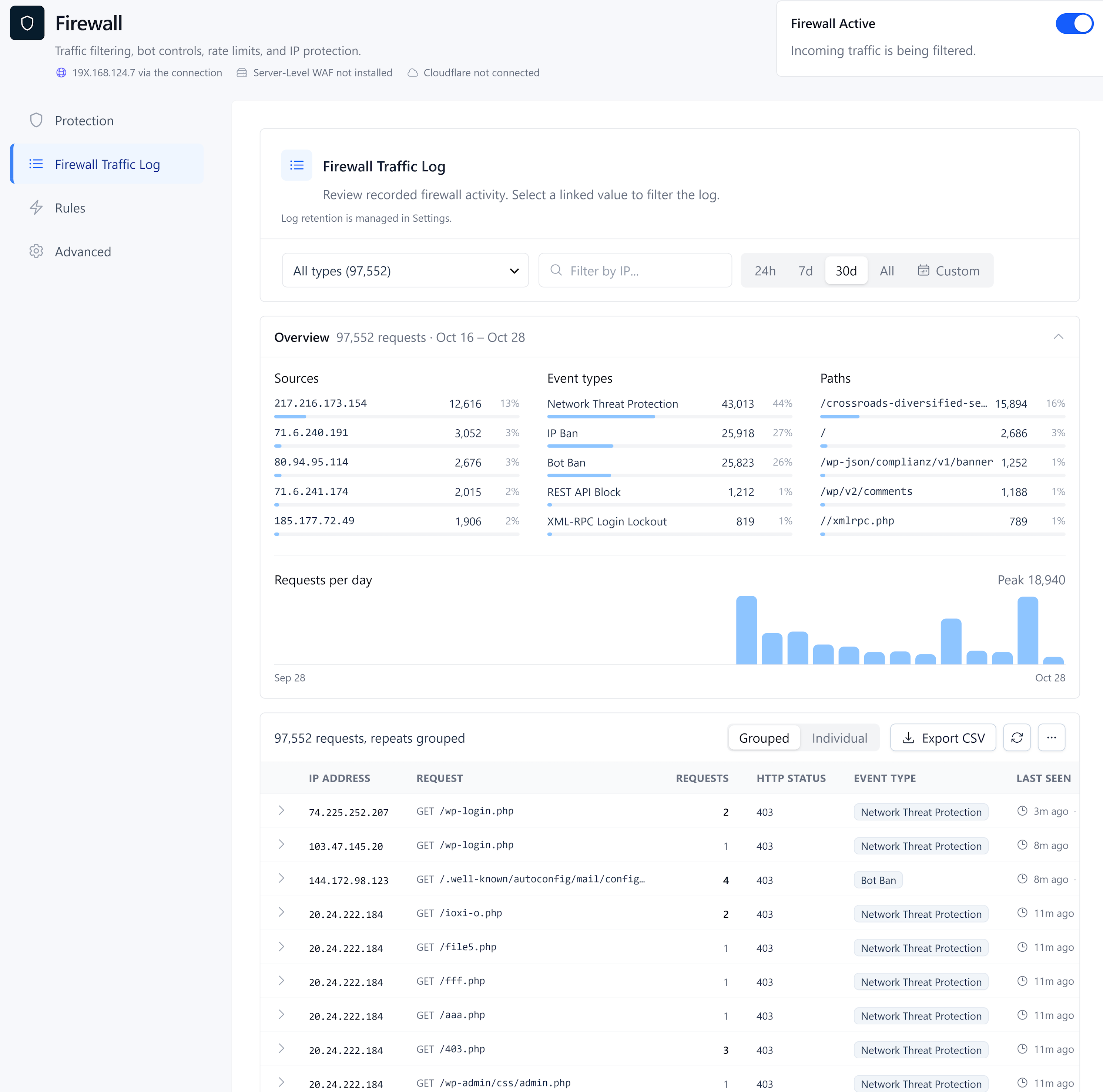
SiteFort filters malicious requests, exploit attempts, and abusive traffic using layered firewall protection, bot detection, network threat intelligence, rate limiting, and configurable firewall rules.
- Exploit Protection: Blocks attacks targeting selected known vulnerabilities in WordPress, plugins, and themes, along with common malicious exploit payloads.
- Malicious Scan Protection: Blocks hacking tools and automated probes searching for vulnerable software, exposed configuration files, backups, and other sensitive resources.
- Repeat Offender Blocking: Automatically blocks IP addresses after repeated threat detections within a configurable time window.
- Network Threat Protection: Blocks known malicious IP addresses using regularly updated threat intelligence shared across the SiteFort network.
- Bot & Crawler Controls: Provides Basic, Balanced, and Maximum filtering presets, with separate controls for AI training crawlers.
- Rate Limiting: Limits excessive requests and repeated 404 activity to reduce abusive traffic.
- Custom Firewall Rules: Block or allow IP addresses, CIDR ranges, countries, and selected user agents, including country allow-only rules.
- Cloudflare Protection: Synchronizes supported firewall rules and blocks repeat attackers at Cloudflare’s edge when enabled.
- Firewall Traffic Log: Review blocked requests, detected threats, matched rules, and firewall activity, with controls for managing IP restrictions.
Bot Protection Policy
SiteFort provides three bot protection presets for straightforward setup, with the option to allow or block specific bots and crawlers individually.
- Basic: Filters automated scripts and requests without a user agent.
- Balanced: Adds data scraping bot protection. Recommended for most WordPress sites.
- Maximum: Extends filtering to unrecognized bots for websites requiring stricter automated traffic controls.
- AI Training Crawlers: Optionally block training-focused crawlers such as GPTBot, ClaudeBot, CCBot, and Bytespider while supported AI assistants and AI search crawlers remain allowed.
Supported search crawlers are verified using reverse DNS and published IP ranges and are allowed through bot protection, while bots impersonating known search engines are detected and blocked.
Malware & Security Scanner
SiteFort combines hash-first file verification with cloud-assisted deep threat analysis to detect malware while reducing scan workload on the WordPress server.
- Hash-First File Verification: Known WordPress core, plugin, and theme files are verified against trusted hashes.
- Deep Threat Analysis: Files that cannot be verified by hash or show suspicious indicators are sent to the SiteFort cloud for deep threat analysis, including backdoors, web shells, injected PHP or JavaScript, malicious redirects, SEO spam, and obfuscated code.
- File Integrity: Detects modified WordPress core, plugin, and theme files, along with unexpected files that do not belong in trusted packages.
- Account & Content Checks: Checks administrator accounts, WordPress content, options, URLs, and redirects for suspicious changes and indicators of compromise.
- Sensitive File Exposure: Identifies publicly accessible backups, logs, configuration files, debug files, and other sensitive files commonly targeted by attackers.
- Domain & IP Reputation: Checks the site domain and server IP against supported blocklists and abuse intelligence.
Database and content checks run locally. External link reputation checks use hashed data rather than uploading plaintext URLs or database content.
Login Security & 2FA
SiteFort protects WordPress login and account access against brute-force attacks, credential abuse, and unauthorized access.
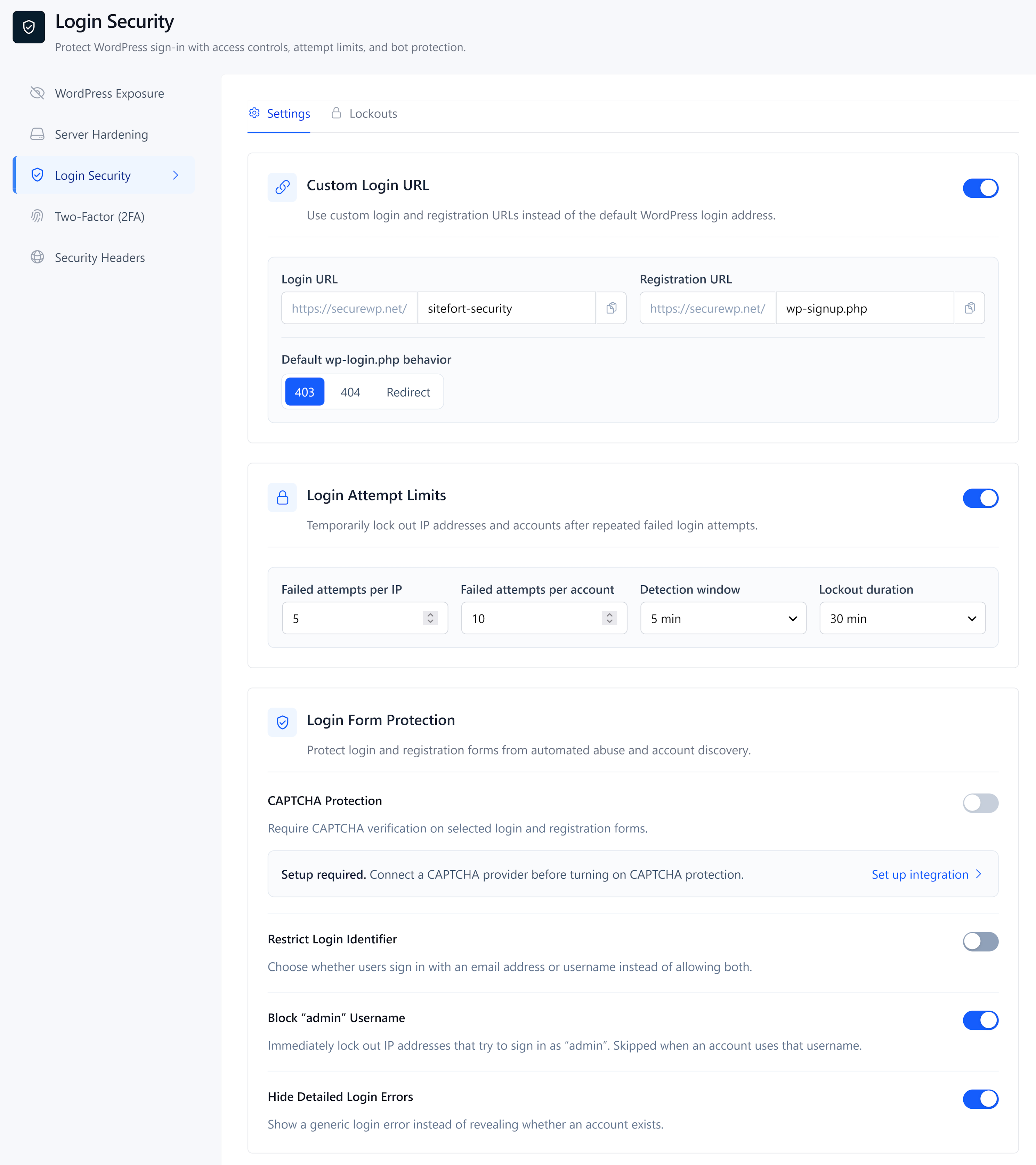
- Brute-Force & CAPTCHA Protection: Limits repeated login attempts and adds CAPTCHA protection to WordPress, WooCommerce, and supported custom login and registration forms.
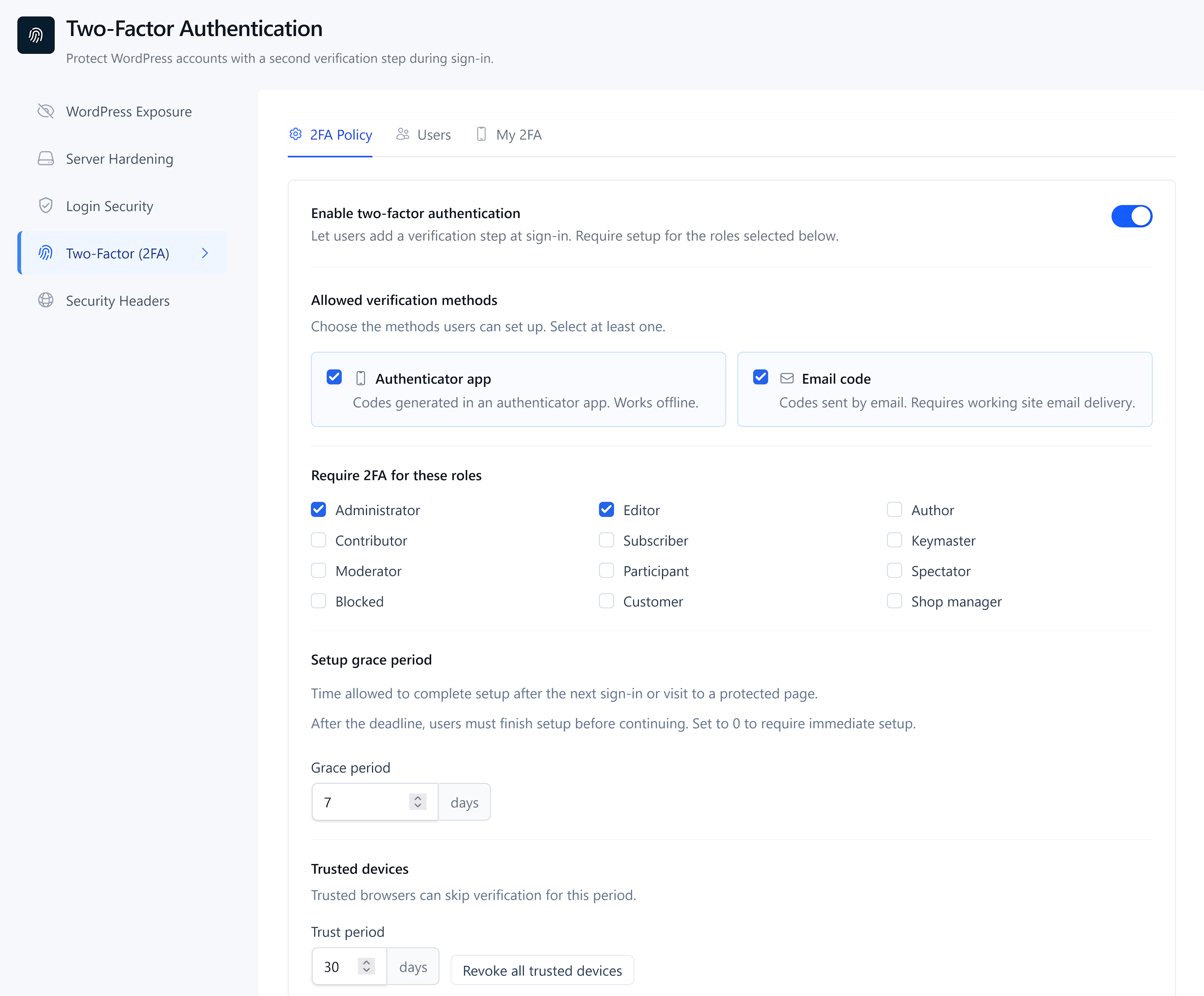
- Two-Factor Authentication: Adds role-based 2FA with authenticator apps, email codes, recovery codes, grace periods, and trusted devices.
- WooCommerce & Membership 2FA: Lets customers and members manage 2FA from WooCommerce My Account or supported custom account pages.
- Custom Login URL: Move the WordPress login page to a private URL and control requests to the default
wp-login.phpaddress. - Password Security: Detects weak and breached passwords, enforces password strength, prevents reuse, and supports optional expiration policies.
WordPress Security Hardening
SiteFort provides simple, toggle-based WordPress hardening controls to reduce common security exposure and shrink the attack surface.
- Sensitive File Protection: Blocks public access to WordPress configuration backups, database dumps, debug logs, backup files, installer files, and other sensitive resources, including exposed
.envor.gitdata when present. - PHP Execution Protection: Blocks PHP execution in uploads and restricts direct access to PHP files in plugin and theme directories.
- XML-RPC Controls: Disable XML-RPC, restrict authentication, or block pingback abuse.
- User Enumeration Blocking: Reduces username exposure through author archives, REST endpoints, and common discovery paths.
- REST & Application Password Controls: Restricts REST API access and controls WordPress Application Passwords based on site requirements.
- File Editor Protection: Disables the built-in WordPress theme and plugin file editor.
- Directory Browsing Protection: Disables directory listing to reduce file discovery and unintended information exposure.
- Security Headers: Analyze and manage CSP, HSTS, X-Frame-Options, X-Content-Type-Options, Referrer-Policy, Permissions-Policy, and disclosure headers.
- Version & Metadata Cleanup: Reduces exposed WordPress version, generator, and header information.
- Protection Verification: Confirms supported hardening protections are active and identifies items that require manual hosting or server configuration.
Vulnerability Scanner
SiteFort checks installed WordPress core, plugins, and themes against vulnerability intelligence and identifies affected versions, severity, and available remediation.
- Affected Components: Identifies vulnerable WordPress core, plugins, and themes with installed versions, severity, and CVE references where available.
- Fix Guidance: Shows fixed versions and recommended actions when remediation information is available.
Malware Repair & Quarantine
- Delete or Quarantine (Free): Remove malicious or unwanted files from scan results, with optional quarantine for recovery when needed.
- One-Click Repair (Pro): Repairs malicious or modified files directly from scan results when a trusted clean source is available.
- Clean-File Restore (Pro): Restores supported WordPress core, plugin, and theme files, including selected commercial plugins and themes when verified clean sources are available.
For active WordPress compromises requiring hands-on investigation, Securewp expert cleanup is available for malware removal, root-cause remediation, blocklist assistance, and post-cleanup review.
WordPress Security Audit Log
SiteFort records important security and administrative activity, providing a clear history for review and investigation.
- Login Activity: Successful and failed logins, lockouts, 2FA events, and account-related activity.
- User Changes: User creation, updates, role changes, and other account actions.
- Plugin & Theme Activity: Installations, activations, deactivations, updates, and other recorded changes.
- Security & Settings Changes: Hardening, login security, firewall configuration, and other sensitive administrative changes.
SiteFort Console
SiteFort Console provides a central panel for managing security across multiple WordPress sites. No separate add-on is required; Console connectivity can be enabled or disabled directly from the SiteFort plugin.
- Run security scans and review findings across sites.
- Monitor vulnerabilities and update hardening settings remotely.
- Review security status, scan history, uptime, and SSL expiry.
- Route alerts and download reports for individual sites or clients.
- Manage team access and support workflows from one place.
All site-level security features remain available directly in WordPress; Console adds centralized management for multiple sites.
Hosting Compatibility
SiteFort supports shared hosting, managed WordPress hosting, VPS, and dedicated servers across Apache, Nginx, and LiteSpeed.
- Cloudflare: Works with Cloudflare-proxied sites and supports optional firewall rule sync for edge enforcement.
- Lower-Resource Hosting: Hash-first file verification and cloud-assisted deep analysis reduce scan workload on the hosting server.
- Flexible Server Support: Does not require a specific web server stack or managed hosting environment.
Free vs Pro
SiteFort Free includes security hardening, firewall and bot protection, network threat protection, login security and 2FA, vulnerability scanning, activity logging, and 10,000 monthly cloud file-analysis credits. Pro removes the cloud analysis limit and adds automation, repair, monitoring, alerts, and reporting. Exploit Protection is available in both Free and Pro. New protection rules are delivered immediately to Pro users and become available to Free users after 30 days.
SiteFort Pro adds:
- Unlimited deep threat analysis
- Scheduled malware scans and automated vulnerability alerts
- One-click malware repair and clean-file restore
- Uptime and SSL expiry monitoring
- Slack, Discord, email, and webhook alerts
- Remote scan history and detailed security reports
- White-label options for agencies
Managed adds hands-on monitoring, incident response workflows, and expert cleanup coverage from the Securewp team.
See the WordPress Security Plugin Comparison for a feature-by-feature comparison with other WordPress security plugins.
External services
SiteFort uses external services only for features that require them, including license activation, cloud-assisted malware analysis, vulnerability and firewall intelligence, reputation checks, optional Console sync, CAPTCHA, GeoIP, Cloudflare Sync, and administrator-configured notifications.
Optional integrations are not contacted unless they are enabled or used.
SiteFort Cloud
- Servers: securewp.net, intel.securewp.net, console.securewp.net
- Used for: Account activation, cloud malware analysis, vulnerability and reputation checks, Network Threat Protection, Exploit Protection rule updates, file repair, and optional Console sync.
- Data sent: Depending on the features used, SiteFort may send account email, license credentials, site URL, WordPress and plugin versions, installed components and versions, file hashes, scan findings, vulnerability and reputation results, attacker IP addresses, security events, and relevant configuration metadata.
- Malware scanning: File hashes are checked first. Only unknown or suspicious files may be uploaded for cloud analysis and are deleted after processing. Database checks run locally. Sensitive configuration values are removed before uploading
wp-config.php. - Reputation checks: External URLs and domains are hashed locally. SiteFort checks four-byte SHA-256 prefixes and sends full hashes only for possible matches. Plaintext URLs, database content, credentials, and query strings are not uploaded for this check. Temporary lookup data is cleared after scanning.
- Firewall IP verification: Works without an account. SiteFort uses a signed test request through intel.securewp.net to identify the correct visitor IP header, including when the site operates behind a proxy or CDN.
- Network Threat Protection: Requires a connected SiteFort account. SiteFort receives signed threat lists of known malicious IPs and ranges and shares detected attacking IPs with relevant security event details to improve protection across the network. Reports do not include request contents, passwords, cookies, or form data. Submitted reports are evaluated before contributing to network-wide blocking.
- Temporary storage: SiteFort Cloud may provide temporary
*.amazonaws.comURLs for malware analysis and clean-file restoration. - Privacy: https://securewp.net/privacy-policy/
- Terms: https://securewp.net/terms-and-conditions/
- Storage provider policies: AWS: https://aws.amazon.com/privacy/ and https://aws.amazon.com/service-terms/; Cloudflare: https://www.cloudflare.com/privacypolicy/ and https://www.cloudflare.com/website-terms/
Optional integrations
-
MaxMind GeoLite2 (download.maxmind.com): Used only when an administrator downloads or updates the local GeoIP database. The configured MaxMind account ID and license key are sent to MaxMind. Visitor IP addresses are resolved locally and are not sent to MaxMind during normal requests. Privacy: https://www.maxmind.com/en/privacy-policy Terms: https://www.maxmind.com/en/geolite2/eula
-
Have I Been Pwned Passwords (api.pwnedpasswords.com): Used for breached-password checks when enabled. SiteFort sends only the first 5 characters of the SHA-1 password hash. Full passwords and full hashes are not sent. Privacy: https://haveibeenpwned.com/Privacy Terms: https://haveibeenpwned.com/TermsOfUse
-
Google reCAPTCHA (www.google.com) and Cloudflare Turnstile (challenges.cloudflare.com): Used only when selected and configured for CAPTCHA protection. The selected provider receives the challenge token, site key, and visitor or browser data required to process the challenge. Policies: https://policies.google.com/privacy https://policies.google.com/terms https://www.cloudflare.com/turnstile-privacy-policy/ https://www.cloudflare.com/website-terms/
-
Cloudflare API (api.cloudflare.com): Used only when Cloudflare Sync is enabled. SiteFort sends the Zone ID, API token or credentials, zone details, blocked IP addresses, country rules, selected user-agent rules, and firewall rule data required for synchronization. Privacy: https://www.cloudflare.com/privacypolicy/ Terms: https://www.cloudflare.com/website-terms/
-
Notification webhooks: Security alerts may be sent to Slack (hooks.slack.com), Discord (discord.com, discordapp.com), or a custom HTTPS webhook configured by the administrator. Payloads may include site name, site URL, event type, severity, scan counts, vulnerability names, CVE identifiers, firewall counts, usernames, IP addresses, browser names, action URLs, timestamps, and event details. Slack policies: https://slack.com/trust/privacy/privacy-policy https://slack.com/terms-of-service/user Discord policies: https://discord.com/privacy https://discord.com/terms
Local site checks
Some SiteFort checks send loopback requests to the protected site’s own public URL, including security-header and public-file exposure checks. These requests contact the protected site itself, not a third-party service.
Installation
- Install and activate SiteFort from Plugins > Add New, or upload the plugin ZIP file.
- Open SiteFort in wp-admin and complete the setup wizard.
- Optional: activate a free SiteFort account to enable cloud-assisted scanning, vulnerability checks, and network threat protection.
- Review the recommended hardening, firewall, bot protection, login security, and 2FA settings.
- Run the first security scan and review the findings.
- Optional: configure Cloudflare protection under SiteFort > Firewall > Protection to extend supported firewall rules and repeat-offender blocking to the edge.
For manual installation, upload the extracted sitefort folder to /wp-content/plugins/ and activate SiteFort from the Plugins screen.
SiteFort requires outbound HTTPS for license activation, cloud-assisted scanning, threat intelligence updates, and optional Console sync.
Changelog
Improved audit logging, clearer scan and setup messages, and updated German and Brazilian Portuguese translations.
2.1.5 – 2026-11-25
- Fixed white-label logos not being used when the logo was the only branding set.
- Fixed wide white-label logos looking squashed in lockout and firewall alert emails.
2.1.4 – 2026-11-23
- The audit log flags changes to published content made without permission or with no user signed in.
- Audit entries show how content changes were made and keep usernames after accounts are deleted.
- The Audit Log page shows logging settings and warns when events are saved only to files.
- Clearer scan, license and two-factor setup messages, including help with email delivery errors.
2.1.3 – 2026-11-19
- Two-factor policy changes now save automatically. No Save button needed.
- Far fewer background requests to SiteFort Console for console enabled sites.
- Fixed some Console updates waiting until the next admin visit.
- Exploit Protection keeps its last rules when SiteFort Intelligence can’t be reached or a license lapses.
- Exploit Protection now fully checks large form submissions and uploads.
- Removed three database tables SiteFort no longer needs.
2.1.2 – 2026-11-18
- Fixed custom login URLs and two-factor sign-in on Pantheon and similar hosts.
- Devices remembered for two-factor sign-in will ask for a code once after this update.
2.1.1 – 2026-11-18
- Fixed custom login URLs showing a cached blocked-login page when the LiteSpeed Cache “Cache Login Page” option is enabled.
- Prevented page caches from storing SiteFort block pages.
- Fixed blocked requests returning the wrong HTTP status code. 404 flood limiting now returns 429 instead of 404, and the related PHP 8.5 warning no longer appears.
- Fixed PHP 8.5 deprecation notices during malware scans.
2.1.0 – 2026-11-17
- Added Exploit Protection to block attacks targeting selected known WordPress, plugin, and theme vulnerabilities, along with common exploit payloads.
- Consolidated malicious scanner detection and repeat-offender blocking under Exploit Protection.
- Added a targeted allow action in Firewall Activity for incorrectly blocked requests.
- Fixed scan results showing old “Modified file” findings after a plugin, theme or WordPress update.
- Repair now stops if the plugin or theme was updated after the scan, so it can’t restore a file from the older version.
- Fixed scans failing to save results on sites with older database servers, which also prevented findings from being ignored.
Screenshots



For developers
Is this your plugin? Show off the numbers.
Add a live badge to your site, docs or GitHub README. It updates on its own — no account needed.
Best SiteFort Security alternatives
All 2FA plugins →





FAQ
SiteFort Security: quick answers
Straight answers, pulled from live WordPress.org data.
Source: WordPress.org
Is SiteFort Security free?
Yes. SiteFort Security is free to download and use from the official WordPress.org plugin directory.
Is SiteFort Security safe to use in 2026?
Yes — SiteFort Security is a safe, well-maintained plugin to use in 2026. It runs on 100+ sites, is rated 5/5 and was last updated 4 days ago, and scores 80/100 on our health check.
How many websites use SiteFort Security?
SiteFort Security is active on 100+ WordPress websites and has been downloaded 6,929 times since it launched in May 2026. It was downloaded 2,187 times in the last 30 days.
Does SiteFort Security work with WordPress 7.1?
Yes. The developer has tested SiteFort Security up to WordPress 7.1.5, the latest release. It requires WordPress 6.0 or newer.
What PHP version does SiteFort Security need?
SiteFort Security requires PHP 7.4 or higher. Most hosts run PHP 8.x today, so it works on any modern WordPress hosting.
When was SiteFort Security last updated?
The latest version, 2.1.5, was released on November 25, 2026 (4 days ago).
Who makes SiteFort Security?
SiteFort Security is developed and maintained by securewpteam.
What are the best alternatives to SiteFort Security?
The most popular alternatives to SiteFort Security are Wordfence Security (5M+ installs), Really Simple Security (3M+ installs) and Limit Login Attempts Securi… (1M+ installs).
Powered by PageForge
One template and a spreadsheet. A real page for every search.
PageForge turns each row of a CSV into a WordPress page with its own title, URL, SEO fields and schema, built on the layout you already designed. Free on WordPress.org.
- CSV and XLSX, plus Google Sheets on Professional and Enterprise
- Its own title, URL, SEO fields and schema for every page
- Works with the block editor, Elementor, Divi and Avada
- Free on WordPress.org, no credit card